

I
n May of 2019, I sat staring at my
reflection in a small rectangular
mirror. I pulled my hair back
tightly, entangling my fingers within locks
of hair. Staring at my complexion I saw
a round, egg-shaped face and pale pink
lips that were cracked from unseasonably
cold weather. I ran my hands through my
hair, letting it fall to my shoulders. Some
intertwined pieces coiled around one
another forming knots. I laughed at the
knots. It was a tangle of time — or it would
be the last tangle for some time. Again, I
pulled my hair back, asking myself “Will I
like it? Why does that really matter?”
The material security of a full head of
hair blocked my ability to fully interrogate
my relationship with it. It was a weight
that shackled me into a performance of
failed conformity. I wanted to rid myself of
this performance — who am I rehearsing
for? A week of heavy risk assessment left
me embracing potential repercussions
of shaving my head — which included
frustrating
my
conservative
family,
accepting a new mirror image and being
more vulnerable in public.
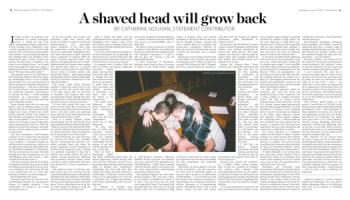
Three friends came into the room and
placed a pair of crafting scissors on the
table in front of me. My untrained hands
hacked away ropes of black hair, which
swiftly entered freefall and landed in
their ultimate resting place on the wooden
floor. In one minute, I saw my face in an
uneven set of bangs, an unnerving mullet
and an asymmetrical pixie cut. With the
haphazard smock left sitting on my head,
the buzz of hair clippers began to drown
out all sounds.
The buzz stimulated a brief moment
of regret. It was a buzz that represented
both an aesthetic and a desire to be free
of an aesthetic. It sounded through my
self-destructive construction, adhered to
my adolescent reflection and battled with
my blemished foundation of femininity.
The buzz oscillated in the room, vibrating
through my hands, drumming in my ears
and filling my eyes with curiosity — what
a fragile form of finery hair is.
I sat there looking at myself, not feeling
as though the motions of my arms swiping
the clippers back and forth were my own.
I was looking at the mirror, but felt like
I was sitting front row at a hazy film
showing, in which I was the protagonist.
My head felt like soft carpet.
Hot tears leapt from my cheeks in the
overwhelming moment of instantaneous
change, of complex austerity. I was
reintroduced to myself in the small
rectangular mirror.
In the last decade, more women and
non-binary
folks
have
shaved
their
heads in an effort to subvert mainstream
heteronormative
and
patriarchal
beauty standards. At the same time,
the mainstream media focus on this
trend has consistently highlighted those
who meet Eurocentric and/or feminine
beauty standards. In January 2018, the
pages of beauty magazine Allure were
adorned with glamorous pictures of high-
fashion models for a feature about women
who shaved their heads as a sartorial
statement. Similarly, the New York Times
shared stories of female models who
shaved their heads — again perpetuating
the idea that a buzzcut is only a fashionable
hairstyle if you have a femme face or “the
right head shape.”
LSA senior Taylor Luthe (she/her)
decided to shave her head twice in the
summer of 2019. She agreed that many
of the bald women that are perceived
as beautiful had features that were
stereotypically female. During that time,
she noticed parts of herself that made her
sometimes insecure about the decision.
“It was hard seeing little parts and
pieces of your body, like in pictures, in
the mirror, and not having ever seen those
before. And then really over-analyzing
those. Like ‘Oh, is that what the back of my
neck looks like? Is there a roll?’ ”
Even as a radical feminist, Taylor
acknowledged that she held deep-rooted
ideas of gendered beauty. She asked herself,
“Who do I need to feel feminine for? Why
do I need to embody these characteristics
if I already feel okay within myself about
who I am and how I act in the world?”
A shaved head has not, and will never
be, reserved for those with “suitable”
features. Promoting this narrative over
others excludes those who shave for
gender expression, sexual orientation or
freedom from gendered beauty. Though
it is perfectly acceptable to buzz for a
fashion look, media outlets that fail to
include varying perspectives, identities
and experiences beyond runway trends
continue to silence individuals who have
been harmed by a binary promotion of
beauty.
The physical action of shaving one’s
head is the same for everyone, but the
reasons behind the decision are beautifully
dissimilar. For LSA sophomore Aldo Pando
Girard (he/they), hair has been something
that has always separated them from their
peers. “It was a big thing for me to be like
no white people are going to touch my
hair, ever, period, at all,” Aldo said.
Aldo is Cuban and Black, and has
experimented with a variety of hairstyles
throughout their college career. From
box braids to waves, changes in their hair
have often left friends initially disoriented
upon seeing them.
“It’s been weird making big changes to
my hair and people not recognizing me,
that has been very surreal,” they said. “My
hair is just pretty closely tied to how I view
myself and how I can express myself.”
As someone who is gender fluid and
likes to stretch and surpass traditional
masculine
beauty
ideals, shaving their
head made Aldo feel
as though they had
less control over their
outward perception.
It made them feel
more masculine and
publicly
perceived
as masculine, even
when
they
had
the
desire
to
be
androgynous.
LSA senior Leena
Ghannam
(they/
them) shaved for a
more
androgynous
look.
Their
relationship
with
their hair has been
“antagonistic”
partly due to their
hometown.
“To
have
curly
hair or kinky hair,
especially
because
I grew up in a town
that
was
majority
white, I did not feel
comfortable with the
texture of my hair,
and the quantity of it
also,” Leena said.
They are from a
Palestinian
family
that holds traditional ideals about the
female appearance. When shaving their
head, the “fear of family reaction” was a
pressing thought. But the action ultimately
aided
in
healing
that
“tumultuous”
relationship they had with their hair,
making the threat of family backlash a
worthy fight. “It felt like a weird worship
of hair, or an appreciation of it, but also
a castration of it. It helped me develop a
much better relationship with my hair,”
they said.
In
addition
to
looking
more
androgynous, Leena also shaved to help
prevent the symptoms of trichotillomania
— a somatic symptom of anxiety and OCD
that causes an uncontrollable urge to
pluck hair.
My desire to shave my head was similar
to Leena’s. At age thirteen, I started losing
the hair on my head from trichotillomania.
The idiomatic expression “I want to
pull my hair out” exposes a real and
diagnosable disorder.
A
2002
University
of
Wisconsin–
Madison study found at least 13 percent
of adults in the United States engage
in
body-focused
repetitive
behaviors
(BFRBs). Of the 13 percent, an estimated
one to two percent of the population has
trichotillomania. I didn’t meet someone
with this disorder until I was 20 years old.
We cried, hand-in-hand, understanding
one another without words.
Hair-pulling triggered my first head-
shaving fantasies. The only place where
it was socially acceptable for women to
be hairy was your head, and my scalp
was being picked clean. The strands that
sprouted from my head were of varying
lengths after years of plucking in high
school. A healthy mane only seemed
attainable if I buzzed it down to the root,
but the thought of being a teenage girl
with a shaved head in a religious and
conservative
community
deterred
all
plans of execution. My body only became
a vehicle for expression once I entered
college.
My parents were not happy the first time
I came home with a buzzcut. My mom’s
first questions were: “What’s wrong? Are
you gay? Why did you do this?” Though I
knew the reasons behind my decision, it
was hard to come home to a place where
my appearance was not only unacceptable
but also immediately and constantly
questioned.
The history of shaved heads is one that
is full of freedom — but also deviance.
It’s been used to physically display an
entrance into a group or an obliteration
of individuality — a social tariff on social
interactions. The common associations of
shaved heads are of religious conformity,
military admission or a chemotherapy
patient. Throughout history and in most
places, women and men have parted
with their hair for reasons of religious
purification,
public
humiliation
or
cultural erasure.
For instance, after World War II, French
women accused of sleeping with German
soldiers were publicly humiliated by
having their heads shaved. “The shorn
women” were forced to walk through the
streets bald, with swastikas painted on
their bodies. Some 20,000 women were
shamed in the streets.
During
the
Atlantic
Slave
Trade,
Africans were captured by colonizers and
their hair was cut
off.
This
signified
an
eradication
of
personality
and
culture, as head and
hair adornment was
a fundamental part of
one’s wardrobe.
These
dark
histories still inform
perceptions
of
shaved heads, even
though
practicality,
convenience,
androgyny
and
style are now the
predominant factors.
LSA junior Hannah
Meyers
(she/they)
has shaved their head
three times in their
life. The last time
they
shaved
their
head, it was because
of a bad bleach and
hair-coloring
job.
Even in the messy
moment,
shaving
their head was saving
their hair.
“I feel like the
Britney
moment
came before the head
shaving, and the head
shaving was like the
reclaiming of the moment,” they said. “It
was starting over.”
Recently, she entered the workforce
as a middle school student teacher.
Hair is used as a uniform for students
and
teachers
alike.
Students
with
nonconforming hairstyles can be subject
to expulsion. Teachers can be fired for not
setting appropriate examples. But Hannah
believes that their choices regarding body
and head hair will be a model for younger
children.
“I am questioning what it means to be
hairy or not hairy in the workforce. I want
to be a public school teacher, I’m getting
certified for middle or high school. I’m
not sure which one I would prefer yet,”
Hannah said. “Working with young kids
who are just forming their opinions, I
think it’s important to have people who
they look up to who they see different
options of what to do with their hair.”
At the first extended family gathering
since my buzzcut, my grandmother came
up to me, smiled and said I looked like
“an Italian opera singer.” I was incredibly
surprised. I had already put up defenses,
practicing half-true explanations for the
buzzcut. When my grandmother was
growing up in Italy in the 1930s and 40s,
the common hairstyle for women was a
short cut. The disparity between how my
mother and grandmother reacted to my
hair must have been due to the fluctuating
ideals of femininity and hair.
In 2016, Time magazine talked to
historians who track the social and
gendered history of hair. Long hair was
a status symbol as complex hairstyles
require the help of another person
demonstrating wealth and power. In the
U.S., though, women began cutting their
hair into bobs during World War I, a trend
attributed to military nurses adopting
shorter cuts for convenience and hygiene.
In the 1920s, many American schools
and churches rallied against flappers
for “acting like men.” A shaved head has
never formally been an accepted style for
women. A woman’s hair has long been
regarded as the key to her femininity and
a persuasive symbol of her sexuality.
Zoe Cutler (she/her) is a graduate
student at the School of Music, Theatre
& Dance. As a trans woman, Zoe’s chosen
hairstyle has much more to do with her
identity as a lesbian. She never actually
shaved her hair, but keeps a short hairstyle
to “lean into the butch aesthetic,” and to
“establish a specific genre of womanhood.”
“I think originally, I was trying to lean
into some more classic model or like a
mainstream model of womanhood that
wasn’t really working for me in various
ways. And so that was something that I
could latch onto,” Zoe said.
Femininity
has
invariably
been
synonymous with long hair, but the regular
removal of body hair is a relatively recent
phenomenon, gaining steam in the 1970s
during Second Wave Feminism. Former
Atlantic writer Nadine Ajaka traces the
original campaign against women’s hair to
Darwin’s evolutionary theory in the mid-
nineteenth century where scientists were
determined to show hairiness in women as
“indicative of deviance” from femininity
and the white race.
Heavy-handed marketing techniques
from companies, like Gillette, convinced
adolescent girls that a women’s right of
passage included shaving your legs. Those
girls became our mothers’ mothers, and
our mothers brought the idea into this
generation — an oral tradition.
Recently, Gillette was criticized for
the “pink tax” they placed on female hair
removal products. The “pink tax” refers
to the price disparity between men and
women’s commercial hygiene products.
I can’t remember the exact day I
started attaching abstract ideas to the
presence of natural hairs growing from
my body, but once my classmates could
label me in one word — hairy — my
reflection was no longer an impression
of my appearance, but instead a place of
personal scrutiny. All my features were
up for reevaluation. My Mediterranean
and Arabic genealogy was not forgiving
in an era that idolized and still idolizes
hairlessness.
With leftover lunch money in my
pocket, I would bike to CVS half a mile
from my house and buy Sally Hansen Body
Hair Bleach Cream – Extra Strength. In
those impatient 13 minutes, my arm hair
was lightening and my skin was faintly
burning, but my excitement was rising.
From ages nine to 19 I tried plucking,
shaving, waxing, threading, chemically-
removing, lasering and bleaching most
of the hair on my body. These removal-
rituals began prior to my understanding
that the male gaze was the origin of the
assault on women’s body hair.
The regrowth of my shaved head
has been a space for me to interrogate
gendered beauty ideals. A shaved head does
eventually grow back, but the experience
has left me with a permanent introspection
of my reflection’s foundation. There was a
time when I ran around with a dark brown
bob and a set of bangs that would tickle my
eyelids in the weeks my mother forgot to
trim them. And that’s all hair was to me.
The unlearning process is slow, but I am
confident knowing that the presence of
hair on my head or body — or lack thereof
— will not play a role in defining my
femininity.
Catherine Nouhan is a senior studying
English and Philosophy. She is the former
Podcast Managing Editor at the Michigan
Daily and can be reached at cnouhan@
umich.edu.
Wednesday, January 29, 2020 // The Statement
4B
5B
Wednesday, January 29, 2020 // The Statement
ILLUSTRATION BY JONATHAN WALSH
BY CATHERINE NOUHAN, STATEMENT CONTRIBUTOR
A shaved head will grow back
COURTESY OF CATHERINE NOUHAN