

events. He specifically mentioned some
organizing of the movement to stop a pro-
posed visit last semester by white suprema-
cist Richard Spencer — referred to online
as #StopSpencer — was done on the same
couches on which we were sitting during our
conversation.
“How can we best have this be a space
where people who care about chang-
ing the world for the better know
that they have a home here?” Lukens
asked. “On the one hand, there are
these big expectations that come
from (the history) but, on the other
hand, there’s also this allowance for
whatever you come up with which
might be completely wild and out of
left field and that’s totally fine, let’s
do it.”
Lee faced similar challenges when
he became the concert coordina-
tor for Canterbury. Nowadays, Lee
is constantly commuting between
his final year of classes at the Music
School, facilitating concerts at Can-
terbury and playing with various
jazz combos in Detroit. According to
Lee, the position is typically passed through
the Jazz Department.
Before accepting the job, Lee was told by
the previous coordinator he would make “X
amount of money for six concerts a semes-
ter,” but was quickly informed “every con-
cert coordinator ever has put on at least 30
concerts a semester.” Knowing he wasn’t
going to get paid for the amount of work
he put into the job, Lee still accepted the
responsibility of cultivating the music scene
at Canterbury.
When he stepped into his role, he hit the
ground running, acknowledging the musical
legacy of the coffee shop and, perhaps more
fitting for Lee’s musical palette, Rush’s Jazz
Mass. However, he said the pressure to live
up to the past pushed him too far his first
year out.
“My first year as concert coordinator, I
booked way too many things, it was like four
nights a week of music which is just crazy
and I was freaking out because I couldn’t
practice, I couldn’t study, I couldn’t do any-
thing and I was just here,” Lee said. “I slept
on that couch so many nights … My second
year … I wasn’t going to make those efforts
anymore because I don’t need to do that but
that resulted in (me seeing) the musical com-
munity shrink a bit … This year is my final
year as concert coordinator and the year is
just beginning but I feel like I’ve got it down.”
Like many who have come through
Canterbury’s doors, Lee was not raised in
an Episcopal household. With “an atheist
Berkeley hippy father and … a Shinto Bud-
dhist (mother) from Japan,” Lee under-
stands the skepticism from touring bands
who don’t know how, as Lukens described it,
“fluid” a space like Canterbury can be.
“I’ll get emails and calls from people
like, ‘OK we don’t know if we want to play a
church’ or whatever,” Lee said. “Canterbury
House is the first religious space that I’ve
ever felt comfortable in … I think getting that
question like, ‘What is Canterbury House,’”
I still use (former Chaplain Reid Hamilton’s)
answer all the time: It’s the home of left-
wingy causes.”
Lukens acknowledged this disconnect
between social activism and religion that’s
commonly expected to exist today. While
Lukens said, “Christianity has such a repu-
tation … for not creating welcoming spaces,”
Lee said Lukens’s being in the position of
Chaplain as a gay man and the activism and
music that has always inhabited the walls of
Canterbury no matter where in Ann Arbor
they resided should speak to the one-of-a-
kind magic of Canterbury House.
“It’s common knowledge that this place is
on the right side of history,” Lee said.
A
fter taking out my earbuds and
reveling in the recording samples
of Mitchell, Odetta and the oth-
ers found by the Michigan History Project, I
couldn’t help but think about those annoying
YouTube comments made by middle school-
ers on Rolling Stones and Jimi Hendrix lyric
videos.
“I was born in the wrong generation lol
XD,” the children would whine.
I am not proud to say I was one of those
middle schoolers. Now, it’s endearing to say
you listened to classic rock and folk with
your parents growing up. You already have
the musical palate of an indie movie. Back
then, you were obnoxious and pompous if
you wanted to kick Ke$ha to the curb instead
of Mick Jagger. One time, I almost blew a
gasket because my friend said Bastille was
better than The Doors. I refused to embrace
any music from the past decade.
Much to Middle School Matt’s delight,
these tapes give us a gateway into the musical
incubator Ann Arbor was during this influ-
ential time in music history. But if I could tell
Middle School Matt anything, it would be to
get your head out of your ass and look around
at the local creatives taking what was being
made at Canterbury in the ’60s and building
upon it. The same goes for political organiz-
ing. Innovation is the key to discovery. How
would singers like Joni Mitchell, Neil Young
and Dave Van Ronk have come to be if they
hadn’t taken the Harry Smith Anthology of
American Folk Music, learned what they
could and move forward?
Canterbury House has been an institu-
tion in Ann Arbor for more than a century
now. As long as people like Middle School
Matt embrace what it has to offer, it should
be around for another century and maybe
more.
Wednesday, October 17, 2018// The Statement
7C
Alec Cohen/Daily
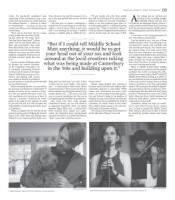
Hannah McPhillimy performs at the Canterbury House Thursday, October 4.
Alec Cohen/Daily
Chaplin Matthew Lukens with the Canterbury House dog, Bear.
“But if I could tell Middle School
Matt anything, it would be to get
your head out of your ass and look
around at the local creatives taking
what was being made at Canterbury
in the ’60s and building upon it.”