

Michigan State Government
are open to Whitmer’s idea. I
think both Republicans and
Democrats can agree that
tobacco usage has an adverse
impact on Michigan’s well
being and work to limit its
usage,” Berger said. “As Ms.
Whitmer has said, 95 percent of
adult smokers started smoking
before the age of 21. I believe
raising the age required to
buy tobacco would help curb
Michigan’s tobacco usage. The
human and economic costs of
tobacco usage in Michigan are
overwhelming.”
Berger also added he felt the
proposal would help Michigan
economically,
something
Whitmer also mentioned in
her health care proposal.
“Over
200,000
children
currently under the age of 18
will eventually succumb to
tobacco-related
illnesses,”
Berger said. “On the economic
side, Michigan spends over
$4.5 billion on health care costs
due to smoking. Moreover,
smoking costs Michigan over
$4.75 billion in productivity
loss as a result of tobacco-
related illnesses. Working to
minimize tobacco usage in
Michigan will be a boon for
our health and economy.”
Shortly after Ann Arbor’s
smoking
ordinance
went
into effect in 2017, Attorney
General Bill Schuette, who
is now also the Republican
candidate for governor, issued
an opinion saying claiming the
ordinance was in conflict with
state law, though it was never
challenged in court.
Additionally,
Whitmer,
Kelly and Berger all said they
were in favor of extending
smoking codes and regulations
to products such as vapes and
e-cigarettes.
“Per CDC data, the number
of high school students that
used e-cigarettes in the past
30 days increased by about 75
percent over the past year,”
Berger said. “ I believe that
e-cigarettes
are
harmful
on their own and have the
potential
to
raise
a
new
generation of nicotine addicts.
I would like to see Michigan
State Government take action
to combat e-cigarette usage by
happening at the Palestinian-
Israeli
border.
Families
are
subject to family separations,
discrimination,
harassment.
They’re usually detained for
hours and hours, even if you are
an American citizen.”
The
member
explained
how
students
of
Palestinian or Arab heritage
who go on study abroad trips
through the University are often
stopped at checkpoints, where
they are forced to wait in long
lines and are subject to intense
interrogation, strip-searches and
other forms of harassment.
The
member
also
spoke
about
international
political
blacklists, highlighting the fears
many Palestinian, Arab and
Pro-Palestinian students have of
being placed on a blacklist.
Central
Student
Government passed a #UMDivest
resolution for the first time in
the University’s history in 2017,
which was also the first time the
body allowed for a secret ballot,
which members approved to
protect pro-Palestinian students
from blacklists.
“If you are put on that list
and
you
go
through
these
checkpoints, they’ll pull you
out and you’re going to be
interrogated, you’ll probably be
deported, not allowed in,” the
student said. “That’s something
that the University has ignored
time after time and has not
released any statements about,
and that’s another thing we’re
trying to raise awareness about.”
LSA senior Yezenia Sandova,
a member of La Casa, an
organization
that
supported
SAFE in its divestment resolution
last year, said it was important
to
show
solidarity
with
communities
facing
similar
struggles.
Sandoval spoke about the
parallels
between
the
two
border
walls,
especially
considering the human rights
violations committed as a result
of the walls. She also highlighted
the demonstration’s aim to raise
awareness of struggles faced by
minority students on campus and
how the walls are affecting their
lives at the University.
“Our main purpose, hopefully,
by having this painting out here,
was just to raise awareness and
continue to have the U.S.-Mexico
border conflict in the minds of
people, especially when it comes
to family separation, especially
when it comes to Trump’s zero-
tolerance policy, his termination
of catch and release and just
to show how inhumane these
policies are and how even
after so many months, there’s
literally
no
comprehensive
immigration reform,” Sandoval
said. “There (are) people in
Central America and all of
these countries struggling and
trying to come to the U.S. for
more
educational,
economic
opportunities,
and
who
are
facing violence, persecution in
their communities, and that’s
a lot of the parallels that’s
happening in Israel, Palestinians
are facing a lot of human rights
violations and inhuman policies,
especially in interactions when it
comes to border patrol.”
The SAFE member agreed,
highlighting
their
efforts
through
divestment
and
demonstrations like Tuesday’s, to
hold the University accountable
for its actions in human rights
violations. The 2017 divest vote,
which was later voted down
by the Board of Regents, called
for the University to divest
from Boeing, Hewlett Packard
and
United
Technologies
for
supplying
weapons
and
equipment to the Israeli military.
As recently as June, Israel
has been condemned by the
United Nations for using lethal
forceagainst Palestinian civilians
protesting at the Gaza border.
“It’s important for us to get
these walls out because we
want to make sure that people
are understanding the stake
and how complicit we are as a
University in these crimes. I
know the border wall seems so
far away… but our University is
very complicit in these human
rights violations because we are
investing in American companies
that are profiting off these border
walls,” the student said. “We’re
still pushing for the University to
form a committee to investigate
our
investments
in
these
companies that are complicit in
the human rights violations at
each of these borders.”
to help any of those workers,”
she said.
Linkon also emphasized the
importance of cultural effects
from the economic devastation
of
deindustrialization,
and
how a feeling of hopelessness
has
extended
to
multiple
generations. She referenced
the common perception of
Detroit as a fallen power to
illustrate the point.
“You may not see the losses,
but they’re there. And it’s
continuing to create disease
and difficulty and destroy
the lives of communities,”
she said. “If you live in a
deindustrialized community,
you hear again and again to
get over it, and there are many
reasons why they can’t get
over it.”
Russo shifted the focus
away from solely the industry
workers
and
taking
into
account the widespread effects
of economic recessions.
“It’s not just about the
workers,
It’s
about
what
happened in 2008, the Great
Recession. It’s the people who
lost their health care, lost
their pensions,” he said. “No
doubt steel workers are part
of the argument, but this is
happening continuously.”
He
also
claimed
Democrats
have
failed
to
mobilize the working class
because separation between
Washington, D.C., and the
Midwest has isolated unique
problems faced in previously
industry-driven cities.
“In our studies, we found
that a lot of people from
the East Coast never really
fully
understood
that
was
happening
to
the
country.
Washington is a bubble,” he
said. “I live there nine months
of the year, but the issues that
are happening in the Midwest
are
not
fully
addressed
politically. Youngstown’s story
is America’s story.”
He also emphasized the
issue of grouping the working
class together. He compared
Trump’s rhetoric to former
presidential candidate Bernie
Sanders,
explaining
how
Sanders’s platform mobilized
this group’s anger but directly
targeted
corporations
and
Wall
Street,
creating
an
institutional barrier.
“Firstly,
there’s
no
one
working class: The Black is
different from the white, which
differs by state,” he said. “Why
Trump won is he redirected
all
that
worker
anger
of
their economic security, and
moved
it
into
a
fight
against
African
Americans,
immigrants,
rather
than
against corporations or Wall
Street.”
LSA junior Jeremiah Dunne
said the event gave him new
perspective into the history of
the working class.
“It’s a really interesting
issue in this country, now
especially. In my class we
talk about the perspective of
the working class people a
lot, and how they’ve become
disenfranchised through this
careful effort of the wealthy.
You can look back when unions
first started in the thirties,
and the working class was very
involved in politics, and they
were willing to work together
and fight for their worth,”
he said. “But nowadays the
average auto worker doesn’t
feel like they’re worth much.
In fact, their employer tells
them how much they’re worth
depending on their paycheck.
So
a
lot
of
people
work
minimum wage and they don’t
feel like they’re worth health
insurance, so they don’t fight
for it.”
He provided the example
of nationalized health care
as a way that workers are
mistreated.
“That’s also one of the
reasons why corporations are
against
nationalized
health
care, because it makes the
average person feel like they’re
worth more, and they deserve
things from the government
and
corporations,”
Dunne
said.
“Despite
nationalized
healthcare being cheaper for
corporations,
because
they
don’t have to pay for people’s
health care, they won’t in the
long-run because it gives the
worker power. That’s just an
example of how bad things are
for workers.”
swollen cheeks and jaw.
Ernst
noted
severe
complications
with
the
virus can sometimes occur,
which
include
encephalitis,
meningitis and deafness.
Mumps can be prevented
by vaccination, though Ernst
said mumps can cause some
non-serious
symptoms
even
in
people
who
have
been
immunized. It is also possible
for people carrying the virus
to not display any symptoms.
Ernst said a person with mumps
could remain contagious until
five days after symptoms begin.
According to the Centers
for
Disease
Control,
the
implementation of the U.S.
mumps vaccination program in
1967 decreased recorded cases
of mumps by 99 percent to less
than 1,000 cases per year. In
both 2016 and 2017, however,
the number of mumps cases
recorded nationally was above
6,000, “mainly due to multiple
mumps
outbreaks
reported
across the country in settings
where people often have close
contact with one another, like
college campuses.”
This is a developing story.
Check back at michigandaily.
com for more details.
The Michigan Daily — michigandaily.com
News
Wednesday, October 10, 2018 — 3A
PRASHANTH PANICKER/Daily
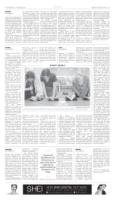
Guests pour through books from the 19th century to the present at the Special Collections After hours: Skeletons in Our Closet event Tuesday.
SPIRIT BOOK S
attempt to deter immigrants from
coming to the United States or
spending years in the United States
while applying for asylum. Nelsen
said these immigration policies
are harsh and often inhumane by
nature, but emphasized that the
current hardline policies have
done very little to stop the flow
of immigrants from Honduras,
El
Salvador
and
Guatemala,
that we saw during the Obama
administration.
Nelsen
also
discussed
the
shift in how U.S. Customs and
Border
Patrol
officials
have
interacted with the media, and
the implications this has on the
current political conversation.
He claimed under the Obama
administration,
Border
Patrol
was very straightforward and
clear about their intentions. Now,
he claims, they are intentionally
vague to hide the fact that they are
denying interviews to immigrants
trying to enter legally.
Thompson explained she was
able to investigate what was
really happening inside these
camps, through a confidential
source that risked their job to
garner
attention.
Thompson
obtained a tape of a young girl
crying to call her aunt inside of
a detention center, which caught
the attention of the nation and the
White House.
“Those children and their
voices
drowned
out
all
the
political noise and the only thing
anybody could hear anymore
were those cries. Even people
who thought they might support
the idea of cracking down at the
border, and more security at the
border, didn’t think it should look
like that,” Thompson said.
The
panelists
explained
their personal experiences with
the success of giving a face to
the statistics, and of simply
portraying humans as humans.
Lin explained those coming to
the U.S. seeking asylum know that
once they get here, things won’t
necessarily be easy; they will
just be easier than the turmoil of
their home country. People are
immigrating to escape cultures
of crime and violence to gain the
ability to work and provide for
their families. None of these fears
satisfy the requirements to be
granted asylum.
The Obama administration was
relatively lenient on deporting
people that had legitimate reasons
to come to the U.S., even if those
reasons may not have qualified
them legally. Immigration and
Customs
Enforcement
has
historically delayed deportation
for immigrants that have led
successful lives in the U.S. for
decades,
but
recently,
these
same people have been deported
immediately upon their arrival to
their court dates.
Thompson argued the high
deportation rates in the U.S.
violate the international laws
the
U.S.
government
signed,
and the U.S. should be accepting
more people, even if we are
not comfortable doing so. Lin
explained that in 1980, the U.S.
accepted more than 200,000
immigrants, taking responsibility
for the wars and civil unrest the
U.S. contributed to in Southeast
Asia. The Trump administration
recently stated that they are
implementing a ceiling for 30,000
immigrants this year.
Nelson argued U.S. policies are
a major contributor to the influx
of immigrants trying to come
to the U.S. He explained that
Americans are exporting gang
culture to Central America and
enjoying recreational drug use
from the illegal drugs imported
from Mexico. These drug cartels
are terrorizing citizens, with the
money we are handing to them, he
argued.
In terms of solutions, Lin
proposed the U.S. needs to
reinstate previous policies to
the forefront of our actions. She
explained that many people are
trying to enter the states legally,
citing that 90 percent of people
asked to come to asylum hearings
show up, and suggested that the
government simply give them a
chance to enter legally.
Clemetson
concluded
the
conversation
reiterating
the
goal of this panel, which wasn’t
to identify one clear solution,
but rather to simply start the
conversation.
“In a conversation like this the
goal cannot be to provide answers
. . . the goal we decided on is to
provide context, to provide true,
on the ground experience, to
provide different points of view,
and to provide connections with
the audience,” Clemetson said.
BORDER
From Page 1A
VOTING
From Page 1A
SAFE
From Page 1A
MUMPS
From Page 1A
SMOKING
From Page 2A
I think both
Republicans and
Democrats can
agree that tobacco
usage has an
adverse impact on
Michigan’s well
being