

Wednesday, April 11, 2018 // The Statement
6B
I
n her own words, Remi Murrey isn’t supposed
to be at the University of Michigan. Born and
raised in Detroit, her passion and sociability
have driven her toward a career in broadcast
journalism. As did many of her high school classmates,
Remi set her eyes on historically black colleges and
universities, specifically Howard University and its
program in broadcast journalism.
“Howard was ‘that’ one,” Murrey told me, sitting, in
a small meeting room in the basement of North Quad
Residence Hall. But after acceptances to both Howard
and the University of Michigan, scholarships made
Ann Arbor an obvious choice despite the absence of a
broadcast journalism program.
“When my mom and I did a tour here before
Howard, I had a strong feeling that Michigan was the
right place for me to be because it just felt at home,”
Murrey said. “Howard was so far away.”
Despite a 21 on the ACT exam and a 3.5 grade
point average in high school, Remi defied the odds
of admissions. She eventually opted for a degree
in communications studies in lieu of broadcast
journalism.
“You know the credentials,” Murrey said with a
wave of her hand. “However, I made it on the first
round: boom, boom, boom. I wasn’t deferred — it was
my essay and who I was as a person. I was like, ‘Ah-ha
I made it!’”
And with her no-nonsense instincts and support
from her parents, grandmother and her devout faith
in God, Remi has continued to defy odds and “(make)
boss moves,” both across campus and in her pursuit
of broadcast journalism. Now, weeks away from
graduation, she shares the anxious anticipation of all
those with uncertain post-graduation circumstances,
but when asked about her various roles during
undergraduate career her expression asks, “You want to
know it all?”
To be fair, there’s a lot to know. Remi has held
secretary positions in Central Student Government
and the Comprehensive Studies Program, The Inn at
the Michigan League in addition to stints as a mentor
for Pretty Brown Girl Club and a tour guide, all the
while making pocket money in the University’s dining
halls, first Bursley Residence Hall and then South
Quad Residence Hall. But these are merely Remi’s
side hustles. Her staying power is best displayed by
her time at The Michigan Daily as a beat reporter, in
Delta Sigma Theta Sorority, Inc., as a member and
then as chapter president and, finally, as an intern
with Detroit’s Local 4 News.
“Who can say they had an internship while taking
classes and had multiple jobs and was the president of
their sorority?” Murrey asked toward the end of our
interview. “I didn’t let someone hold me back from my
dreams, so I’m not going to let anyone hold me back from
my future dreams because if I was able to make it here, I
feel like I can make it anywhere. But, hey, that’s just me.”
Remi’s (well-earned) sense of pride is tag-teamed
in and out by humility and a genuine appreciation for
her opportunities and all those around her who make
them possible.
“I just want to say thank you, that’s it,” Murrey said
at the end of our interview. “Thank you to whoever
nominated me. People may overlook this but I’m not.
When I say I beat myself up sometimes … We all do. We
compare ourselves to the next person who looks like
they’re doing better, but if we just focus on ourselves
and our own journey we can realize we are doing just
as much, or even better, so thank you.”
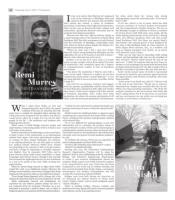
Remi
Murrey
BY CHRISTIAN KENNEDY,
DAILY ARTS WRITER
W
hen I asked Akira Nishii, an LSA and
Engineering junior, how it felt to be named
a student of the year, he chuckled. He took
some time to compile his thoughts before sharing that
it felt good to be recognized for his efforts, but that he
would not be where he is today if it was not for other
people in his life — the professors and students who
helped get him this far.
Nishii wants to build bridges between people and
opportunities. Connecting people, both to resources and
each other, is his passion.
Nishii’s motivation to build bridges can be traced back,
at least in part, to his experiences as an international
student from Japan. Like many international students
on campus, he faces unique challenges. For instance,
as an aspiring physician, he can only apply to certain
U.S. medical schools. However, Nishii never wanted
his citizenship to be a barrier to him so he got creative
and built a bridge by beginning to translate Japanese
into English. Now he translates TED Talks, and he
guest lectures about audio-visual translation to Asian
Languages and Cultures classes. Though it may not help
him surmount the application barrier, he sees translation
as a way to be proud of his roots while creating new
opportunities.
When he started doing research in high school, Nishii
treated his work as an intellectual venture. However, his
feelings toward medicine and research changed after being
diagnosed with ulcerative colitis, an incurable bowel disease.
“Even though being diagnosed with a disease isn’t a fun
thing, at the same time, it gave me a new perspective,” he said.
Nishii understands research and development are
expensive but also believes patients should not have to
pay exuberant prices for treatment. Therefore, he is now
interested in pursuing a medical degree and an MBA to
bridge the gap between patients and the biomedical industry.
“I think I’m more interested in optimizing health care
practices and research, more so than the research itself,”
he said.
Nishii’s knack for building bridges is apparent upon
examining the connections he has made while creating
Perch, a platform that matches undergraduate students
with research labs.
“It is very difficult for undergraduates to get into
laboratories and so, currently, the primary means to
reach professors is email, which can be discouraging to
undergraduate students because either professors don’t
check their emails or a lot of professors’ lab websites that
currently exist are geared towards graduate students,”
he said.
To facilitate the process, Perch uses an algorithm to
match undergraduates and their skills to labs.
“So this is like LinkedIn meets eHarmony?” I asked.
“Kind of,” he admitted jovially.
Starting next year, the University’s Undergraduate
Research Opportunities Program will be using his
platform. Perch is also collaborating with the Chemistry,
Biology and Chemical Engineering Departments
to create a new research fundamentals classes for
students. Nishii expects over 8,000 University students
to be using Perch by next year. Perch has also been
recognized as one of the top 32 student startups and
has received attention from Sanjay Gupta, a prominent
neurosurgeon and medical correspondent, and Jeff
Arnold, the entrepreneur behind WebMD.
Bridges were even built during our interview as
we discussed our shared interest in Orson Scott
Card’s “Ender’s Game” and its much-maligned sequel
“Ender’s Shadow.”
Nishii is building bridges, between students and
professors, between Japan and America, between patients
and medicine, and he is just getting started.
Akira
Nishii
BY ALI SAFAWI,
OPINION COLUMNIST
Amelia Cacchione/Daily
Carter Fox/Daily