

F
or LSA junior Meaghan Wheat, working with
high school students was something she has
wanted to do since she was in high school
herself. So despite being a college student, Wheat spends
a lot of time with high school students and teachers.
In fact, she has facilitated conversations and leads
workshops on social identities with about 430 teachers
and many more students.
“High school students are at such a formative period in their
lives,” Wheat said. “You can see their light bulb moments.”
Wheat was first exposed to the impact of dialogue when
she was 16 years old. By participating in Summer Youth
Dialogues through the University of Michigan, Wheat
joined high school students from across the Detroit area
for a series of conversations about race and ethnicity in the
context of the city’s social systems and injustices. These
conversations inspired her to create a dialogue-based course
in her own school, Novi High School, which encouraged
dialogues about gender, race, sexual orientation, class and
religion among students.
Five years later, Wheat is now a consultant for Novi High
School and will be a facilitator for Summer Youth Dialogues.
“Creating those types of spaces and being passionate
about that work has sustained me,” Wheat said. “I’m really
interested in the student voice — always have been.”
About a year ago, Novi High School reached out to Wheat
because of her interest in these issues. They hired her to
facilitate conversations between high school students
and teachers through workshops. For the faculty, these
workshops serve as part of professional development. For
the students, they create a bridge between students and
teachers by addressing disconnects between student needs
and how teachers accommodate them.
Last summer, Wheat led 16 workshops in the span of two
days for K-12 teachers. The workshops focused on lower
socioeconomic status and cognitive ability.
“Novi is an upper-middle class suburb of Detroit,” Wheat
said. “But not everyone in that community has a high
economic status, so for teachers, how do we properly navigate
that for students?”
Wheat has also worked with the Martin Luther King
Children and Youth Program, helping middle school and
high school students enact change in their own hometowns.
She was nominated for the Rev. Martin Luther King Jr. Spirit
Award last semester. For Wheat, the most rewarding aspect of
the nomination was getting to know other nominees.
“Meeting other people who do similar action-based and
dialogue-based work was really fulfilling,” Wheat said.
Additionally, Wheat works with Metropolitan Youth
Policy fellows to find out how the needs of young people in
Detroit are, or are not, being met. The program serves to
evaluate how well the city is supporting young people and
whether young people feel they have a voice. Wheat has
presented her findings at various conferences.
“We’re told we don’t know things that we know because
of our age,” Wheat said. “I think that’s why I believe so much
in students having a voice in their education system because
we’re often left out of these conservations and these are
conversations we deserve to be in.”
On campus, Wheat is also involved with Intergroup
Relations, where she leads workshops on identities for student
organizations and other groups. She is also a part of the group
of students that is working to develop the Class and Inequality
Studies minor.
Wheat is majoring in Political Science and Psychology,
with a minor in Community Action Social Change. She has
been pre-admitted to the School of Social Work, which she
will attend after graduating next winter. In the future, Wheat
wants to continue supporting student voices and social justice.
“I’m interested in both education and community organizing,”
Wheat said. “So, I’m hoping to find a career path that does both,
so maybe that’s consulting or maybe that’s teaching.”
3B
Copy Editors:
Elise Laarman
Finntan Storer
Wednesday, April 11, 2018 // The Statement
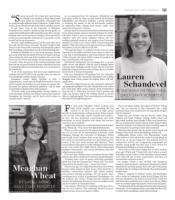
Meaghan
Wheat
BY SAYALI AMIN,
DAILY STAFF REPORTER
“S
eeing inequality first hand and experiencing
it, it brings your attention to these larger issues
and it makes you sympathize with people who
are going through different kinds of injustices,” Public Policy
junior Lauren Schandevel said on her role as a student activist.
In just three years at the University of Michigan,
Schandevel has created a money-saving survival guide, an
organization dedicated to addressing the needs of low-income
students and is in the process of creating a minor devoted to
social class and inequality. Schandevel is a go-getter, not for
herself, but for the community.
“I’m not a super ambitious person, in the sense that a lot of
the work I do isn’t for my own gain,” she said. “I prefer to talk
about it in the terms of the community and the specific policies
that I’m tackling, and less about my role within facilitating that.”
Schandevel identifies as an activist by necessity. Having
grown up in the Detroit suburb of Warren, a largely working-
class community, she is one of few students who come to the
University from lower and middle-income backgrounds. At a
university where 66 percent of the student population hails
from the top 20 percent income bracket, Schandevel has had
to navigate herself across situations that were uncommon in
her hometown.
“A lot of the experiences that lower and middle-income
students face kind of fall by the wayside when you have an
overwhelmingly wealthy campus,” she said.
Schandevel
created
“Being
Not-Rich
at
UM,”
a
comprehensive, crowd-sourced Google document on ways in
which students and families can save money on campus. The
document has gained widespread popularity with its large
accumulation of student advice and comments.
“It’s been really cool seeing people coming together to
write it because I feel like a lot of these resources are scattered
throughout the University and it’s hard to find a place to
centralize them,” she said.
As an expansion from the document, Schandevel and
LSA junior Griffin St. Onge recently started the Michigan
Affordability and Advocacy Coalition, a group dedicated
to bettering the quality of life for low-income students
by addressing issues ranging from renters’ rights, food
insecurity and access to vaccines.
Seeing a need for resources that address individuals from
lower socioeconomic statuses, Schandevel began to wonder
why there wasn’t a space to study social class on campus.
Together with LSA junior Meaghan Wheat, the two
students gathered resources and support from University
members to create a new minor called “Class & Inequality
Studies.” The minor has yet to be approved, but according to
Schandevel, it may be offered in fall 2019.
“Through the minor, I’ve talked to faculty who are really
interested in the subject and don’t have a place to study it in
a way that is interdisciplinary and intersectional,” she said.
“When I’m gone, this minor will be a space for people to do
that, something that will outlast me.”
Schandevel’s background has encouraged her to go into
public service and politics, with the plan of helping others
who have faced challenges similar to hers. She has even been
nationally recognized for her work, earning a place as a finalist
for the Harry S. Truman Scholarship.
Next year, Schandevel will graduate from the University
and sees herself in the community. Schandevel said working
alongside those whose passion for helping others will only
amplify hers.
“Some of my biggest heroes are the community organizers
and nonprofit managers,” she said. “People don’t even realize
how much time, effort, energy and how much of themselves
they put into it. That’s how you know they’re genuine and
really care because they’re not working toward an elected
office or a high paying job. They’re just doing the work because
they think it’s the right thing to do.”
Lauren
Schandevel
BY NATASHA PIETRUSCHKA,
DAILY STAFF REPORTER
Amelia Cacchione/Daily
Amelia Cacchione/Daily