

T
his
September,
The Michigan
Daily held its
Bicentennial
reunion
weekend.
Daily
alumni
from
across
the
country
were
invited
to
return
to
our
beloved
newsroom and, among other
things, mingle. As many of
you know, “mingle” translates
into “network” in hyper-
competitive college speak. As
one of my fellow managing
editors so elegantly put it to
me, fidgeting in her heels and
with an air of resignation,
“Come to happy hour if you
want a job.”
And that I did. I went, drank
a little wine to make myself
more pleasant and talked.
And after conversation after
conversation with Pulitzer
winner after Pulitzer winner,
something
became
very
clear to me: I was making a
mistake.
According to everyone I
met that night — extremely
successful leaders in their
fields, mind you — dedicating
myself to copy editing was
a waste of time. The job
I’ve spent three nights a
week at for months was not
going to exist in a few years;
copy editing, they informed
me, was quickly becoming
obsolete.
Another notable quote from
the evening: “Oh, don’t go
into copy. Can’t your design
editor show you InDesign or
something?”
I like my job. It’s demanding
but rewarding, and I get paid
to be nitpicky — something
people, mostly ex-boyfriends,
consider one of my greatest
faults. I delete commas and
I fact-check. I get to blithely
inform writers that “people
affected by the aftermath
of
the
hurricane”
could
and should be shortened to
“Hurricane María victims.”
I like it, and I’m qualified for
it. In considering post-grad
options, a looming concern
in my final year of college, I
naturally gravitated toward
copy editing. I thought it’d
be a safe bet for an English/
Spanish major who didn’t
want to teach. It was, to put it
lightly, a rude awakening.
I had been paying attention
to the goings-on in my
prospective field, of course,
but not really; when I saw
that The New York Times
was doing away with their
copy desk entirely I was sad
(and I pulled my subscription,
half out of support for those
striking and half out of
spite) but I considered it
an isolated incident. What
I hadn’t realized until that
night, a few months before
my graduation, was that
newspapers
across
the
country are downsizingtheir
desks significantly.
This gem I found after
falling
down
a
massive
research rabbit hole for this
piece sums it up nicely. And
people are noticing; “no other
job classification has suffered
so many losses as the news
business downsizes,” CNN
reported, and it’s the reason
you’ve been seeing so many
typos in online articles as of
late. And while The Times’s
corrections
of
misprinted
facts may sometimes be funny,
this
mass
disappearance
of editors is representative
of a much larger cultural
phenomenon and one that
has
become especially prevalent
since the 2016 election.
Facts just aren’t priority
anymore. This
is not
a
revolutionary
statement;
Donald
Trump’s
shaky
relationship
with
documented
occurrences
has
been
well-reported.
Post-truth
was
Oxford
Dictionary’s 2016 word of the
year. Alternative facts were
not a one-time press gaffe
but instead have become a
cultural phenomenon. And
not to perpetuate the whole
“fake news” nonsense, but
this shift manifests itself in
the media as the sacrifice of
copy editors, the ones whose
job it is to make sure the
facts are true and correctly
represented.
With
the
omnipresence
of
the
internet
and
its
instantaneous
refreshing,
breaking a story before a
competitor has become more
important than ensuring its
quality. Modern American
media
and
culture
have
regressed to a place where
fact-checking
just
isn’t
important anymore, and it’s
telling.
As for me, I’ll be fine.
I’m currently working on
“diversifying,” which you all
know is hyper-competitive
college speak for “starting at
square one,” but I have some
ideas. Maybe I’ll finally learn
how to use InDesign. What
keeps me up at night isn’t
my
personal
professional
instabilities but the larger
existential
questions
they
bring up: Do veracity and
accuracy hold any cultural
weight anymore? Can I fit
in a society that blatantly
disregards
all
I’ve
been
conditioned to care about?
How do we determine truth
if there is little punishment
for a lie? How do we make
sense of nonsensical daily
occurrences? How did we get
here? Do we care?
2B
Managaing Statement Editor:
Lara Moehlman
Deputy Editors:
Yoshiko Iwai
Brian Kuang
Photo Editor:
Alexis Rankin
Editor in Chief:
Emma Kinery
Design Staff:
Michelle Phillips
Hannah Myers
Emily Hardie
Erin Tolar
Emily Koffsky
Managing Editor:
Rebecca Lerner
Copy Editors:
Elizabeth Dokas
Taylor Grandinetti
Wednesday, November 1, 2017 // The Statement
Copy That: Fact-checking alternative facts
BY ELIZABETH DOKAS, COPY CHIEF
statement
THE MICHIGAN DAILY | NOVEMBER 1, 2017
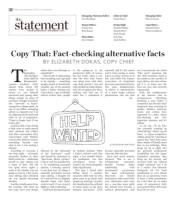
ILLUSTRATION BY ERIN TOLAR