

Four pops.
Five years later, and Chris
Bryant can still hear the
sounds.
It was the week before
Michigan’s
season
opener
against Alabama in the 2012
season
opener
at
AT&T
Stadium.
According
to
Bryant, a redshirt freshman
at the time, he was on the
verge of starting at left guard
after a heated competition
throughout fall camp. His
parents
had
even
booked
flights to Dallas and couldn’t
stop talking about how fired
up they were to see him play.
“Three
or
four
days”
before kickoff, Bryant was
participating in a routine
offense-versus-defense drill.
The running back made a
cut. Someone fell on Bryant’s
leg, and he heard the terrible
noises — the sounds of a
fractured tibia.
It was the first serious
injury
of
Bryant’s
career.
Instead of flying to Texas, his
parents went to Ann Arbor
to talk to doctors about the
medical procedures their son
would have to undergo.
“It
was
very
hurtful,”
recalled Eric Bryant, Chris’s
father. “You start focusing
on how he’s feeling because I
know it’s devastating for him
more so than for myself or for
my wife. But it’s a pain that you
can’t really describe because
you don’t want to show too
much of that emotion to him
because then that would only
make him feel even worse.”
Over the course of the
next year, Bryant underwent
an
arduous
rehabilitation
process. His leg never healed
the way he wanted it to. Still,
he was able to work himself
back onto the field, drawing
a spot in the lineup against
Minnesota on Oct. 5. His
return didn’t last long.
Just
like
the
first
catastrophic injury, Bryant
can still describe the second
in full detail.
It was a routine double
block.
He
had
his
own
assignment and threw his arm
out for an assist — where it
got “completely thrown back.”
“I just felt a bunch of tears,”
Bryant said, “all through my
shoulder.”
He gritted his teeth and
finished the game. In the
following
days,
he
tried
desperately to tough it out,
hiding his full symptoms from
doctors, hoping he could play
the next week at Penn State.
“This was my opportunity,”
Bryant said. “I sat out a whole
year, not about to sit out
another year.”
But
by
the
time
the
Wolverines had lost in triple
overtime to the Nittany Lions,
Bryant knew he had to get his
shoulder looked at.
The
diagnosis?
A
torn
rotator cuff, with damage
to other ligaments and the
rest of the shoulder. And
at that point, Bryant had a
big decision to make. Was
continuing his playing career
worth it?
“Just came to a point where
(you look) 20 years down the
road,” Bryant said. “Do you
want to be able to go outside
in the backyard to throw a
football with your kids?”
One night, Bryant spoke
to his mother, Joy, over the
phone.
His
injuries
had
constantly bothered her and
she told him as much. She also
told him about an intuition
that had come to her.
“It was like I was dreaming,
it was like God was shaking
me, and I understood now, it
was like a puzzle being put
together,” Joy said. “It came
to me, and that morning
when I got up — we talk every
morning — I said, ‘Christian,
God spoke to me and told
me for you to stop playing
football, because he has a
better plan for you. He told me
to tell you to just give it up.’
“I said, ‘When you go to
bed, you talk to God like you
talk to me, and he’ll give you
the answer.’ That night he
did, and he said, ‘Okay, mom,
I’m going to the coach and
I’m going to let him know I’m
taking a medical.’ ”
Chris
Bryant’s
football
career — what had led him to
Ann Arbor in the first place —
was over.
“That’s
what I’d been
known for my
whole life —
as a football
player,”
Bryant, now
Michigan’s
director
of
high
school
relations,
said.
“To
actually
have to close
that chapter
and open up
another one,
it was tough.
Took a while to get over it.
“A lot of long nights just
crying, man. It was just a hard
feeling.”
***
It took Bryant a “couple
months” to deal with the end
of his career.
He met with famed sports
psychologist Greg Harden. His
parents reassured him that
things would turn out okay
and told him that he would
find his true calling. Bryant’s
relationship with Brady Hoke
developed quickly as well,
especially in the aftermath of
his second injury. The head
coach met with Bryant often,
checking up on him regularly
and prodding him to think
about his options. Did he
want to coach? Did he want to
recruit?
“Coach
Hoke
supported
me the whole way,” Bryant
said, “and sat me down until
I found out what I wanted to
do.”
And it just so happened that
one of Bryant’s best friends
was in a “very, very similar
situation.”
Antonio Poole, a linebacker
signed in the same class as
Bryant, never played a snap
due to two injuries — a torn
pectoral
and
a
ruptured
Achilles tendon.
The two were roommates
freshman year. At the time,
they couldn’t have known
what they were in for. But
their friendship only grew
as the pair bonded over their
shared misfortunes.
“I was just like, ‘Damn,
one of us gotta stay healthy,
man,’ ” Poole said. “It was just
funny, every time one of us got
hurt, the other got hurt, and
after that, we just bonded. It
was just trying
to
keep
each
other’s
spirits
up,
because
coming
there
to play football
and then things
didn’t
go
the
way we thought
they would. We
pushed
each
other
through
our rehab and
continued
to
push each other
and keep our
spirits up after
our
football
careers were over.”
Poole was the first to hang
up the cleats. After Bryant
followed suit, Poole found
himself giving advice. They
talked about ways to cope.
About
life
after
football.
About finding a new identity.
Poole realized he couldn’t
leave the game completely
behind
and
became
a
recruiting assistant. Bryant
was his first recruit.
“Yeah, I remember I told
(Bryant), that was one of the
great ways to stay part of the
team, just helping out,” Poole
said. “He asked me, ‘How was
it?’ I said, ‘At first, you’ll be
Football Saturday, October 7, 2017
4
In end of a career, Bryant finds peace
ORION SANG
Daily Sports Editor
COURTESY OF THE BRYANT FAMILY
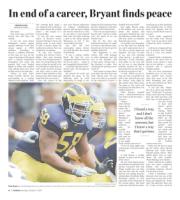
Chris Bryant saw limited playing time as an offensive lineman in Ann Arbor due to a laundry list of injuries, but found a new role in the Michigan program.
I found a way,
and I don’t
know all the
answers, but
I know a way
that I got here.