

4B — Thursday, March 23, 2017
the b-side
The Michigan Daily — michigandaily.com
Not Insane: A study of the
complex ‘Legion’ ’s David
FX
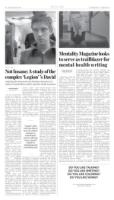
David in FX’s ‘Legion’
Analyzing the intracacies of a television character as it
relates to mental illness and its repetitive media treatment
Sitting down to speak with
Mentality Magazine, I was
sucked into a space where
honesty
was
encouraged,
where mental health and art
were intertwined and where
speaking up was and always
will be the answer.
The student-run publication
made its first appearance at
the University at Festifall this
past semester. After years of
not having an organization
dedicated to freely writing and
publishing
work
exclusively
about mental health, Mentality
Magazine filled the space.
“If you think it’s important
to write about, put it out
there,” said Anna Learis, an
Engineering sophomore and
senior editor of the magazine.
With a once a semester
print
publication,
weekly
meetings
and
a
constant
stream of website posts, the
group produces content with
individual styles and twists.
Every writer contributes his/
her own perspective on mental
health, highlighting how it
affects everyone differently.
This originality in their work
also reflects the individuality
of mental illnesses, according
to Liz Fernandez, an LSA
freshman
and
writer
for
Mentality.
“Stories weave themselves
naturally because they are real
people’s emotions,” Fernandez
said. “You don’t fabricate it.
Those stories and emotions
themselves
are
inherently
motivating.”
Learis
and
Fernandez
explained the different types
of articles that the magazine
publishes. Producing columns
— like “Speak Out Sundays,”
which connects mental health
and celebrities — allows the
writers to talk about mental
health through other artists
and art mediums. Additionally,
the
writers
do
“Mid-Week
Music” playlists, where they
compile songs that reflect how
they are feeling that week.
The women also described
how the articles serve as
opportunities to discuss how
the outside world may or may
not fully understand the extent
to which people suffer from
mental illness. Some of the
articles display the negative
stigmas of mental illness in
media, review mental practices
like
meditation
and
even
discuss the importance of the
simple, but helpful sun lamp.
Learis also explained that
the
pieces
propose
little,
“gimmicky
mental
health
things,” providing ideas as
to how people can cope with
mental health.
However, it is important to
note that Mentality Magazine
is not solely a group of people
who have mental health related
issues and are writing about it.
The group strives to shine light
on mental health and to profile
the importance of awareness,
especially
on
a
college
campus, but does not restrict
its staff only to those who are
personally affected.
“Our primary goal as a
magazine
is
to
foster
the
conversation
about
(mental
health),” Learis said. “Our view
is that, by sharing our stories,
we want people to feel less
alone.”
In order to create such a
distinct and serious publication,
Learis really thought about her
personal life and how mental
health has affected her.
“In high school we had to
read Walt Whitman’s ‘Song
of Myself’,” she said. It was
here where she realized she
can “write bluntly, but still
artistically” about the things
that mattered most to her ––
the recognition and severity
that is mental health.
“It doesn’t have to be black
and white … you don’t have to
sugarcoat things,” she added.
With these conditions in mind,
Learis
was
determined
to
design a space for mental health
and to bring forth the concept
that the it is more common than
many believe.
And as one of the first student-
run, mental health publications
on college campuses across the
country — and the only one at
the University — Mentality
Magazine
has
a
duty
to
perform.
“There is a power in writing,
both reading it and doing it
yourself,”
Fernandez
said
when explaining the difference
between
reading
someone’s
story versus just hearing it.
The
magazine
staff
continues to share their stories
and perspectives not only with
the public, but closely with one
another. As a tight-knit group,
organization members spends
time outside of work, like
hanging out at Sweetwaters
and holding pot lucks. They
openly talk about how their
mental health affects each of
them on a daily basis.
“I
had
a
really
hard
time
adjusting
to
college,”
Fernandez explained. “I was so
sad in a place where everyone
is so excited,” and she did not
quite understand why.
Encouraging
that
conversation,
the
group
lingered on Fernandez’s phrase
about feeling lonely at a new
place like the University, not
letting it slip into the shadows
like so many mental health
topics usually do. They are the
type of people expanding on
the question: Why isn’t this
something people talk more
about?
“People are looking for a
community to sit and talk, and
that is OK,” Learis added.
These hangouts are not like
typical therapy sessions ––
ones that can be intimidating
or
scary
when
expressing
one’s mental health problems.
They’re a group of trustworthy
friends who understand that
there is no need to hold back
about the issues at hand.
“(Mentality
Magazine)
creates
a
culture
where
people can talk about it and be
comfortable … I immediately
felt connected to these people,”
Fernandez said.
The beauty of the magazine
is that anyone can submit pieces
to it, not just MM writers or
University Michigan students.
Learis said she frequently
recieves emails from readers
stating that they appreciate
Mentality, and also want to
contribute to the conversation.
“I would (write an article)
1,000 times over if it means
making one person feel better
about their condition or about
how they are feeling on any
given day.”
AMELIA CACCHIONE/THE MICHIGAN DAILY
Mentality Magazine looks
to serve as trailblazer for
mental-health writing
The issue of mental illness
has been at the forefront of
television for a while now.
Acclaimed shows like FX’s
“You’re The Worst,” the CW’s
“Crazy
Ex-Girlfriend”
and
Netflix’s “Unbreakable Kimmy
Schmidt” have been praised
for their sensitive, nuanced
portrayals of mental health.
And while its exposure into
mainstream TV has helped
emphasize its social relevance,
mental illness is still a very
tricky, often perplexing topic
to depict.
Using mental illness in TV
delicately and acutely requires
several necessary steps: doing
extensive
research,
getting
advice from mental health
consultants,
hiring
writers
with
familiarity
or
lived-
in
experiences
of
mental
illness and getting actors who
approach the material in a
thoughtful way. But it’s possible
for a show that successfully
discusses mental illness to also
simply use creative storytelling
to immerse the audience into
understanding mental illness
on a personal, cultural and
institutional level.
FX’s “Legion” is one such
show that puts that tactic to
the test.
Created by Noah Hawley
(“Fargo”) and based on a
character of the same name
from
the
“X-Men”
comics,
“Legion” is one of the most
unusual and refreshing TV
programs in recent memory.
It works as both a superhero
drama
and
psychological
thriller,
incorporating
arresting visuals, innovative
cinematography and a haunting
electronic music score. Though
“Legion” remains steadfast in
joining the canon of peak TV —
it was just renewed for a second
season
—
the
authenticity
of its perspective on mental
illness has become somewhat
debatable.
“Legion”
follows
David
Haller (Dan Stevens, “Beauty
and the Beast”), a powerful
mutant
who
is
diagnosed
with schizophrenia at a young
age but later discovers that
his “illness” is actually just
telekinetic powers. After he’s
recruited by a team of mutants,
David learns to harness his
abilities, leading him on a
journey of self-discovery of
differentiating between reality
and fantasy.
Given its jarring visual style
and unconventional, non-linear
narrative,
“Legion”
walks
a thin line between making
mental illness into a spectacle-
heavy storytelling device and
deconstructing it in order to
subvert its stigmas.
Some reviewers believe the
portrayal of mental illness
in
“Legion”
lacks
nuance:
Wired’s Eric Thurm claims
the “groundlessness” with its
treatment of mental health
“threatens to upend the show,”
while
The
Village
Voice’s
Angelica
Bastién
believes
“limiting
David’s
character
flattens the story’s emotional
resonance.”
I would argue that “Legion”
offers an intelligent, complex
and
daring
illustration
of
mental illness. In fact, it wants
the audience to understand
David through the unreliability
of his thought process and the
frustrating lack of control he
has over his illness / powers.
Almost every sequence in each
of the show’s first four episodes
deliberately tries to cultivate a
distortion of reality similar to
David’s. From the disarmingly
colorful production design to
the variety of camera lenses
and angles, “Legion” gives
audiences an experience so
disorienting that it not only
forces us to look at mental
illness
from
a
different
perspective,
but
also
to
question our own reality and
what it means to be “normal.”
Perhaps “Legion” can also
be seen as a broader critique
of
our
society’s
treatment
(or lack thereof) of mental
illness. In the first episode,
we see David shackled to
the confines of Clockworks
Psychiatric Hospital, a mental
institution he lives in after
an attempted suicide. Later,
a group of seedy government
officials
interrogate
David,
believing that he is the most
powerful
mutant
they’ve
ever witnessed. After a few
failed
experiments,
David
escapes from the hospital and
receives help from psychiatric
therapist Melanie Bird (Jean
Smart,
“The
Accountant”)
and a special team of other
mutants, including David’s own
girlfriend Syd Barrett (Rachel
Keller,
“Supernatural”).
But even then, David is still
bereft of control, as he is
constantly pressured to open
up his thoughts and memories
under Dr. Bird’s demanding
treatments.
At
one
point,
Dr. Bird, who denies David’s
schizophrenia, even admits to
her own ominous intentions:
“I want to fix him because he
deserves to be healthy. And
then I want to use him.”
By having us empathize
with David and his condition,
“Legion” plays with this idea
of how our culture attempts to
understand a person suffering
from a mental malady by
medicating
and
controlling
them. The show intentionally
pushes us away from truly
knowing what is going on inside
David’s mind because it puts
David into a box and simplifies
the complex character he really
is. Near the end of episode
three, David addresses this
concern directly: “Everybody
in here keeps saying that I’m
sane. What if they’re wrong?”
Nevertheless, mental illness
remains
a
difficult
topic
when it comes to “Legion.”
It’s true that people who are
schizophrenic
and
mentally
ill in general can live full,
productive
lives.
Watching
David
struggle
with
his
demons and ultimately become
a charity case might be seen as
trivializing mental health and
perpetuating negative myths
about
people
with
mental
illnesses. Using visual trickery
and cool set pieces to show
David’s
mental
breakdowns
might also sound ill-advised
in theory — artistic depictions
of mental health should focus
on substance more than style.
Still, “Legion” does its best to
demonstrate just how intricate
mental illness can be, while
managing to be entertaining
and thought-provoking. As the
show continues to grow and
David’s
character
develops,
“Legion”
may
potentially
become an example of a show
that portrays mental health in
a sensitive manner.
ERIKA SHEVCHEK
Daily Arts Writer
“Legion” plays
with this idea of
how our culture
attempts to
understand a
person suffering
from a mental
malady by
medicating and
controlling them
DO YOU LIKE TALKING?
DO YOU LIKE WRITING?
DO YOU LIKE COLORING?
DO YOU LIKE SKIING?
If so, e-mail arts@michigandaily.com for
information on applying.
COMMUNITY CULTURE PROFILE
TV NOTEBOOK
SAM ROSENBERG
Daily Arts Writer