

6B — Thursday, March 9, 2017
Arts
The Michigan Daily — michigandaily.com
“These
people
are
no
different from any of us. It
would be impossible for anyone
not to develop a connection
to these families if they spent
some time with them.”
This
is
VICE
News
Correspondent Gianna Toboni.
In a recent interview with
The Michigan Daily, Toboni
shared her experiences from
creating
the
documentary
episode, “Trans Youth” for
VICE on HBO. The 30-minute
piece
follows
transgender
youth across America, all in
different stages of their medical
transition. It’s raw, real and asks
viewers to do a lot more than
simply watch. “Trans Youth”
asks its viewers to think about
a group of children and parents
who are in the fight of their life.
The “fight of their life”
is
not
something
to
be
taken
metaphorically.
The
documentary
begins
in
Pearland, Texas, with five-
year-old Kai Shappley. Kai is a
transgender child in one of the
most conservative, right-wing
school districts in America.
After spending some time at
home with Kai and her mother,
Kimberly, the episode follows
Kimberly to the Pearland local
school
board
meeting.
She
stands before her community
members
and
leaders,
and
makes the case for Kai’s right
to use the bathroom of her
choosing:
“I am a mom of a little girl
that I would like to see live,”
Kimberly said in the episode.
“I am a mom of a little girl
who has a 41% suicide rate.
That is a very real thing. Please
understand. I’m not fighting
about bathrooms. I am fighting
about her life.”
A lack of support from the
community is crystal clear.
The
school
superintendent
left the room halfway through
Kimberly’s
speech.
At
this
point, it would be easy to spend
the rest of the episode exploring
in the politics of transgender
laws — but that’s not what
“Trans Youth” does, and it’s a
stronger episode for it.
The fight for Kai’s life runs
much deeper than conservative
politics, and not just for Kai
— for all transgender youth,
to live in a body with which
he or she does not identify is
excruciating. So painful, in fact,
that for those who can’t remedy
what they feel, suicide is the
only option.
It is this fight — the fight to
transition medically — that
“Trans Youth” highlights.
“[The
episode’s
creators]
made a decision to focus on
the medical transition because
(they) felt like that’s what
other media companies hadn’t
focused on,” Toboni said.
Bathroom laws are all anyone
hears about — but those laws
hardly scratch the surface of
what it means for a transgender
youth to transition. The medical
process
of
transitioning
is
relatively unexplored.
“I have never done a story
where I can talk to the experts
and
they
don’t
know
the
answer,” Toboni said.
This
uncharted
territory,
though scary, has not deterred
children intent on making the
transition. Toboni interviewed
eight-year-old Max O’Brien as
he went through the process
of receiving hormone blockers.
The blockers aren’t permanent,
but undergoing cross-hormone
therapy is. Max and his parents
have a few years before they
have to make that decision.
With no long-term data backing
these medical treatments up,
no one can know for sure what
these medical treatments will
mean 10 years down the road.
The
episode
does
an
excellent job of exploring what
this
uncertainty
means
for
transgender youth and their
families. Intimate interviews
put viewers directly in the
homes, backyards and hospital
rooms of these people, giving
outsiders a perspective on an
issue which is foreign to them.
Uncertainty about the long-
terms effects isn’t the only issue
with the medical transition
process. It’s expensive. Very
expensive. Toboni estimated
that a hormone blocker costs
between $750 and $800 per
month. So, the transition is, per
Toboni, “completely prohibitive
if insurance is not covering it.”
In the wake of President
Donald
Trump’s
executive
order
to
dismantle
many
benefits of the Affordable Care
Act, families of transgender
youth are in a state of limbo. As
a viewer watching interviews
filmed prior to the executive
order, a major question raised
is how things have changed
since. Toboni and her crew
have stayed in touch since the
election.
“There’s no other way to put
it, they’re devastated,” Toboni
said. “They don’t know how this
is going to affect their health
insurance,
whether
they’re
going to be able to continue
transitioning.”
The episode features men and
women at each stage of their
transition — from pre-medical,
like Kai, to surgical, like 18-year-
old Charlotte. Charlotte has
lived at the Waltham House — a
group home in Boston for LGBT
youth — since she was 14, after
her mother threatened her life
for wanting to be a woman. For
someone like Charlotte, made
to feel like she “had no place
in this world,” the opportunity
to surgically transition is life-
altering. It allows her to feel
comfortable in her own skin.
Without the assistance of
health insurance, however, this
might not be possible. Those
unaffected cannot fully imagine
the emotional toll it takes.
15-year-old
Steevie
Geagan
offers a glimpse.
“You have no idea how hard
it is, waking up and not really
connecting with what’s there,”
Geagan said in the episode. “To
prolong the treatment process,
would be dreadful.”
By highlighting the medical
transition,
the
documentary
is better equipped to capture
the emotional fight America’s
transgender youth face daily.
The biggest take-away is that
this issue is about more than
politics. It’s people’s lives. To
highlight the medical process
and present it to a large audience
creates discussion that may not
have been present before.
“Trans
Youth”
showcases
people who are fighting for
their right to be happy.
“I think that’s the reason
we do this work. To help
educate people and help those
influencers,
policy
makers,
civilians
go
on
into
their
communities and act in a way
that they feel is appropriate,”
Toboni said, reflecting on the
episode’s potential to inspire
viewers. “That’s the first step in
creating change.”
Those in Ann Arbor who are
eager to make change don’t
have to look far. The University
of Michigan’s Spectrum Center
offers
programs,
academic
services and a comprehensive
list
of
LGBT
student
organizations.
Residential
group homes like the Waltham
House exist nationwide.
Though they live in an almost
constant state of uncertainty
and turmoil, Toboni admired
that the transgender youth will
not be deterred.
“They’re still going to protest,
they’re still connecting with
their community and they’re
continuing to fight,” she said.
“Trans Youth” is available
to stream for free on YouTube
through March 18th courtesy of
HBO.
EMILY BICE
Daily Arts Writer
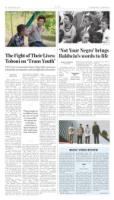
HBO
The Fight of Their Lives:
Toboni on ‘Trans Youth’
VICE News Correspondent Gianna Toboni talks experiences
with families of transgender youth and difficulties of transition
‘Not Your Negro’ brings
Baldwin’s words to life
James Baldwin, novelist and
playwright, tells the story of
Black men in America with a
voice of wisdom,
sorrow
and
mourning.
Baldwin’s
memoir
is
a
touching,
personal account
of combating the
ever-prevalent
racism in the United States while
paying due tribute to his friends,
Medgar Evers, Malcolm X and
Martin Luther King Jr., who died
trying to end it.
From Baldwin’s poetic prose
to Samuel L. Jackson’s calming,
hushed narration (Though the
actor usually prefers a forceful
yell, as evidenced by Marvel’s
Nick Fury, “Snakes on a Plane”
and
“Pulp
Fiction”),
Raoul
Peck’s
(“Murder
in
Pacot”)
documentary version of the
author’s unfinished manuscript,
“Remember This House,” is
a meaningful homage to the
unpublished masterpiece.
More than just depicting a life,
the film depicts a struggle — the
struggle of the African American
community
in
America
and
the struggle of the people who
fought to end that struggle.
Within the span of five years,
three great men were murdered
for fighting in the name of civil
rights, equality and justice.
First was Medgar Evers, then
it was Malcolm X, then Martin
Luther King Jr. The world
lost
three
great
leaders, but James
Baldwin lost three
dear
friends.
In
the film, Baldwin
recalls the details
and
memories
of
discovering
the news of the
assassinations.
He
was
on
vacation when he found out
about Medgar over the radio, he
was out to dinner when he found
out about Malcolm, he was in
L.A. when he got the call about
Martin. Baldwin’s losses are
what inspired him to write the
famed manuscript and they drive
the film forward.
“I Am Not Your Negro”
manages to seamlessly weave
together found and real footage
into
a
clear
and
stunning
portrayal of Baldwin’s work.
Even
Baldwin’s
plentiful
references
to
Hollywood
blockbusters like “Guess Who’s
Coming to Dinner” and “Dance,
Fools, Dance” are incorporated
with skill and artistry. The
collage of images compiled into
the film takes Baldwin’s words
and turns them into the perfect
narration for events both past
and present.
The
historical
footage
of
Baldwin is representative of his
personality, adding his own voice
and mannerisms to the film.
The audience finds him on “The
Dick Cavett Show” flicking the
ash from his cigarette, speaking
eloquently in the hallowed halls
of Cambridge, riding in the
passenger seat through his native
Harlem, rubbing shoulders with
the likes of Marlon Brando,
Sammy
Davis
Jr.,
Harry
Belafonte and Charlton Heston.
In addition to providing a
portrait of Baldwin during his
lifetime, the film showcases
a
variety
of
footage
and
photographs illustrating a still
evident racial divide within
American society. From riots in
the streets of Ferguson to police
brutality in Los Angeles, the film
intertwines Baldwin’s memories
of the disturbing past with
today’s disturbing present. Raoul
Peck has compiled an impressive
arsenal of found footage that tells
a story in and of itself; it is only a
fitting that it sings so beautifully
in duet with Baldwin’s work.
“I Am Not Your Negro” is an
innovative and simply excellent
documentary that gives voice
to the genius of James Baldwin,
while addressing race in America
from a perspective both old and
new.
REBECCA PORTMAN
For the Daily
AMAZON STUDIOS
MUSIC VIDEO REVIEW
alt-J is a band long recog-
nized for its music videos. My
first-ever introduction to the
band was when a friend rec-
ommended me not their music,
but to their music video for
“Breezeblocks” and try to fig-
ure out what was going on. The
band hasn’t been afraid to get
strange with their videos over
the past few years, and that
holds true with this week’s
“3WW,” an imaginative vir-
tual translation of the pain of
denied love.
The video opens in dark-
ness, and then shades of
golden-brown light begin fil-
tering into view in the form
of geometric shapes. At the
same time, a single wandering
guitar guides us into the soft
percussive rhythm that soon
becomes the backbone of the
song. The sound is endlessly
soft and exploratory, and it
evokes waking up in the morn-
ing or stepping into the light
out of a dark room.
Equally intriguing are the
corresponding
images.
The
rapidly flashing shapes from
the very beginning set the
tone for the rest of the video,
which looks like it takes its
animation from some com-
puter program or video game.
The constant flashing and
switching
between
images
makes it hard to discern any
concrete plot, but the images
themselves still suggest dis-
tinct feelings and senses of
meaning. Many of the images
recur — a man walking into a
room to meet another person, a
pinkish shape floating upward
into a near-cloudless sky, a
field of grass with a single tree
beginning to bloom — and con-
vey a sense of continuation, of
nature taking on meaning in
an unnatural world.
The succession of images
repeats several times in the
same order, and for all the hope
that comes across in the bright
landscapes, like a beautiful
dock and a road through green
fields, the song definitely car-
ries a strong element of sad-
ness, of hope lost. The figure
walking alone toward the per-
son in the room never reaches
them; the series always ends
with the final note of an object
or figure, lying dead in the
middle of a road. I took this
as an indication of the futility
of the speaker’s love, but the
video is constructed in a way
that lends itself to personal
interpretations, rather than
a clear narrative. No matter
the
interpretation,
though,
“3WW” is a beautiful example
of how a music video doesn’t
need a plot or even a live cast
of people in order to convey
something deep, meaningful
and complete.
— LAURA DZUBAY
“3WW”
alt-J
Infectious Music
“These people are
no different from
any of us. It would
be impossible
for anyone not
to develop a
connection to
these families if
they spent some
time with them”
“I Am Not Your
Negro”
Amazon Studios
Michigan Theater
TV INTERVIEW
FILM REVIEW
INFECTIOUS MUSIC