

Wednesday, March 8, 2017 // The Statement
4B
Wednesday, March 8, 2017 // The Statement
5B
Cassandra’s Song
memories from motor city
b y M e r i n M c D i v i t t, Daily Arts Writer
S
pringfield Street, a short stretch of
asphalt on Detroit’s east side, used to
have so many elm trees shading the
road that Detroiters could barely see the sky as
they drove on their way to the freeway. Passersby
would stop for gas after work at Cliff’s, or grab a
snack for the road at the Bamboo Bar, and I imag-
ine they’d stand there for a minute and watch the
husky flecks of sun come down from the west and
nearly stop cold over that dense canopy. In the
summer, when the leaves got thick and bristly,
the trees gave shade to kids biking and roller-
skating down the pavement. The street sweep-
ers would trim the branches so they stayed neat,
twined together so it seemed like one long arch: a
shadowy green tunnel with light at the end.
The trees were the first thing Cassandra
Compton noticed when her family moved to
Springfield from the north side.
“I can remember December 1954 like it was
yesterday,” she said, recalling all the stories she’s
told me.
To me, she’s always been Dr. Montgomery,
never Mel or Cassandra or even a Compton: a
kind recreation director with a Ph.D. in medical
anthropology. She became the director of Del-
ray Recreation Center on the southwest side of
Detroit the year after I began working there as a
high school volunteer. I quickly got to know and
love Dr. Montgomery as we worked side by side
over the years. She cut her hair short last year,
for the first time in a decade, and now it twists
around her head like a halo. Dr. Montgomery is
one of the smartest people I know, and one of the
most caring. Her face is smooth and bright for her
66 years — wrinkle-free, except for a few smile
lines around her eyes and mouth, and a line of
worry stretched thin across her forehead.
While I was volunteering under her, she pep-
pered our conversation with old anecdotes, and
brought her childhood home back to life.
The city’s present state is all I’ve ever known
of it, and I love it as it is. In the five years I worked
at the community center, I met enough wonder-
ful people to pull me back there often, for Christ-
mas parties and baptisms and the occasional
quinceañera.
But Dr. Montgomery’s love is so much stron-
ger and more beautiful. It’s not easy to love a
place when you remember the light glinting at
the western edge of that green tunnel of trees
above 5572 Springfield St., and she tells me you
can’t bring yourself to drive by all that emptiness
where you played, and learned to read and went
on your first date. You can hold it in your hand
and squeeze tightly, but it will just fall through
like dust. I want to understand, at least a little bit,
what it means to love something like that.
******
Detroit, the birthplace of the automotive
industry and the heart of the American Arsenal
of Democracy, hit a golden age coming off the
second World War. Its population hit its all-time
peak of 1.85 million in the 1950s, and the Big
Three automakers — General Motors, Ford and
Chrysler — fueled a growing middle class. How-
ever, labor disputes and racial tensions between
white and Black workers — followed by energy
crises, automation and imports — hurt employ-
ment in the region’s largest industry.
The city would also suffer from severe racial
tensions that came to a head in the summer of
1967 race riots, a product of segregation, unem-
ployment and police brutality. It has been 62
Decembers since Montgomery’s move to the east
side.
“I am 66 years old,” she said. “Let’s put it that
way, and you do the math.”
November 1954 had been cold and clear, sur-
prisingly sunny for a gray Detroit winter. But
December made up for it with piles of thick wet
snow, and while it must have turned instantly to
lead-laced gasoline slush on the gray street below,
up high in the elm trees it would’ve made a tun-
nel all the same, lacier and more delicate than the
jungly summer canopy. On the days that hovered
just above freezing, maybe it looked like a watery
spider’s web, one that would splatter you with
chilly droplets when you walked underneath.
That was their new street, and even with the
novelty of the tree tunnel, Cassandra and her
older sister, Tywania, were not thrilled when
Jimmy Compton Sr. packed up the family that
December and moved across town to Springfield
Street. Their dad worked for the Detroit Post
Office, and he decided it was time for a differ-
ent zip code. To make things even more difficult,
they were the first Black family to move onto the
street.
They missed their old brownstone, with bed-
rooms all upstairs; many years later they would
recognize an almost identical home in the
Huxtable’s apartment in “The Cosby Show,” and
remember it fondly. They got used to their new
house on Springfield Street, though, and the way
she talks about her former neighborhood often
makes me wish I had grown up there.
Cassandra was 4 then, but already everybody
called her Mel. Her middle name is Melody, and
the nickname stuck. She used to sing with her
brothers and sisters while her mother played the
piano.
“It rained 40 days, and it rained 40 nights;
there wasn’t no land nowhere in sight. God took
a raven to bring the news, hoisted his wings and
away he flew. To the East! To the West!”
Mel’s sister would stand behind her and har-
monize, “Didn’t it fall, my Lord, didn’t it rain!”
Mel still sings, in church concerts and on her
own, and sometimes to me. Her rich voice fills
the room, even if we are in the high-ceilinged
gym of the community center. She hums melo-
dies that have stuck in her mind long after her
nickname slid off, songs that sweep me up in her
nostalgia for a different time.
“It seemed like everything we wanted was
close by, you know?” Mel said, her voice bright
when describing her childhood home. “Big stores
— there were still mom and pop stores. We could
walk within a mile radius — I could go roller-
skating; to a restaurant; I could do Christmas
shopping; I could get donuts from the bakery; I
could go to the movies; I could go swimming.”
These are things she can’t do now because many
of these businesses are now shuttered and the old
residents now departed.
Dr. Montgomery talks about this time and
place with such longing. The snow heaps up
outside the coffee shop and I can close my eyes
and see Springfield in summer: Head east out
the front porch, turn right on Shoemaker Street
and pass Betty’s Sweet Shop, with model cars (all
American, of course) and candy and a chrome-
plated soda fountain just like in the movies.
Round the corner again at Lemay, and there’s
Rinaldi’s Supermarket. Frank’s was across the
street, and a restaurant with jukeboxes and cheap
hamburgers, and those plush stools that kids can
swirl around on until they start to feel sick.
Turn back for home and there on the corner
of Shoemaker and Springfield was a big empty
lot with some old billboards. “It was kind of hilly,
and you’d play in the ice and the snow, or in the
summer we went and would catch grasshop-
pers — you can’t get me to go in tall grass now,”
Dr. Montgomery remembered with a chuckle “I
don’t know how I did it back then. I was a kid. I
was a tomboy.”
*****
Dr. Montgomery isn’t the only one grasping
at these old memories. So many of the people
who live or work in Detroit today, and those who
were raised in the city but moved away — Dr.
Montgomery now lives mere miles from me in
Washtenaw County — are nostalgically drawn
to the glimmer of the old city, the splendor of
its ballrooms and mansions and movie palaces.
Publishers can’t print enough books with titles
such as: “Detroit: An American Autopsy,” “Hid-
den History of Detroit,” “Once in a Great City,”
“Detroit City is the Place to Be,” and “Where Did
Our Love Go?” There are more than 1,000 images
tagged “Detroit Nostalgia” on Pinterest, entire
Tumblr blogs and coffee table books and art-
ists’ careers dedicated to frayed black-and-white
photographs. In them, older suburbanites lament
their lost childhood homes and recite the litany
of forgotten city landmarks like well-worn rosary
beads, like saying them over and again will bring
them back to life: Hudson’s Department Store,
the streetcar, Vernor’s Soda Fountain.
Even Berry Gordy, Motor City’s prodigal son,
returned to cash in on this thirst for nostalgia.
Two years ago, I took the University of Michigan
shuttle to see “Motown: The Musical,” Gordy’s
version of the record label’s rise, from Hitsville,
U.S.A. to Hollywood. This was the nostalgic nar-
rative, Motown the company as gentle and pater-
nal, Motown the city as idyllic until the riots hit.
I lapped it up. Gordy crammed the musical with
every classic hit he still held the rights to, and,
sitting there in the Fisher Theatre, surrounded
by older ladies jamming to every song like it was
1965, I beamed for three hours straight.
It was nothing, though, compared to what the
Comptons saw at the Motown Revues. Forget
plain old nostalgia. If I too had been able to see
The Jackson 5 and The Temptations in the same
night — as Mel was able to multiple times while
growing up — I’d be clawing at the door of the
Fox Theatre like it was a time machine, begging
to go back. In the 1960s, Motown would toss all
its artists into one big show around Christmas-
time. They would perform maybe four shows
a day, one after the other, with a short break in
between. Mel would stay for all of them.
“We got there in the morning, and they didn’t
clear out the Fox and say, ‘Hey, you paid for this
time, for another group.’ You could stay. (Their
wait brought them) Gladys Knight and the Pips,
Stevie Wonder, Marvin Gaye and Tammi,” Mel
said, drawing out their names long and slow.
“Tammi Terrell was beautiful. Those big pretty
eyes, and the way she wore her bangs — they kind
of had a little peak right there. Oh, she was beau-
tiful.”
Listening to my recording of our conversation,
scratchy voices heard above the saxophone music
of the coffee shop, something in Dr. Montgom-
ery’s tone struck me. I rewound a few seconds,
“Oh, she was beautiful.”
*****
Dr. Montgomery’s stories are all tinged with
this soft quality of light, these infectious melo-
dies that make me want to believe, to go back.
“Sometimes when I’m talking to you, I hear
music,” she tells me. “I’d carry a transistor radio
about as big as a box of cracker jacks. … I’m walk-
ing home listening to Dee Clark singing ‘Rain-
drops.’ ”
That glossy sheen never really wears off Dr.
Montgomery’s memories of this time.
There are nicks in the varnish, though, and
they get bigger as we talk, as each year of Mel’s
childhood passes by with a quick step, as the
grown-up world creeps in alongside the slow and
tedious decline of her neighborhood. Growing up
in the first Black family on a Detroit street was
not all jukeboxes and soda fountains.
“It was challenging,” she said. “Our neighbors
on either side of us were welcoming, but there
were neighbors farther down that weren’t so wel-
coming, and did some things that, you know …
weren’t neighborly.”
The kids made up other nicknames, too, these
ones not particularly fond or funny.
“There was another lady, we called her ‘Miss
Hellcat-Raiser,’ because she didn’t like Blacks,”
Mel remembered. “Neither did her son. I don’t
know where we got that name from.”
Other neighbors ignored Mel, pretending she
didn’t exist and refusing to move their spurting
hose from the sidewalk to let her pass by on bicy-
cles and roller skates. The shade of the canopy
overhead could protect the Compton kids from
the harsh sunlight, but there was little protection
against a petty, agitated white neighborhood — a
neighborhood whose local high school yearbook
was titled “The Aryan” until a year or two before
Mel enrolled there.
Then there was a neighbor who never had a
nickname.
“There was this one gentleman that would not
want to walk on the same side of the street with
us,” Mel said. “And if we did get too close with
him, he’d take the collar of his coat and put it up
to his face, and he’d turn to the side and spit on
the ground.”
And there were faceless neighbors too. Ones
who came in the night and broke all their garage
windows.
As bad as things could get on Springfield
Street, they were nothing compared to the
Compton’s original home: Alabama. Mel was
born in Birmingham, and her grandparents lived
in an old company town built by the steel indus-
try. Though she grew up in Detroit, the Comp-
tons would visit Alabama when they could to
catch up with family. She remembers the view
out the window seat of the Greyhound bus as it
approached the city during the trips throughout
her childhood — first, flat farmland, then, heavy
industry on the outskirts and the hulking, slight-
ly goofy silhouette of the huge steel Vulcan statue
that welcomed them to Birmingham, glowing
dark red while the sun set.
It wasn’t much of a welcome. Grandma Lar-
cena and Grandpa Mose kept the Compton kids
occupied, but as Mel entered her teens, she start-
ed to notice things. She would sit on the stoop in
her red majorette boots, which got so tattered by
her marching that the heels wore off. Just down
the way was a bar.
“To my right when I looked over my shoulder
was ‘Black Only,’ and I looked over my shoulder
to the left and it was ‘White Only,’ ” Mel said,
referring to the Jim Crow-imposed signs on pub-
lic spaces in the South. She was a northern kid
unfamiliar with this sort of legally codified dis-
crimination, so she stared too long and too hard.
“I was looking over there and they stared at me,
like ‘What are you doing?’ ” she remembered.
“And they were hostile.”
By the late 1950s and early ’60s, the memory
fades out.
“It seems like everything after that is blank,”
Dr. Montgomery said. “I don’t know if we took the
bus, or were they boycotting at the time? I don’t
remember, I don’t remember. I just know when
I saw that look on their faces, I can’t remember
anything after that.”
Soon after, the trips faded too. The Compton’s
last visit down to Birmingham was in 1959. After
that, some of the buses that went down stopped
coming back up. The Freedom Riders took the
Greyhound too, from Detroit and other cities in
the North. Mr. Compton didn’t want his children
sitting next to these well-meaning kids who had
no idea what they were getting themselves into.
“My dad was fearful of letting us,” Dr. Mont-
gomery said. “It was bittersweet. I felt a little
resentful that year after year we couldn’t visit
because of the civil unrest.”
One of these buses sits in the Birmingham Civil
Rights Institute now — its hull, that is, charred
and bare. Sometimes, people would set fire to
the Greyhounds as they carried the Freedom
Riders, idealistic students on a mission to regis-
ter Black southerners to vote. Her father didn’t
want his children coming back up north the way
14-year-old Emmett Till did — in an open casket.
Mel’s mother sang for the True Rock Missionary
Baptist Church on the east side; later, the family
switched to the Lemay Avenue Baptist Church.
Plunk these churches down in Birmingham, and
Mel might’ve ended up like Denise McNair. Or
Carole Robertson, Addie Mae Collins or Cynthia
Wesley. That Birmingham church bombing, the
notorious one in 1963, was the third such incident
in 11 days in the city.
*****
There is a dark side to our nostalgia — the
memories that are hazy and gray, the things that
Mel didn’t understand well at the time and have
since faded, fast. Yearning for the past also means
a shared agreement that we will cast out the rec-
ollections that don’t fit. Or perhaps agree that the
present day is not better, but worse. That what lay
at the end of the tunnel was not salvation.
The glumness of these memories casts a pall
over the warm glow of Springfield Street. Still,
Dr. Montgomery and I sail past them, perhaps
too easily. Recollections are twisted like bal-
loon animals into what we wish to see in them;
words, those nimble acrobats, contort themselves
around tricky subjects.
Consider a memory Dr. Montgomery shared a
little earlier: the thinly veiled racial animus she
received from some of her more distant white
neighbors. Dr. Montgomery paused for a second,
and then she wasn’t Dr. Montgomery anymore.
She was Mel. The gleam of Springfield Street,
of that shining tunnel of tree canopies, would
always win out over the foggy gloom of the bad
days.
“But the trees,” Mel pivoted. “The street
sweepers would come, they’d trim the trees. I
mean, it was just this beautiful archway that it
looked like.”
*****
A Methodist pastor, Woody White, had moved
across from the Comptons on Springfield Street
and took them to church on East Grand Boule-
vard every Sunday. He encouraged the kids to do
service, and Mel started getting involved in the
church group.
“That was the most impactful time of my life
— in the Methodist Youth Fellowship,” Mel said.
“(Reverend White is) a staunch, staunch advo-
cate, to this day, for civil rights.”
On June 23, 1963, he took the Compton kids
to a civil rights march at Cobo Hall down by the
river. Jimmy Sr. was across town representing his
union in the march.
“I have a picture of my dad holding a picket
sign that reads: ‘President Lincoln freed the
slaves, but did nothing for the Negroes. Free us!’
” Mel remembered. “And for a long time, I didn’t
know what that meant.”
This was no ordinary event. At the time, just
a few months before the March on Washington,
it was the biggest civil rights demonstration in
American history. It drew a crowd of 125,000
people. Mel wore her best dress, and craned her
neck to see, and Martin Luther King Jr. walked
up to the podium in Detroit. Organizers called
this the Walk to Freedom; later, King would call
it “one of the most wonderful things that has hap-
pened in America.”
And King said this:
“I have a dream this afternoon that one day,
one day little white children and little Negro chil-
dren will be able to join hands as brothers and sis-
ters. … And with this faith I will go out and carve
a tunnel of hope through the mountain of despair.
With this faith, I will go out with you and trans-
form dark yesterdays into bright tomorrows.”
Later that summer, King would deliver an
abridged version of this speech on the steps of
the Lincoln Memorial, overlooking more than
200,000 people on the National Mall. This, of
course, would eclipse the Detroit march until
it faded into nothing more than a footnote, an
unlikely story told by wet-eyed grandparents.
That September in Detroit, as schoolchildren
prepared to return to class, a bomb detonated
by members of the Ku Klux Klan would kill
four little girls, blind an 11-year-old in her right
eye, and injure 20 others. At the twilight of that
decade, King was shot, riots racked Mack Avenue
and Woodward as Mel took the bus home from
a concert downtown, a war began in Vietnam
and classmates lost their lives, those hostile and
frightened white neighbors moved away and
didn’t come back. The decades passed, and Mel
became Dr. Montgomery and moved away. The
house on Springfield Street was torn down.
I want so badly to believe in just the happy
stories — the snow globe city in Mel’s memories.
I think that’s what Dr. Montgomery wants, too.
She spins her stories around me faster and faster,
it dizzies me and I imagine we pick up the globe
and shake so hard. And the snow turns to leaded
slush and ashes. And we are back in the desert,
wandering; wandering.
This is all I can give you; it’s all I have. Hold
Springfield Street 1963 in your hand and hope it
doesn’t slip through like dust. And there is no five
years later. No slumped, bloodied reverend, no
sun-bleached balcony in Tennessee. No house-
burning, fear-raising riots; no broken windows;
and no concerts cut short by nearby looting. No
for-sale signs or wood-panelled station wag-
ons speeding to the east, to the west. No Devil’s
Night, no flames.
There is none of this.
Instead, Berry Gordy gets King to record some
speeches at the label before the big day. He nearly
jumps out of his socks when the good reverend
instructs Gordy to donate all royalties to the
Southern Christian Leadership Conference. King
doesn’t want a cent. Gordy never forgets.
Instead, Jimmy Compton Sr. gets up early
like usual and marches with the postal workers’
union. In a few years, Jimmy will be president of
the union, bringing him plenty of trouble and a
reputation as a hell-raiser. He will always stand
for what is right, and raise the Compton kids to
do the same. Jimmy steps down the asphalt in his
old work boots and holds his sign aloft, gingerly,
like it doesn’t weigh more than an ounce.
And Mel wears her Sunday best, and strains
to hear the reverend in the echoey hall, and what
she does hear, she likes. Afterward they ride
back home with Woody and Kim White, and pass
under the tunnel of elms, leaves thick and check-
ered with sunlight in the late afternoon. And
maybe on the other side, there is salvation.
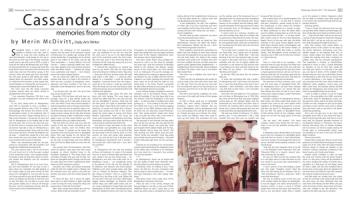
COURTESY OF DR. CASSANDRA MONTGOMERY