

T
he palms of my hands inch forward, slow and
steady, farther and farther away from my body. My
eyes close, surrounded by darkness, with disso-
nant sounds that clatter and ring like hovering shards of
fragmented glass occasionally colliding, I feel my hands
quiver in space, this dimensionless zero-gravity place. I
wait in this darkness, for some sort of cue, a sign, a voice
that’ll tell me exactly what to do and what to feel.
Maybe a minute or so of this, and the space just beyond
my hands that are stretched before me feel different — it’s
charged with energy, some kinesphere crashing toward
me, molecules vibrating as they bounce off the ridges in
my skin. They feel warm.
And then I feel a touch. It starts on my pinky, the slight-
est, lightest brush, hardly palpable. It timidly presses
into the outskirts of my palms, and then slowly shifts to
the rest of my hand. The thumb is last. I feel a sense of
warmth and humility, a sort of security in a place of loss.
When his hands retract, I am left alone in the dark again.
Touch — it sounds sensual, weirdly sexy and uncom-
fortable at the same time, but what exactly is it? And
do we have any idea how powerful “touch” is? I know I
didn’t, and still don’t.
Last Wednesday, I participated in an event hosted by
the Medical Arts program in the University of Michigan’s
Medical School and hospital. It was a physician-dancer
collaborative event, a first of its kind. My professor in the
dance department invited me to demonstrate and perform
at the function, surrounded by current medical practitio-
ners and physicians in training.
When I say I am a double major in dance and neurosci-
ence, 50 percent of reactions are a form of congratulatory
amusement, and the remaining are a combination of con-
fusion, doubt and impossibility.
“Well that don’t make no sense, does it?” my Uber driv-
er scoffs. After the twinge of animosity fades, I usually
force a laugh and say something like, “Well, there’s more
overlap than you think,” and change the subject.
The problem is more widespread and disheartening
than I had originally thought.
The arts and sciences are segregated in their own
worlds, the practitioners siloed into their study they often
forget the other’s presence, or publicly categorized as
entities with no possibility for exchange and integration.
The option for crossing over hardly even exists.
We are in a world where we are overstimulated by our
senses and completely saturated with information that is
handed to us in school and often spewed at us by society.
To understand a person is to understand the world they
inhabit, and the world they wish to be a part of. Trying to
understand a person without their world, the context and
background, seems to neglect the spokes of their wheel
and the network that gives rise to the machine of miscel-
laneous nuts and bolts that makes up who she is.
On Tuesday, I stood in a room full of medical practitio-
ners. We did some collaborative movement exercises to
tune in our senses and see the room from a new angle, a
wider aperture, to understand a person from a non-tradi-
tional perspective.
We played with space — how do we enter a room, exit
a room, move within a confined place? These are simple
ideas that seem tedious and maybe not worth exploring,
but confronting a patient is as much of an improvisation
game as dance.
No, there is no music or spot-
light, chandeliers or dramatic fog, but
there is an audience and a performer.
I remember waking up from my
ACL reconstruction surgery in the post-
op room of the hospital. I can still feel the
light hand that woke me up from my anesthetic
daze. Despite the drugs that were circulating
in my veins, I remember the flush of panic that
nearly made me puke on the bedside table — did
the surgery go well? What if it didn’t, what if I
can’t walk anymore, what if they had to amputate
my leg? I couldn’t begin to fathom the horror and
grief.
I remember watching intensely, scrutinizing
eyes following the doctor as he lifted his hand
from my shoulder and walked around the table,
noticing the distance between him and the bed
rails, his posture and gait, the subtle nod that ges-
tures the nurse to walk this way, the tightness of
his jaw, and the loose fists at his sides that brush the
pockets of his white coat. He lifts up the sheets and I
shut my eyes, because all I feel is fear.
My legs are still numb, my body is foreign and I
am occupying a temporary container with my sloshy
thoughts and medicated blood. It doesn’t matter that I’m
sitting in a bed with carefully calculated and concentrat-
ed fluid bags hanging at my sides, or that the crash cart is
around the corner, and defibrillators are ready to percuss,
or that the abundance of surgeons here guarantees me
life, even if I fall unconscious this instant.
I feel his hand on my foot.
It’s gentle and humble, the way my grandpa used to pat
my knobby knees. When I slowly blink my eyes open, his
eyes are at my level, I wonder if he’s squatting at the foot
of the bed, and then realize he is sitting on a short stool to
match my eye level. There’s a smiley face Sharpied on the
big toe of my left foot, a little crooked so it looks smirky,
and the doctor reassures me the operation was successful.
I nod and muscle a smile on my heavy cheeks and let the
darkness take me away again into the expansiveness of it
all. His movements speak as loud, if not louder than the
words of comfort that escape his mouth.
Maybe I am just a keen observer because of 18 years
of analyzing body positions and their associated mean-
ings. But just like every novel and poem has an intended
audience, why wouldn’t every physician? It’s not that
the motions and gestures of pre- and post-operative care
need to be choreographed or calculated to perfection —
but that they can carry an enhanced consciousness and
body awareness.
As patient-centered care becomes a central focus of the
medical school curriculum and professionals are trained
to be cognizant and empathetic in more complex ways,
there is a necessity for spatial, tactile and body mindful-
ness that is both
artful and rigorous.
When I stood across
from a current med student
and we played this simple hand
game for heightened sensitivity,
I was moved by the dedication and
curiosity he rendered.
I could feel my silos overlapping like
two waves crashing into each other,
standing at the confluence where these
two rivers cross. I was stunned by the
possibility that maybe, just maybe, 18
years of cultivating creativity gave me
something to offer to him.
Maybe I could show him my safe
space, the dance studio — even if it is the
outpatient ward of a hospital — a play-
ground for adults, where every day, we
create new movement, explore the inner
workings of our bodies, and learn to use
spontaneity as our shovel and pail. And
this, the possibility of influencing patient
care with a different type of conscientious-
ness, is the answer I want to give the Uber
driver, the reason for my seemingly anti-
thetical pursuits.
But also, beyond the exercises and dia-
logues of how this specific form of art and science inter-
twine, I believe there is a fundamental understanding
of empathy and lack of judgement that comes with the
practice of music, dance, theatre, visual art and even lit-
erature.
There is immense bravery in delving into your imagi-
nation and then presenting it for display. There is dedi-
cation in the time and years of repetition that it takes to
foster creativity and curiosity. Like flexibility, these are
things that need to be practiced and reinforced to be as
malleable and infinite as they were when we were young.
There is fear in speaking your ideas and exposing yourself
to vulnerability and criticism, and then incredible humil-
ity in learning to accept the arrows and fingers that are
pointed directly your way.
These are not to discount the decades of training and
learning that go into the life of a physician. There is a
part of me that is more afraid of the things that lie ahead
of this crossroad, the challenges and battles I do not yet
even know exist. But needless to say, there are inherent
values in the arts and sciences that are worth taking the
time to share and explore.
And maybe this is the next step we take, as aspiring
health care professionals, entrepreneurs and collabora-
tors, artists and learners, to better understand the people
around us and our individual purpose in this changing
world. Maybe this is how we get a little closer to under-
standing our existence and the short time we have to
make a difference.
Wednesday, November 23, 2016 // The Statement
7B
by Yoshiko Iwai, Daily Staff Reporter
At the Interface of Medicine and Art
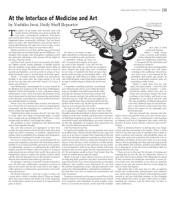
ILLUSTRATION BY
EMILIE FARRUGIA