

The Michigan Daily — michigandaily.com
News
Tuesday, November 1, 2016 — 3
homophobia,” Schlissel said. “I
think that faculty have a big role
to play in helping our students.”
Schlissel
also
noted
that
throughout
his
interactions
with various groups on campus
about the incident, students have
expressed disappointment that
many professors did not bring up
the incidents in their classrooms
to discuss.
“It was on the forefront of the
minds of a lot of our students,
almost in a way that distracted
from learning,” Schlissel said.
In the discussion that ensued,
Schlissel and many committee
members
talked
about
increasing faculty interaction
with the Center for Research on
Learning and Teaching, a center
dedicated to improving teaching
responses to events that impact
campus climate, by having the
center facilitate trainings on
having
difficult
discussions
in classrooms and phasing in
training for faculty new to
campus.
SACUA
member
Robert
Ortega, a professor of mechanical
engineering
and
naval
architecture and engineering,
suggested extensive resources
should be made available to
faculty.
“I think some of the students
have difficulty with the kind
of language to engage in these
conversations; some don’t even
have the words,” Ortega said.
“Our approach really has been
one of humility and that is, even
the instructors don’t have the
answers — we certainly can aim
the discussion, but it has to be
done with great care.”
Though
Schlissel
acknowledged
that
making
the use of CRLT resources
mandatory for faculty members
might
receive
an
adverse
response, he said he hoped
faculty would want to use
resources the community had
deemed important.
“Mandatory
scares
people,
but
if
it’s
something
that
really touches our values as
a community, I don’t think
mandatory should be threatening
... but something that we as a
community agree is important
enough
to
make
mandatory
ourselves,” Schlissel said.
In response to the concerns of
member of SACUA regarding the
DEI plan, Schlissel stressed that
a quota system is not part of the
University’s strategies.
“There is no quota system,”
Schlissel said. “There are no
quantitative targets as part of
the plan.”
Specific racial quotas
are
illegal
in
college
admission
policies, after the Supreme Court
ruled setting aside specific seats
for minorities went too far in
diversifying schools in 1978. The
Supreme Court has since upheld
a Michigan proposal banning
race-based affirmative action of
any kind in 2014.
The University stopped using
affirmative action in 2006, when
voters approved the statewide
ban,
and
Black
enrollment
slipped from around 10 percent
at the time to under 5 percent
today.
In
addition
to
discussing
the posters and the DEI plan,
Schlissel and members of the
committee
also
discussed
improvements in financial aid,
an issue heavily emphasized in
the upcoming University Board
of Regents’ elections, especially
as tuition prices continue to
increase each year.
“We’ve increased our shared
investment and financial aid
has gone up over 10 percent
per year,” Schlissel said. “The
quality and the depth and the
size of our pool is fantastic. What
we really have to do is work hard
on socioeconomic diversity and
all the other points of diversity.”
Ortega
echoed
Schlissel’s
remarks and stressed outreach
as a crucial factor in changing
the way financial aid is allocated.
“When we talk about the
Michigan difference, that’s part
of the difference,” Ortega said.
“The other one is what they get
while they’re here as part of the
difference and what happens
after.”
SACUA
From Page 1
students, faculty and alumni
were in attendance.
Wallace, who grew up in East
English Village on Detroit’s
east side, said in an interview
after the event that he believed
O’Cleireacain
painted
lower-
income
citizens
of
Detroit
as
projects
for
research,
something he found particularly
demoralizing as a resident.
“I found that referring to
Detroit as a laboratory for public
policy experiments (was) very
offensive because you’re dealing
with people’s real lives,” Wallace
said. “I am very fortunate to
come out of my neighborhood
and go to one of the best schools
in the world, but I had a lot of
opportunities that some people
don’t have and to refer to
their lives and their futures as
experiments … is a very slippery
slope. It causes you to view
the city and the people in it as
something less than human.”
When asked about Wallace’s
question
after
the
lecture,
O’Cleireacain
declined
to
comment.
O’Cleireacain devoted most of
the lecture to the city of Detroit’s
financial strategy. Detroit filed
for Chapter 9 bankruptcy in July
2013, making Detroit the largest
municipality to file for said
chapter of bankruptcy in U.S.
history, slashing approximately
$18 billion in debt. In October
2014,
Detroit
Mayor
Mike
Duggan confirmed New Yorker
O’Cleireacain as the deputy
mayor
for
economic
policy,
planning and strategy.
At the lecture, O’Cleireacain
assured audience members that
Detroit’s economic operations
will not be returning to the state
of the city was in before the
bankruptcy.
“There are strict recording,
budgeting
and
oversight
standards
that
have
been
written both into state law and
into the bankruptcies … that
are governing Detroit’s fiscal
reality and behavior for the
next 40 years and very strictly
until 2024,” she said. “Virtually
nothing
about
Detroit’s
financing and budgeting will be
the same as before and, folks,
that’s a really good outcome.”
Along with these guidelines,
O’Cleireacain discussed what
Detroit
offers
to
University
students. Describing the city
as a “hollowed field,” she said
students at the University will
have the chance to implement
new public policy technology
in
a
city
without
common
infrastructural systems, such as
a stable school system.
“LED street lighting, mobile
health units, smartphone-based
on-street parking meters, and
Internet bus arrival times have
been implemented in the last
two years and that’s just the tip
of the iceberg,” O’Cleireacain
said.
During the Q and A, Wallace
said the litany of infrastructural
reforms O’Cleireacain listed in
her speech are not reflected in
his experiences in Detroit.
“My street had one light
on it,” Wallace said. “There’s
abandoned
buildings
everywhere, there’s tall grass
everywhere. Streets are filled
with
litter.
This
cleanup
isn’t happening … You don’t
see the improvement in the
neighborhoods and with the
people.”
O’Cleireacain emphasized
that economic recovery will not
occur without the inclusion of all
Detroit citizens in the process.
“While
Downtown
and
Midtown are well on their way
to recovery, the recovery has to
include the Detroiters who live
in neighborhoods largely left
untouched by Downtown and
Midtown,” O’Cleireacain said.
Wallace was approached by
several students and faculty
members
after
the
event,
thanking him for his question
and comments and asking to
speak with him in the future
about public policy projects
in Detroit. Among those who
sought out Wallace was Tom
Ivacko,
administrator
and
program director of CLOSUP,
who said he believed some of
O’Cleireacain’s
remarks
may
have
been
misinterpreted.
However, he said Wallace was
correct
in
questioning
how
policies impact people.
“(In regard to her public
policy laboratory comment), I
interpreted Dr. O’Cleireacain’s
statement in light of the famous
phrase
by
Louis
Brandeis:
The states are ‘laboratories of
democracy,’ ” Ivacko said. “It’s
easy to think about policies on a
theoretical level but they impact
people’s lives directly and so
there’s numerous roles for the
University to be engaged at the
policy level in neighborhoods
dealing with people and dealing
with
organizations.
Being
engaged is the key.”
DETROIT
From Page 1
and brought people together.”
Victor said once she realized
she was passionate about in
political
activism
and
the
diversity and welfare of Detroit,
she decided to open a bakery
in 1997 in the Cass Corridor of
Detroit, using a lot of the same
equipment from Wildflour after
they decided to shut down.
“It was a cool handoff,” she
said. “We even use some of their
recipes, like their date bars. So
in some ways my roots are from
Ann Arbor.”
Noting
a
relatively
new
bakehouse her company owns
downtown, Victor said Avalon
has increased their production
over the last few years, enabling
them to be able to open up shop
so close to campus.
“So we decided to just go for
it,” Victor said. “There’s always
been a demand for our product
in Ann Arbor. Space became
available
—
that’s
a
great
location.”
Helping to make the Ann
Arbor space a reality is Chef
Maggie Long, who founded
the Jolly Pumpkin’s Detroit
location and will make their
menu. Victor noted in particular
that Long works closely with
local farmers, which she said
is in line with Avalon’s social
mission of using locally grown
products.
“She’s an amazing chef and
has a wonderful relationship
with local farmers,” Victor said.
In addition to the breakfast,
lunch and dinner menus, the cafe
will sell coffee, baked goods and
all of Avalon’s breads. Almost
everything, except some baked
goods, will be shipped directly
from the Detroit warehouse.
Additionally, will sell a full line
of sweets and dessert goods —
such as the vegan blueberry
muffin, scones, brioche, granola
bars and breakfast sandwiches.
The cafe will also serve beer
and wine, including some from
Jolly Pumpkin on Main Street.
Victor said the cafe will have
an easy and simple breakfast
menu during the weekdays, but
a more extensive brunch menu
on the weekends.
“Our cafe will be featuring
more meals, some highlighting
our
breads
and
others
highlighting the ingredients we
will be using from local farms
and other vendors,” Victor said.
“The cafe will be what I call
an
ingredient-driven
menu,
so it’s going to be driven by
what’s seasonal, local, fresh and
delicious.”
Given this new location is the
first outside of Detroit, Victor
said it will be a learning process
for the bakery, relying mostly on
customer feedback.
“I think how we’ve always
evolved as a company is in
response to our customers,”
Victor said. “That’s what we’ll
be doing in Ann Arbor as well.”
“We even use
some of their
recipes, like
their date bars.”
BAKERY
From Page 1
spark discussion of the greater
political discourse, particularly
amid the upcoming presidential
election.
“I feel that liberals have
failed standing for liberal ideas,”
Carlos said. “They have failed to
be as critical of communities of
faith that have attached to them
communities like ISIS or people
that are radicalized — who have
ideas — that are not compatible
with liberal values.”
A student who wished to
remain anonymous said he called
the police upon seeing the man
for the second time since Sunday
night.
“He was walking past the Math
building through the Diag,” the
student said. “He was walking
with the flag … There’s a problem
with, I think, in particular, the
fake firearm, because that’s not
legal.”
Police came to the scene, spoke
to Carlos and patted him down.
Carlos said police asked him to
leave both Sunday and Monday
night.
“Apparently
this
guy
is
just
against
how
liberal
media portrays such an open
environment
and
something
about how they neglect the more
oppressive culture of Muslims,”
Carlos said.
DPSS
spokeswoman
Diane
Brown told The Michigan Daily
Monday night that the man is not
committing
any
determinable
crime due to his right to free
speech.
Following his encounter with
the police, which he filmed on his
iPhone, Carlos spoke to a number
of students gathered around him
to explain his ideology. Among
the students was one military-
affiliated male who felt especially
offended and a female student
who said she didn’t know how she
felt about it.
LSA senior Nicole Khamis,
who witnessed the event, said as
a Palestinian she felt offended by
the man’s actions, adding that it
perpetuated a dominant rhetoric
around Islam being violent.
“He’s perpetrating this by, first
off, he’s dressing up as Muslim
or somebody who believes in
Islam, continuing furthering that
stereotype that Islam is a violent
religion,” Khamis said. “When if
you look at ISIS and you look at
the text they use, it’s very specific
and
it’s
cherry-picking
and
anybody who’s actually Muslim
and believes in the Quran you can
see that they disagree vehemently
with ISIS and their use and
contextualization of this.”
Carlos said he found much of
what students told the Daily in
response to the Sunday incident
untrue, though he did not mention
any specific claims. Students
said they felt offended by Carlos’
actions.
“I want to get rid of political
correctness that keeps us afraid
of having a real honest debate
about this, and that’s why I did
this,” Carlos said. “I knew that it
would be offensive and I guess I
feel that there’s costs and benefits.
The cost being that it is offensive,
but the benefit is that we get
attention, we get a conversation
going here about what’s going on.”
He added that he expected a
backlash from students; however,
he said he doesn’t oppose that
if the people are doing it in
opposition to radical Islam.
“I’m not here to make people
mad,” Carlos said. “I want to have
a clear critique of ideas, and I want
there to be space in our public
discourse for that critique of all
systems of belief … I’m not saying
that what I’m doing is ‘working’ —
it doesn’t have to ‘work.’ ”
ISIS
From Page 1
text messages, and these public
displays as well.”
In addition to local efforts,
Clinton’s
campaign
has
nationally been working to
appeal to the youth vote in
addition to encouraging people
to participate on Election Day.
Clinton’s
daughter,
Chelsea
Clinton, hosted a conference
call
with
students
around
the
country
in
September
reminding
them
of
the
importance
of
millennial
participation in the election.
Young people historically
have low voter turnouts and the
current millennial generation
is no exception. While there
has been a gradual increase
over the years, the numbers of
young voters still remains low.
Less than 20 percent of people
under 30 voted in the 2014
midterm elections — the lowest
youth turnout rate in recorded
federal election history.
During the primaries, Sen.
Bernie Sanders’ (I–Vt.) support
from college students helped
him up-set Clinton and win the
state of Michigan. Following
Sanders’s
strong
presence
on the University’s campus,
he returned to campaign for
Clinton for the general election
in attempt to persuade college
students to vote for Clinton.
Despite students’ support of
Sanders in the primary, LSA
junior Jay Dutcher, campus
outreach chair of Students
for Hillary at the University,
said he believes Clinton is the
best candidate not just for the
nation, but also for college
students.
“Hillary
believes
in
the
American Dream and believes
that America is already great
and believes in the future
for kids our age and human
rights,” Dutcher said. “She
thinks all kids should have
equal opportunity with their
education and future.”
HILLARY
From Page 1
MAZIE HYAMS/Daily
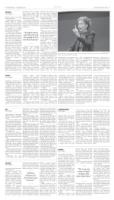
Carol O’Cleireacain, deputy mayor for economic policy, planning & strategy for the city of Detroit speaks at an event on
Detroit’s fiscal issues at Weill Hall on Monday.
“It causes you to
view the city and
the people in it as
less than human.”
“Hillary
believes in
the American
Dream.”
opposing Smith, said Smith’s
conduct had been disingenuous,
though he noted his opponent
was likely to win.
“He
had
the
luxury
of
turning his back on the people
he’s supposed to represent for
a couple months, forcing the
rest of the board to appoint an
interim successor, knowing that
he’ll get re-elected in November
because
of
straight-ticket
voting,” Hayner said.
In
an
interview,
Eyer
was hesitant to discuss her
opponent’s conduct, focusing on
her platform to improve access
to public services and combat
inequality in the county.
“I can’t pretend what was
in Conan’s head,” Eyer said.
“I don’t know at what point
he made decisions or what the
timeline was. I feel like it’s not
my place to second-guess those
decisions. I will say the net
result was a confusing situation
for everybody involved but I can
only focus on my campaign and
what my standards and conduct
will be.”
She
acknowledged
the
difficulty write-in candidates
face in being elected due to
greater
straight-ticket
voting
in presidential election years.
However,
she
emphasized
that she is running a “robust
campaign,” and has raised $1,500
for her campaign as of Oct. 24,
according
to
state
financial
disclosure forms.
Ann
Arbor
resident
Judy
Foy, who said she has largely
agreed with Smith’s agenda as
commissioner, noted that his
handling of the OCED issue
disappointed
her.
Foy
also
expressed disappointment about
a lack of awareness on the issue.
“I understand even when you
have great intentions but are
still not aware how the process
should move, you can lose a great
deal of credibility,” Foy said. “It’s
kind of sad how many people
don’t know about this situation,
he’ll just be the name on the
ballot.”
Vivienne Armentrout — a
local blogger and former county
commissioner
who
defeated
Smith in the 2002 Democratic
primary — declined to discuss
whether she believed Smith’s
behavior
has
been
ethical.
However,
she
was
more
optimistic that Smith’s write-in
opponents could win, saying she
planned to write in Eyer on the
ballot.
COMMISSIONER
From Page 2