

for so long and that the rent
is getting raised on them but
that’s sort of the unfortunate
downfall of being a small busi-
ness,” she said.
Bathish said in his experi-
ence, many students aren’t
necessarily interested in sit-
ting and eating when they go to
Amer’s.
“A lot of the students are on
the go anyway so the reduced
seating won’t affect them,”
Bathish said.
LSA senior Stephanie Choi,
echoed Schuman’s sentiments.
“It definitely got smaller, a
bit more crowded; it’s a differ-
ent experience from usual.”
Choi added she hopes small
business
like
Amer’s
stick
around.
“They’re very unique and
Ann Arbor-esque,” she said.
Bathish said he wanted to
assure students nothing was
cut from the menu, and the
quality of the food will remain
the same. He said he’s confi-
dent that these renovations
won’t affect business.
“My formula has always been
the same: same quality of food,
same
distributors,”
Bathish
said. “As long as the overhead
stays the same, I plan on being
here for another 28 years.”
Chief Information
Officer announces
retirement
Laura Patterson, the University’s
chief information officer and
associate vice president for
Information and Technology
Services, announced her retirement
Thursday after 23 years of working
at the University.
In an e-mail to Information
and Technology Services staff
members, Patterson wrote, “As
we complete the implementation
of NextGen Michigan and work
begins in earnest on the goals and
initiatives outlined in the new IT
strategic plan, I believe it is the
perfect time to pass the torch to a
new leader.”
Patterson’s role consists
of overseeing the leverage of
information technology across the
University’s three campuses and
health system. Though Patterson
will not officially step down
until tihis summer, she will work
with University President Mark
Schlissel in the meantime to recruit
the next CIO.
Cit y of Detroit
investigates DPS
buildings
Detroit mayor Mike Duggan
(D) announced safety inspections
of all Detroit Public Schools
buildings Wednesday evening
in response to complaints from
teachers and parents about the
poor state of safety in schools, the
Detroit Free Press reported.
Many teachers took part
in “sickout” protests staged
earlier this week
during which
mass teacher absences forced
some schools close for three
days. Duggan promised both
legislative reform and concrete
solutions to reportedly hazardous
conditions in DPS buildings such
as extremely cold buildings, mold
and rampant mice.
Legislation introduced
Thursday by Gov. Rick Snyder
upset many state Democrats who
called the plan unsatisfactory.
The bill proposed a nine-person
interim school board charged
and hiring a superintendent until
a new school board is elected
next November.
“It doesn’t go far enough to
address our concerns,” State Rep.
Brian Banks (D–Detroit) told the
Detroit Free Press. “This is just
going to be another form of an
emergency manager.”
Jesse Jackson
expected to attend
Flint water rally
Rev. Jesse Jackson Sr. will
attend a rally over the Flint water
crisis taking place this Sunday
at Heavenly Host Church in
Flint, MLive reported. Jackson
has previously condemned the
state’s handling of the crisis in
an opinion piece published in the
Chicago Sun-Times earlier this
month, writing that Gov. Rick
Snyder considers Flint residents
“disposable.”
A recent spike in Legionnaires’
disesase in Flint sparked
national outrage and calls
from public figures, including
Michael Moore, Erin Brokovich
and Tim Gremiel, state House
Democratic leader, who are
calling for Snyder’s resignation if
he knowingly participated in the
contamination.
Ithaca College
president steps
down after protests
Tom Rochon, president of
Ithaca College, announced his
resignation Thursday. Ithaca was
among the campuses rocked by
racially charged protests this
winter, and according to NPR,
faculty and staff expressed in a
vote they had no confidence in
Rochon’s ability to effectively
manage racial dialogues on
campus and respond to students
of color.
Rochon hired a chief diversity
officer, but students continued to
criticze him for failing to foster
relations with Black students.
Rochon’s resignation will be
effective next July.
— RIYAH BASHA
NEWS BRIEFS
The Michigan Daily — michigandaily.com
News
Friday, January 15, 2016 — 3
AMER’S
From Page 1
who identify as having non-
white skin, this area of study
holds a particular importance.
“I think it’s a very interest-
ing area,” he said. “Being a for-
mer U-M faculty professor, it’s
an area we don’t often empha-
size among the residents and in
other training areas. It doesn’t
get the resources that it should
and if you look at the demo-
graphics of this country, we
certainly need to be spending
more time understanding skin
of color.”
According to December 2012
U.S. Census Bureau statistics,
by the year 2060, approxi-
mately 57 percent of the popu-
lation will describe itself as one
the non-white ethnic groups.
Already, there is a majority of
people globally who have dark-
ly pigmented skin.
Among the most common
reasons for people with skin
of color to see a dermatolo-
gist are dyschromias, which
are disturbances in pigmenta-
tion. Dr. Alexis said how dark-
er pigmentations might make
a person more susceptible to
conditions like hyperpigmen-
tation, keloids, alopecia, lupus
and many others. However, he
also noted that increased levels
of melanin among these indi-
viduals, responsible for deter-
mining skin and hair colour, in
these people actually serve as
protection against photoaging,
skin damage done by UV rays,
and skin cancer in some cases
because they provide a natural
UV shield.
LSA freshman Ari Spellman,
a member of the Undergradu-
ate Research Opportunity Pro-
gram, attended the event in
hopes of learning more about
dermatology.
“I have really little experi-
ence with medicine,” Spellman
said. “I thought it was very
interesting to hear the basics
of dermatology and about the
differences in dermatological
issues between skin of color
and skin of lighter pigmenta-
tion.”
These differences between
ski of color and skin of lighter
pignentation can also be ampli-
fied by cultural variances in
skin care, grooming, percep-
tions of beauty and alternative
medicine practices, according
to Alexis. He highlighted dif-
fering treatment methods that
are used to combat various
skin ailments as examples of
this, each of which possess the
potential to benefit a patient
though some risks and side
effects could also exist.
Alexis said his mother is his
inspiration to study dermatol-
ogy and the nuances of treat-
ment based on skin color.
“My mother was probably
the first Black dermatologist
in Toronto,” Alexis said. “I
was inspired by a number of
prominent African American
physicians who I had the good
fortune to meet.”
featured speakers from civil
rights activist Cesar Chavez
to last year’s lecturer Marc
Lamont Hill, a prominent
activist and journalist. This
year, Naomi Tutu will take
the stage to speak about her
experiences as a race, gen-
der justice and human rights
activist. Tutu, the daugh-
ter of South African activist
Bishop Desmond Tutu, has
dedicated much of her work to
cultivating inclusion and rais-
ing awareness about gender-
based violence.
OAMI will live streamed
the memorial lecture publicly
for the first time this year. A
number of watch parties are
being hosted both by student
groups on campus and by
alumni as far away as Cincin-
nati and Washington, D.C.
Helaire said it was important
to the planning committee to
open up access to members
of the Michigan community
both on and off campus.
“We have a large alumni
body and we want to be able
to reach them with the same
message,” he said. “As much
as we celebrate the social jus-
tice legacy with the keynote,
much of what’s talked about
here on campus is happening
right now. Wherever you are,
we want you to think about
how to dialogue, network and
act.”
The symposium’s website
offers a downloadable watch
party toolkit consisting of
logistical tips and ideas for
discussions after the lecture.
Engineering senior Saumya
Khurana, community service
chair for Delta Theta Psi and
organizer of a watch party
tye sorority is hosting in the
Union, said the livestream
enables
more
students
to
watch the lecture in a familiar
setting.
“I think it’s a great idea to
watch the speech and have
a space afterwards to talk
about it,” she said. “I think it’s
important to watch as a com-
munity because there’s a lot of
issues going on currently that
the symposium addresses.”
In addition to lectures and
panels, the symposium’s pro-
gram also features multiple
performances and other cre-
ative homages to both Mar-
tin Luther King Jr. and the
broader topic of social justice.
Young Jean Lee, a Brooklyn-
based
experimental
play-
wright, is putting on a handful
of her plays in addition to a
public interview as a part of
the School of Art and Design’s
Penny Stamps Speaker Series.
The Michigan Theater is also
screening “CHI-RAQ,” Spike
Lee’s film about race in Chica-
go, and the Burton Memorial
Tower bells will even chime
famous works by African-
American composers.
Gena Flynn, director of
inclusion at the School of
Music, Theater and Dance
and coordinator of a showcase
Sunday, held by SMTD and
featuring famed saxophonist
James McBride, emphasized
the importance of including
creative expression in the
symposium.
“What’s new is that we’re
bringing in an outside guest
and performer really to add
an opportunity to reflect on
how music has been used in
storytelling, and in particular,
how (social justice) issues and
history can be shown through
music and through the arts,”
she said.
The symposium’s program
runs from its start this week
through February, but Helaire
said he is determined to make
its impact last throughout the
year.
“What I’m trying to move
us towards is asking how can
we make this not just some-
thing that happens in January,
but using it as a springboard
to address issues our com-
munity has,” he said. “That’s
where the planning commit-
tee comes in, which is made
up of various units around
campus. There are people in
these units doing work related
to social justice issues, and
we want to look at how this
committee can support those
issues more intentionally.”
SYMPOSIUM
From Page 2
underrepresented individuals,
but then are not taking time
to understand what are their
plights.”
The panelists also sought
solutions to strengthen minor-
ity voices in the United States.
Taylor stressed the impor-
tance of voter turnout at every
election, pointing to the 2010
Republican takeover of the
state legislature. He fervently
suggested
that
Americans
work to bring people of color
back to the voting booths in
order to elect candidates who
will bring minority desires to
fruition.
“Voting is both a means for
empowerment and an expres-
sion of empowerment,” Taylor
said. “To the extent that these
groups feel and experience a
lack of power within society, I
think that relates to a lack of
confidence in the efficacy of
the political system. We have
to work on all fronts to fully
and completely bring these
groups into society in a mean-
ingful way.”
Panelists, such as Rack-
ham Ph.D. candidate Austin
McCoy, also spent chunks of
time discussing voter disen-
franchisement. Each speaker
touched on voter ID laws and
closed
registration
booths.
Public Policy junior Swathi
Shanmugasundaram,
CSG
representative and panelist,
spoke about modern voter sup-
pression tactics.
“Because
of
gerryman-
dering and redlining, we are
putting all these minority
populations into such a small,
densely populated area under
the guides that they will be
represented, but they get a
very small proportion of the
larger scale of representa-
tives,”
Shanmugasundaram
said. “It just doesn’t work out.”
When asked who each pan-
elist believes the next presi-
dent will be, all but Mayor
Taylor, who answered “Hill-
ary,” pointed to Bernie Sand-
ers or skirted the question.
Regardless
of
candidate
choice, each panelist pushed
for students and young people
to put pressure on all candi-
dates to see and act on the
fact that, as Prof. Country-
man stated, “this is no longer
a white nation.”
LSA
sophomore
Shavon
Edwards, who attended the
event, said she enjoyed the
discussion.
“I’m happy with the conver-
sation,” Edwards said. “I think
it is really important that stu-
dents get a viewpoint from
the mayor. I really think that
the points the panelists talked
about are important for stu-
dents to hear.”
Symposium events in honor
of Martin Luther King Jr. will
continue throughout January.
PANEL
From Page 1
depending on which proposal
is ultimately chosen.
According to Jennifer Hall,
executive director of the Ann
Arbor Housing Commission,
the trust fund plays a vital
role in funding affordable
housing initiatives in the city.
“The primary sources of
revenue for the fund are gen-
eral fund contributions from
City Council — sales proceeds
from the sale of city property
and private developer contri-
butions,” she said.
Hall added that the devel-
opment of this lot is impor-
tant for the development of
further projects in affordable
housing in the city, noting
that the AAHC is in the mid-
dle of redeveloping all 18 pub-
lic housing sites in the city,
which include 355 apartments
for affordable housing. $60
million is needed to complete
this project.
Ackerman agreed, saying
that a healthy trust fund is
needed in order for action to
be taken in this area. He said
other than the contribution
from the Library lot, there are
no other clear funding mech-
anisms.
LIBRARY
From Page 2
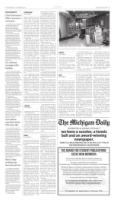
MATT VAILLIENCOURT/Daily
Amer’s Mediterranean Deli on State Street is under construction to downsize due to rising rental costs.
SKIN
From Page 1
INTERESTED IN JOINING THE DAILY?
we have a scooter, a tennis
ball and an award-winning
newspaper.
COME TO A MASS MEETING JAN. 19 OR JAN. 21 AT 7 P.M. IN
OUR NEWSROOM AT 420 MAYNARD