

Wednesday, November 25, 2015 // The Statement
7B
I
walked into the second floor study room
of the School of Education ready to do
some research for a final paper I was
writing; I had put myself in just the right
mindset to sit down and finish a good por-
tion of work. Surveying the area, I found the
seat of my choice: a table to myself tucked
away in the far corner, facing the tall, leaded
windows that reached all the way to the high
ceilings, allowing the crisp evening light of
spring to shower me as I eagerly delved into
primary sources. My thoughts were like
a jagged slab of marble, hard, strong and
heavy, waiting to be chiseled into a softly
nuanced sculpture.
I settled into my spot and breathed it all
in. I brought out my computer and opened
Facebook.
The magic was gone. I realized this about
five minutes into empty-heartedly scroll-
ing through my news feed; each post I saw
acted not as the careful tap of a chisel but
as a hammer’s blow. My thoughts were tiny
pebbles chaotically, helplessly scattered on
the floor.
I had had enough. For a while I had fanta-
sized about deleting my Facebook, which my
best friend from back home, Madi, bravely
had done during our junior year of high
school.
“I felt like it was taking over my life,” she
told me when I e-mailed her about writing
this article. “I felt addicted to checking it at
least every hour.” It hit me then, also, that I
spent at least five minutes on social media
every time I sit down at my computer. That’s
over an hour every week and almost forty
hours over a school year spent mindlessly
scrolling through my news feed — forty
hours of what I saw then as wasted time I
could have spent on schoolwork or simply
daydreaming.
What’s more is that the moments within
those forty hours usually made me feel pret-
ty horrible. I became extremely pessimistic:
posts from high school friends claiming to
have found their “people,” posts from my
friends at Michigan who seemed to have
found better, cooler lives than I had, and any
other posts you could think of seemed to me
like purposeful attempts by others to shove
their apparent happiness in my face — me,
who was struggling through freshman year,
trying to push my way through the massive
undergraduate population in an effort to
find my niche. What was wrong with me?
Why couldn’t I find the perfect group of
friends who understood me completely, who
went with me to the perfect party with other
perfect people whose portraits complement-
ed my perfect social media profile?
It’s exhausting to relive those thoughts
as I write them, and I’m sure they’re just
as exhausting to read. They were certainly
exhausting to experience; I realized during
that moment in the School of Education how
unnecessary it was to put myself through
that. Facebook seemed to be the place where
all of my anxieties manifested themselves,
and so the only solution for me seemed to be
to get rid of it.
I closed my computer screen and called
my mom, with whom I’ve had countless con-
versations about the advantages and disad-
vantages of living in an age of such constant
connectivity. I gave her a heads up that I was
going to delete my profile — not deactivate,
delete. As in, it would be gone forever.
So I did it. The deed was done. Five years
of carefully curated photos, pages I’ve liked
and groups I’ve joined gone forever, wiped
from the record. I felt all at once liberated
and breathless, like that feeling of getting a
haircut and seeing too-long swaths of your
hair lying on the ground, so impossibly
detached from your head. Just like that, my
Facebook, the most stylish accessory to my
life, the force that legitimized my social rel-
evance was gone, impossibly detached like
chopped locks of hair. Later Madi would tell
me her experience was a similar one, that
the decision to delete her Facebook was a
sudden realization of what was right for her,
and the emotion that immediately followed
reflected this — it was one of arresting relief.
“Deleting it wasn’t going to be the end of
the world,” Madi told me. “Life would go on.
And that was very empowering.” She’s right
— not having a Facebook wasn’t a big deal as
the excitement of life in Ann Arbor fizzled
with everyone engulfed in final coursework.
I had already made most of the friends I
would that year, so Facebook wasn’t as rel-
evant to me then as it had been in the begin-
ning of freshman year.
It lacked importance in a similar way
when I returned home to my old summer
job for the summer, as I already knew most
of my coworkers. Though I was working full
time, most of my friends from home were
gone for long periods of time, either on vaca-
tion or doing some kind of internship or
study program. I had a lot of time to myself,
which I filled by reading, journaling and
exploring Columbus with our family’s old
film camera. Not having Facebook was such
a deliberate action that it influenced the
way I saw my time. By purposefully omit-
ting from my life something that wasted so
much time, I began to see each moment not
as disposable but as a blank space character-
ized by myriad possibilities: did I want to
fill it with wonder? Perplexity? Frustration?
Vivacity? Serenity?
Despite
good-hearted
coaxing
from
coworkers to make a Facebook again, I fin-
ished the summer glad that I had stuck to my
instincts and not submitted to external pres-
sures. Being Facebook-less allowed me to
appreciate those moments in transition that
we usually fill with social media blather. And
even if I was “on my phone” for a moment, it
would be reading an article on my news app
or finding an obscure Instagram account
(my admitted social media kryptonite).
It wasn’t until I settled back into univer-
sity life that I began to question my choice.
I’m living in a single this semester and I’ve
found I’ve had to be very deliberate about my
social life. For this and other reasons, it just
seemed like having a Facebook made sense.
It would be practical.
One night I was feeling a similar impul-
sivity to what I felt that fateful evening in
the School of Education. So far my new pro-
file tells me I have 262 friends.
Personal Statement:
Crushing Facebook
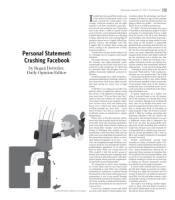
ILLUSTRATION BY CHERYLL VICTUELLES
by Regan Detwiler,
Daily Opinion Editor