

Wednesday, October 28, 2015 // The Statement
7B
Lessons in uncertainty
by Ian Dillingham, Magazine Editor
I
am going to Hell, they tell me. Jokingly, with a twinge
of superiority, friends and neighbors chuckle at the
thought of my eternal demise. But their words never
bother me. If there be a Hell, I doubt they decide who pass-
es through the fiery gates.
Oh God, if there be a God, save my soul if I have a soul.
***
Growing up, my community was predominantly Roman
Catholic. My grandparents on my mom’s side, who lived
with us for most of my early childhood, were devout
observers of the faith, and that devotion was passed down
to my mom. My dad, an atheist, lost the popular vote in
our household, so I attended private Catholic schools from
kindergarten to the end of high school. Because I feared
social repercussions for disobeying teachers and parents, I
partook in the various religious rites of passage prescribed
to children in this school system: Baptism, First Reconcili-
ation, and First Communion. But religion was never some-
thing I believed in; it was just something I did. I considered
the practice on a similar level with doing homework —
annoying, yet unavoidable.
My grade school — kindergarten through eighth grade —
was small. Each grade level was composed of about twenty
students who, for the most part, stayed together for the
first nine years of their education. Religion was promi-
nently featured in the curriculum, with at least one class
per day devoted to studying the Catholic Church, at least
one religious ceremony or tradition marking the schedule
each week, and at least one (torturous) hour spent in Mass
each Sunday.
Otherwise, religion was a non-factor in my life. My
friends and I played violent video games like all the other
kids. We went to the beach and the movies. We played
sports (albeit only against other Catholic schools) and
competed in academic competitions. And, other than those
couple hours per week in class, religion was never part of
the discussion.
Things changed when I got to high school. I moved from
a class of twenty to a class of almost 500. (It was, in fact,
the largest co-ed Catholic high school in the western Unit-
ed States.) And religion changed from something you did
to something that defined you. My friends were no longer
shy in discussing religion or the Church — a product of the
groupthink mentality that emerges in large, homogenous
populations. More often than not, I found myself on the
wrong side of arguments about matters of biblical teaching:
Did God really flood the entire planet and only save Noah?
Did Abraham really die at the age of 175? Did Jesus literally
rise from the dead after three days?
But the debate stemmed from something more than
logical fallacies. I also found myself on the “wrong” side of
arguments about matters of faith and spirituality. I came to
realize that many of my friends — the ones who had rarely
mentioned faith in the years I had known them — were
much further down their path of spiritual development
than they had led me to believe. No longer was I one of the
crowd; rather, I was the one standing against the crowd.
The pain of being treated like an outsider in my own com-
munity wore on me until it no longer felt like my commu-
nity.
One Sunday afternoon, after a particularly grueling ser-
mon on the importance of all-encompassing devotion to
the Church and its teachings, I finally told my mom that
I wasn’t interested in going to Mass anymore. I officially
removed myself from the Church, unsure if I might ever
find my way back.
***
My high school, like my grade school, required students
to attend regular religious classes. The mandated ninth-
grade curriculum was “Catholic Life Choices.” Our teacher
— a 30-something, unmarried layperson — was tasked with
teaching a roomful of walking hormones not to have sex
or think about sex or even say the word “sex.” She stood 5
feet tall, wore floor-length dresses and black-framed glass-
es, and alternated between quiet murmuring and bouts of
screaming. On the best days, the class consisted of chitchat
and busywork; on the worst days, it involved forced procla-
mations of faith and allegiance to the Church.
During a discussion about spirits one day during the
middle of the semester, a member of our class asks the
teacher about Ouija boards, mystical playtoys marketed as
a means to contact the dead. (Despite such ominous claims,
they are primarily used by preteens to entertain their
friends at sleepovers.)
“Are they really possessed by the devil?” the young boy
asks.
His tone suggests he really just intends to rile the teach-
er and to create a classroom ruckus. The teacher, however,
calmly addresses the class and says that, in fact, the spirit of
the Devil can possess such toys. As a preventative measure,
she suggests that anyone who owns one should bring it to a
priest to have it exorcised, and she insists that students not
throw such an item away (lest some residual demons be left
behind in the garbage can, I suppose).
My ninth-grade self feels nauseated that a paid educa-
tor can suggest to a classroom full of students that a $13.16
piece of cardboard and plastic manufactured by Hasbro is a
threat to their safety. Can the makers of Jenga really bring
Satan into my home?
The next day, I visit the room at lunch to probe the issue
further.
“Do you really believe a toy could be possessed by the
devil?” I ask, hoping to reveal some major miscommuni-
cation from class the day prior. Despite my disagreement
with large portions of the Church’s doctrine, I feel com-
pelled to at least attempt to understand how such beliefs
arise. Typically, I find the resulting conversations illumi-
nating, and, even though they rarely change opinions, such
open dialogue is helping me establish my personal creed.
“Well, let me put it this way,” she replies. “Do you believe
in angels?”
“No,” I reply.
I don’t mean for the answer to come out so bluntly, but
I can immediately tell she is taken aback. I’m momentarily
embarrassed, but hardly surprised. Teachers at my school
are rarely prepared to deal with students who openly ques-
tion the Catholic doctrine, which I have now done by elimi-
nating angels from my worldview.
“Oh, you couldn’t possibly understand what I’m talking
about then,” she says. “It’s a matter of faith.”
***
For many years now, I have considered myself a religious
agnostic. I acknowledge that humans have a limited capac-
ity to understand certain aspects of their universe and that,
try as they might, they cannot obtain absolute or ultimate
knowledge in any given subject.
Back when my mother still dragged my brother and me
out of bed for Sunday morning Mass, I was told what to
wear, what to say, and what to do. The process was repeti-
tive and often brainless. Never was I allowed, as I had
wished on so many occasions, to raise my hand during a
homily and to ask the priest to explain further. At first, the
lack of independent thought was a nuisance. But as I grew
older, unanswered questions burned inside me. Every time
I got close enough to someone with “sacred” knowledge,
the questions only became more intense and troubling.
Since coming to college, I have felt more at ease about
my lack of religious affiliation. Studies have shown that
about one-third of college students consider themselves
secular, compared with about 6 percent among the general
population. Very few of my friends identify with a religion,
and those who do often discuss questions of faith openly
with me if asked. I’ve felt that college promotes a certain
amount of agnosticism in everyone. Classes in biology and
chemistry don’t just teach students the nature of science
but, rather, how to ask the right questions.
I may find faith again one day — faith either in the Cath-
olic Church or in one of the other major or minor religions
practiced. If agnosticism asks individuals to acknowledge
uncertainty in life, then I must recognize the possibility
that religion can be the right path for me. But I will never
give up my ability to question. To question is to learn, to
grow and to believe.
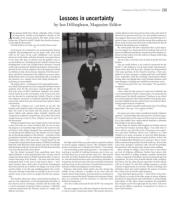
PHOTO COURTESY OF IAN DILLINGHAM