

Wednesday, October 21, 2015 // The Statement
4C
Wednesday, October 21, 2015 // The Statement
5C
I
n 2012, the downtown Ann Arbor area saw 28 new
businesses.
In 2013, there were 38 more.
By June of 2014, the last time comprehensive data was
released, another 15 new businesses were already planned for
the upcoming year.
Their types varied, from a new outpost of Babo’s Market in
Nickels Arcade to vintage and antique store Thistle and Bess.
Alongside them, new housing developments were popping up
as well, with more than ten apartment and condo complexes
entering or exiting construction over the past few years.
Depending on who you ask, those eighty-four businesses
represent an upwards trend that’s been happening in the area
for the past few years. Or the past ten years. Or the past thirty
years.
Regardless of the timeline, though, the growth is good —
that’s what a number of downtown stakeholders, from the city
to business owners to residents to business associations, all
seem to agree on.
But for many of those same stakeholders, the changing
face of downtown has also prompted concerns about another
trend: the sharply rising cost of living in Ann Arbor, and what
an increasingly prosperous downtown means for the economic
diversity of the city.
Reasons for growth
It’s difficult to point to just one reason why downtown is
seeing change and growth, or how development might correlate
to affluence. The way cities grow and change is complex, and
Ann Arbor is no exception.
Part of understanding what’s happening to Ann Arbor is a
question of looking at national trends on prosperity, according
to City Councilmember Sabra Briere (D–Ward 1), who has been
active in city politics since 1978.
“Affluence is just one part of this, and that goes across the
entire country,” she said. “The gap between income brackets
grows, the people in the middle shrink. And so what that really
means is that a lot of people who twenty years ago were living
comfortable lives in a place like Ann Arbor, earning $40,000 a
year, are confronting the fact that they could not buy a house in
Ann Arbor now.”
When it comes to the specific patterns of business growth and
subsequent affluence, Maura Thomson, director of the Main
Street Area Association, said it’s something a lot of downtowns
are experiencing nationwide, albeit in different ways and forms.
“I am sure you can go to any downtown in America, and see
similar patterns,” Thomson said. “But I think those are the
lucky ones, because I think what you’re going to see in a place
that isn’t maybe as economically vibrant (as Ann Arbor), is
you’re going to see downtowns with stores closing but nobody
filling the space. And we don’t seem to have that problem here.”
Within Ann Arbor, the growth over the past few years seems
to be connected to a multitude of factors, each influencing the
city in a different way, from the type of business on the street to
changes in housing density and average income.
Downtown is frequently divided up into four neighborhoods
— Main Street, Kerrytown, State Street, and South University
areas — for planning purposes, and each is experiencing
changes in a unique way, said Thomson.
“I think you’re going to find a different perspective in each
one of the four neighborhoods,” she said. “This neighborhood,
Main Street area, the student impact isn’t as great as, of course,
South U. and State Street. Each neighborhood is going to have a
little bit different reflection of the changes that are occurring.”
Maggie Ladd, director of the South University Area
Association, agreed that different parts of the city were seeing
different changes.
For the South University and State Street areas, she said
change over the past years has been largely expressed in the
balance of businesses, pointing in particular to a higher number
of retail businesses in the area.
She said she thought the changes had more of a cyclical
nature, as opposed to a push toward affluence — and that the
balance between retail and restaurants could already be self-
correcting in another iteration of change.
“It’s cyclical and I think what you’re seeing on State Street
is more balanced than you’ve seen in the past,” she said. “Their
mix is beginning to be balanced and that’s because I think
you have more people living downtown and you have the IT
businesses going, you have the office workers there so they
create a demand.”
On Main Street, Thomson said, growth has also been
signalled through a shift in the type of business, though in
a different sense, and more definitively in a trend toward
affluence.
“Our downtown is becoming less available to, perhaps,
the mom and pop stores and local business that I think a lot
of people in Ann Arbor were used to,” she said. “So I think
we see a change, as far as the type of businesses that we see
downtown, are catering to the more affluent because they are
businesses that can afford to pay the rent. And in this particular
neighborhood, we have seen in the last years, we have seen huge
turnover in the sale of property, and that’s what drives it.”
Thomson cited several of the same factors Ladd did in
explaining the shifts, pointing to more visitors, Ann Arbor’s
booming technology sector and higher housing density from the
new housing developments as a reason for increased prosperity
in the area.
“I always use cranes as an indicator of a strong economy
and if you go around downtown Ann Arbor and look, currently
you’re seeing some cranes up there,” she said. “And it’s also, with
the increase in residents, we’re also seeing kind of a little bit
of downtown expanding a bit from what we have traditionally
thought of as downtown….residents and employers (have a)
huge impact on our downtown economy.”
Business owners cite a number of reasons why they’ve chosen
to expand over the past years.
Roger Hewitt is a co-owner of Red Hawk Bar & Grille as well
as Revive+Replenish, a higher-end restaurant and grocery store
that opened in the South University area in 2010. He said he and
his business partner felt that opening a business like Replenish
made sense in recent years in part because of a customer base in
the area that could support it.
Speaking to why the downtown area is able to support a
business like Replenish, as opposed to a more wholesale, less
high-end grocery store, he pointed to students and the new
development of high-rises in the area in particular.
“The main thing, if you look at all the student high rises,
they’re fairly expensive places,” he said. “People there have
disposable incomes.”
“I think the student body as a whole probably has more of a
disposable income for groceries than say, the average shopper
at Meijer,” he added.
Nonetheless, Hewitt, who is also the vice chair of the
Downtown Development Authority, said he thought the area
has seen change and prosperity, but not necessarily in the
direction of higher affluence, pointing in particular instead to
a rise in mid-priced dining options.
Consequences of change
What development and growth downtown means for the
city in terms of its economic future is a messy question. Across
the spectrum, stakeholders in downtown are quick to note that
there are both positive and negative aspects.
One thing, though, is clear — it’s expensive to live in Ann
Arbor, much more so than the rest of the state.
Overall, the yearly cost of living in the city for a four-person
family is currently at $68,302, higher than any other region in
Michigan, according to the Economic Policy Institute. And,
according to the 2014 Washtenaw County Housing Needs
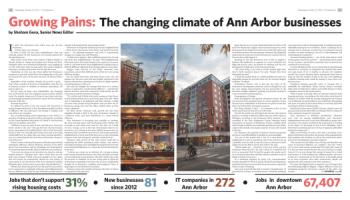
Assessment, 31 percent of Washtenaw County residents don’t
make enough to afford a two-bedroom apartment in Ann Arbor,
a figure that includes the median salaries of many jobs located
in the city.
For Thomson, the question of balance between prosperity
downtown and affordability is familiar in a personal light.
“I’m one of the people that I live in a near-downtown
neighborhood, I rent an apartment, that if my rent does go up
I probably won’t be able to stay this close to downtown and I
might not even be able to stay in Ann Arbor,” she said.
“Which makes me — you know, I love Ann Arbor, and I’m
passionate about the job I do, and I think it’s wonderful that
we’re so successful. But it’s hard for people who maybe aren’t
in an income bracket that will allow them to continue to stay as
things continue to increase.”
In a sentiment repeated by many, City Councilmember
Graydon Krapohl (D–Ward 4) said he thinks the development is
good, but that there are unresolved issues downtown, especially
when it comes to housing.
“Any type of growth like that is positive,” Krapohl said. “It
generates tax revenue. It revitalizes areas. I think the challenge
Ann Arbor faces with our housing market is workforce housing,
affordable housing for our workforce. That’s a challenge for us
and part of it is, you know, we don’t have a lot of land to expand
to build a lot more housing so a lot of it is redevelopment, and
redevelopment is expensive.”
Increased housing density — one of the same factors cited
in discussing reasons for growth — and housing prices seems
to have become a particularly noticeable issue as growth has
continued in recent years.
A recent Michigan Daily survey found that locating housing
downtown is currently so competitive for students that many
now sign leases 10 to 12 months in advance. For residents
overall, the County Housing Needs Assessment found that to
keep up with the number of jobs in the city, 3,137 additional
workforce housing units would be needed in Ann Arbor over
the next years.
Workforce housing generally refers to housing that is
affordable for individuals whose income doesn’t currently
allow them to find homes within a reasonable distance to their
workplace, based on the market prices.
When it comes to pricing, there are upward trends for both
housing and rents. According to the Ann Arbor Area Board of
Realtors, in October 2012 the average selling price for a house
was at $216,465. In April of 2015, it was at $269,321. The median
sale price of a home in the United States is currently $225,000
according to Zillow’s housing index.
Rental prices have seen a similar increase, rising by up to 10
percent in the area for 2014-2015, according to MLive, compared
with a national average of 3.6 percent.
“Our downtown is definitely gentrifying,” Thomson
said. “And it’s causing neighborhoods, near downtown
neighborhoods that were at one time affordable to people who,
you know, were maybe working in the restaurants or working
in the shops, it’s becoming so that it isn’t affordable. And I
think that’s something that our city has recognized, affordable
housing is a huge issue.”
High cost of living, of course, isn’t only a one-factor issue.
Briere noted that in Ann Arbor, the income of the population for
both students and residents, as well as the construction that’s
part of new development, also plays a big role.
“The reasons for the higher cost of living and therefore the
sense of increased affluence are complex,” she said. “Some
of it is how much income people get from their jobs. Some of
it is they get that income because the cost of living is so high.
Some of it is we can charge this amount of money for a rental
unit because U of M students have affluent parents. Part of it
is that new construction in the downtown is inevitably going
to be more expensive than older construction. Maybe not
significantly more expensive, but more expensive.”
For some, the biggest factor in regard to cost of living is that
the relationship might be flipped — higher affluence in the area
prompting prosperity downtown, instead of the other way
around.
Growing Pains: The changing climate of Ann Arbor businesses
by Shoham Geva, Senior News Editor
New businesses
since 2012
Jobs that don’t support
rising housing costs
IT companies in
Ann Arbor
Jobs in downtown
Ann Arbor
81
31%
272
67,407
LUNA ANNA ARCHEY/Daily
See BUSINESS, Page 8C