
The Michigan Daily - Monday, May 23, 2005 - 3
LEO demands promotions from LSA
By Julia F. Homing
Daily StaffReporter
Representing the concerns of LSA Lecturers
who feel they are not receiving the full benefit of
their contract, the Lecturers' Employee Organiza-
tion staged a demonstration outside the LSA Execu-
tive Committee meeting last Tuesday to show their
disapproval of what they see as the administration's
lack of consideration for the Lecturers' contract.
In the contract agreed upon in June 2004, Lec-
turer I's and Lecturer II's are classified as employ-
ees restricted to teaching, while Lecturer Ill's and
Lecturer IV's are also expected to perform an addi-
tional service to the University such as advising or
other administrative duties.
Anthropology Lecturer Lisa Young said the LSA
administration would not reclassify her as a Lec-
turer III, a distinction that would acknowledge her
hard work as a teacher and as an advisor, according
to the Lecturers' contract, despite her work as an
honors advisor within her department.
Handing out letters to Executive Committee
members as they entered the meeting, the LEO
members highlighted the cases of Young and
other Lecturers with similar experiences. LEO
Vice President Kirsten Herold said these cases
are exemplary.
"We are in our first year of our contract, and
we are having a lot of problems. We feel (the LSA
administration is) very resistant to implementing
the conditions of the contract that the University
agreed to," Herold said.
Herold added that Young and Pollard are
not alone, as about 30 other Lecturers are not
being reclassified as Lecturer III's by the LSA
administration despite their additional services
to the University.
LEO Co-Chair Ian Robinson said most of those
30 Lecturer II's can easily be seen as Lecturer III's
from their track records at the University.
"When we are disagreeing even on the easy
cases, we have to wonder - are people truly read-
ing these words, which seem pretty clear, so dif-
ferently? Or are they just ignoring the contract?"
Robinson said.
Young stressed the fairness of the reclassifica-
tion, as her job letter described advising as one of
her duties at the University.
"The main issue is basically getting acknowl-
edged for the work that I've been doing already,"
she said.
But University Spokeswoman Julie Peterson said
the Lecturers' contract does not call for a deadline
for the reclassification. She said each academic unit
has provided a schedule for their evaluations, but
that it will take time to evaluate each Lecturer.
"It's just simply not possible to evaluate every
single member of the union within the first few
months of the contract," Peterson said. "(Any
action) the University is taking to accelerate the
process is out of good will and in wanting to keepa
good relationship with the members of LEO."
Robinson also stressed the organization's dis-
satisfaction with the delay on promotional raises
for Lecturers such as Dennis Pollard, a romance
language Lecturer III whose7 percent promotional
raise has been delayed by the Executive Commit-
tee despite his department's approval of the raise.
Robinson said this is the first chance for a wage
increase for Pollard and possibly other Lecturers in
similar situations.
"The language in the contract is that the
norm should be that if you are reviewed in one
year, you get your raise in the following year.
You don't drag it out for a year and a half," Rob-
inson said. "Why would you want to do that?
These are people who have served the Univer-
sity well for years and years and years."
Robinson said that by avoiding these promotional
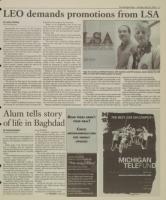
Inigo de la Cerda and Mireille Belloni, LEO members and RC lecturers, stand outside the
office as other LEO members gather to protest.
raises and reclassifications the administration could
be saving around $350,000, an amount that is one-
third of 1 percent of the total LSA budget for the
salaries of all Lecturers in three years, according to
an LEO press release.
Peterson said she strongly disagrees with the
idea that the delays are an attempt by the University
to save money.
"(The delay) is because this is a new contract, and
it is a lot of work to get these evaluations accom-
plished, and it's going totake time," she said.
LSA Dean Terrence McDonald agreed to meet
with LEO on June 6, but Herold said the organi-
zation's actions will persist into the fall if they are
dissatisfied with the results of the meeting.
Robinson said he agreed with McDonald.
"We take these questions very seriously. We will
keep talking and keep trying to both understand the
administration's position and ... persuade them to
alter it," Robinson said.
He added that the delayed actions of the LSA
administration have caused the Lecturers to change
their views of the college.
"If the administration treats you well, you
are going to be happier and more willing to
contribute to the overall quality of education
and the general spirit and progress of the Uni-
versity," Robinson said.
Alum tells story
of life in Baghdad
By Jeremy Davidson
Managing News Editor
University alumnus David Enders said
he was motivated to go to Baghdad by a
desire to "do something" about the war in
Iraq.
Enders spoke at the University Book
Fair on Saturday about his experience
starting and publishing a bi-monthly mag-
azine in Baghdad after the U.S. invasion
of Iraq.
"It was definitely the craziest thing I've
ever done - and I wouldn't hesitate a sec-
ond to do it again," Enders said.
Enders left the University to study at
the American University in Beirut for his
final semester, in order to prove to people
that the Middle East was not too danger-
ous a place for an American to live.
"I like proving to people that their
preconceptions are misconceptions," he
writes in his book, "Baghdad Bulletin",
which details his experience in Iraq.
Funded by what he calls "upper-crust
British philanthropy," Enders and a team
of about a dozen other ambitious twenty-
somethings paid their way to Baghdad and
worked for free to run the magazine. In
the opening of his book, Enders describes
the vitality of having an English publica-
tion in Baghdad.
"It is extremely important to have
English-language reporting here on the
ground right now because English speak-
ers (the Coalition especially) are going to
be making most of the decisions - it's
an unfortunate fact, but they should be
making them based on good information,
and there should be a publication here to
challenge and examine those decisions (in
English) as well."
One of the other leaders of the proj-
ect was Ralph Hassel, who was studying
Arabic in Lebanon just after he graduated
from Oxford. Hassel met Enders in Beirut
and convinced him to come to Baghdad
to run the magazine with him. Enders
said the magazine was originally Hassel's
mother's idea, but that he and Ralph put it
into action.
When the Baghdad Bulletin was pub-
lished from March to September 2003,
Enders and the rest of the staff encoun-
tered unimaginable difficulties producing
the paper.
During the time they were in Iraq, 17
journalists were killed between March
and July of 2003.
Among those killed was a 24-year old
British reporter named Richard Wild.
See ENDERS, Page 11
Scanned image of the page. Keyboard directions: use + to zoom in, - to zoom out, arrow keys to pan inside the viewer.
May 23, 2005 (vol. 116, iss. 127) - Image 3
- Resource type:
- Text
- Publication:
- Michigan Daily Summer Weekly, 2005-05-23
Disclaimer: Computer generated plain text may have errors. Read more about this.