

Racism
Racial tension is nothing new at UMass-
Amherst. An interracial brawl after the
1986 World Series left 10 people injured,
and minorities have long complained about
cuts in student-government funding for
their organizations. The most recent inci-
dent-two black students and a white stu-
dent were reportedly attacked by five
white freshmen in early February-bred
not violence but a well-organized, success-
ful protest. Minority students gave peace a
chance, and it worked.
A few days after the alleged assault, pro-
testing students swept up the steps of the
New Africa House, a cultural center for
minority students and home to UMass's
well-regarded Afro-American studies pro-
gram. Blacks occupied the house and
barred whites in a friendly sit-in. The uni-
versity made no attempt to oust the pro-
testers. Students sent a card to chancellor
Joseph Duffey, whose brother was ill, and
Duffey responded with a basket of fruit for
the occupiers. Some occupiers went to class
while others held the fort. Negotiations
succeeded and, six days after entering, oc-
cupiers paraded out singing "Lift Every
Voice and Sing" as 500 supporters cheered.
UMass officials pledged more space for
minority-student organizations and prom-
ised to take action against students found
guilty of racial violence. (Two of the white
freshmen from the February incident
have withdrawn from the university; two
others were placed on disciplinary proba-
tion for one year.) Racism remains a major
topic of discussion in classrooms, work-
shops and forums. And many students,
including whites, now proudly wear a
badge of their fight: grosgrain ribbons
striped in many colors to symbolize the
racial harmony that UMass is supposedly
striving for.
offers a four-year, $4,000 schol-
arship to an incoming fresh-
man with an interest in animal
rights. Three years ago the Col-
lege of Agriculture and Life Sci-
ences instituted a policy that
allows students who object
philosophically to an animal
experiment to refrain from per-
forming it without penalty to
. L their grades. The current 40
- . members, many of them life-
Ol & sciences majors, are now work-
ing for the elimination of a biol-
ogy-lab experiment in which
students monitor the effects of
drugs on a live frog's heart rate.
SETA wants to replace the live
experiment with a computer
.. simulation that the chapter
members hope to donate.
Demonstrators have by no
means achieved general bans
c on animal research. That goal is
unrealistic, according to Dr. Pe-
ter Gerone, director of Tulane's
Delta Regional Primate Re-
search Center, who says, "An
experiment with 20 monkeys
could save 20,000 children from
BLACK STAR deformities." California's Stu-
CLA dents United Protesting Re-
search on Sentient Subjects
(SUPRESS) has achieved a mixed record,
despite a huge rally at UCLA last spring.
Just last summer the state Board of Regents
approved the design ofa $14.3 million facili-
ty for animal research at Berkeley.
C IA Protests
Students have long rallied against CIA
recruiting on university sites, and this year
was no exception. In October students at
the universities of Vermont and Iowa were
13ART BARTHOLOMEW
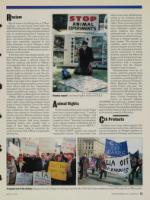
Reaping support: Animal-rights rally at U
Animal Rights
North Carolina State senior Linda Wiggs
came late to animal-rights work. "I used to
have my London broil," says Wiggs, "and
the thought of where it came from never
crossed my mind." Now she's vice president
of the campus chapter of Students for the
Ethical Treatment of Animals (SETA)-
and a confirmed vegetarian.
NC State's SETA chapter has enjoyed
remarkable success. The university now
A moment out of the old days: Supporters of college recruiting visits by the CIA (left) interrupted an anti-CIA march at Wisconsin
NEWSWEEK ON CAMPUS 25
MA Y 1988