
't="'"s a ,«- .+"xT ^ aft-- . 'r'.:+v-gig : ^t rc': L k'.!?c uo' I
. ~ w ., w _._.-"..V _ _ ..,s,,. ,.. ,. ec .u := u, .. :.;'., r: iti. ., sti.... ,,;:' a w.w.' . _-... W.
Mental Illness:
continued
into the Partial Hospitalization Pro-
gram for three weeks. His treatment
in Partial Hospitalization included
five visits per week for the first two
weeks and then three times a week for
the last week.
After those treatment sessions,
Robert was able to visit the outpatient
therapist about once a week Jor the
next six months. He learned how to
handle stress better and his marital
problems decreased.
Robert began to enjoy lfe more.
He wanted to live.
Building better
mental health care
The new mental health facility at
Catherine McAuley Health Center,
Mercywood Health Building, is a
state-of-the-art facility for those suffer-
ing from mental illness. According to
Barbara Hill, administrator for Nurs-
ing/Clinical Services at the Health
Center, the new building will be less
hospital-like and will incorporate
new treatment concepts like suppor-
tive care. Supportive care is an inter-
mediate level of care between
intensive care (or closed units where
people are in danger of harming
themselves) and open units.
The new facility allows more
room for group activities, both
recreational and therapeutic, and
there are more individual therapy
session rooms. Each patient room, al-
though semi-private, is designed to
maximize privacy while allowing the
patients opportunities for social
interaction.
The cafeteria will be used by pa-
tients, staff and visitors alike. This
helps promote interaction and an en-
CAPS UL ES, a quarterly community
health newsletter, is published by the
Catherine McAuley Health Center Com-
munity Relations Department, in coop-
eration with the Office of Health
Promotion.
Vice President for Advancement
and Community Relations .......
Ritch K. Eich, PhD
Director of Community Relations .....
Liz Patterson
Capsules Editor .......... Scott Adler
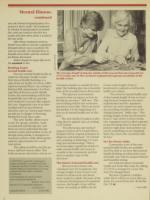
The average length of stay for adults at Mercywood has decreasedfrom
27 to 21 days due to the excellent outpatientprograms available at the
health Center.
vironment similar to outside the hos-
pital. The building also has a beautiful
view of the wooded Huron River area.
"The physical environment
around us has an impact on how we
feel about ourselves," Hill says. "The
new building will be less restrictive
and more home-like. This is an excel-
lent facility. It is the beginning of a
new era in mental health care in this
area.
The new facility's location is also
a big plus for patient care, according
to Dr. Schmit.
"The physicians and medical
support services of St. Joseph Mercy
Hospital will be of great assistance in
diagnosis and treatment," Dr. Schmit
says, pointing to Radiology, CT scan-
ning and Anesthesiology. "Mercy-
wood has taken significant strides to
make mental health care more ac-
cessible to the community and this
move is another step in that
direction."
The future of mental health care
Mercywood provides indi-
vidualized care for its patients. The
average length of stay is four to six
weeks for adolescents and about
three weeks for adults. Because of the
continued development of outpatient
services, the length of stay will de-
crease. According to Miller, the de-
crease in the length of stay is
beneficial for patients as well as the
health care system.
"The trend in mental health care
of decreasing length of stay is occur-
ring because treatments are more
sophisticated and the outpatient
services are more numerous and
are providing excellent care to dis-
charged patients," Miller says. "Our
average length of stay has decreased
from 27 days down to three weeks.
Our outpatient services allow patients
to put the things they've learned into
practice right away. And anytime you
can do something on an outpatient
basis, the cost to the consumer will
be less."
See the future today
Community tours of the new
mental health facility are available.
You'll be able to see how Mercywood
Health Building revolutionizes men-
tal health care with its unique features
and beautiful setting.
See what the future of mental
health care looks like today by calling
572-5351 to arrange for a tour. You
won't be disappointed.
Because of patient confiden-
tiality, there will be no tours after pa-
tients are moved from the old facility
Oct. 25. s
-Scott Adler
Scanned image of the page. Keyboard directions: use + to zoom in, - to zoom out, arrow keys to pan inside the viewer.
August 15, 1986 (vol. 96, iss. 13) - Image 24
- Resource type:
- Text
- Publication:
- Michigan Daily, 1986-08-15
Disclaimer: Computer generated plain text may have errors. Read more about this.