
ARTS
Sunday, July 29, 1984
Page 7
The Michigan Daily
Gatemouth gives his philosophy
By Joseph Kraus
I'm not just here to play music
and see people dance around. I'm
here to teach people about my art.
G ATEMOUTH BROWN is a
philosopher - a philosopher who
does most of his talking on stage with
his guitar and fiddle, but who has plenty
to say backstage.
Gatemouth is certainly best known to
the world for his individual guitar style.
Specializing in agonizingly slow riffs in
the midst of quick arrangements, he
always made it known that his in-
strument was the one doing the talking,
but since he always had something to
say with that instrument, he was fun to
listen to.
Gatemouth is also well-known for his
fiddle playing. Blending only a few
elements of traditional wild-fiddle-
playing with a host of transposed blues
runs, he came off sounding more like
Laurie Anderson and her tape-
recorder-as-violin than any traditional
bluesman I've heard. (And Gate was
doing it in the '50s when Laurie was still
in her crib and transistors were all still
silicon ore.)
Playing a mixed bag of original num-
bers and old-standbys from the likes of
Duke Ellington and the Everly
Brothers, Gatemouth had a way of win-
ding certain tag riffs - bits of song - in
and out of the fabric of the song,
making it his own in a way no one else
ever could.
Gatemouth did have a microphone on
stage, but he sang on only a few num-
bers. When it comes to talking, he is a
backstage man.
"What is the meaning of the
blues? ... See, that is what I am trying
to teach people," he said.
After a couple of had guesses from
around the table, Homer Brown, the
saxophonist, said, "The blues is
anything a blues musician plays . .. It
don't have to be a blues song, it can be a
spiritual (song)."
"The blues is anything you want it to
be," said Gatemouth as he took back
the lead in the conversation.
Noting what he feels is the reason he
has lasted for more than 35 years as a
professional musician, he said, "All of
by blues are positive."
Gatemouth's philosophies go beyond
the blues, however, and even beyond
music in general:
" "You can always come down, but
you can't come up," he observed.
* "If you find something (good),
you'd better get rid of it 'cause here
come the horny mother fuckers (to try
to get it too)," he said.
" "The governments all over the
world are the same," he said, drawing
upon his experiences touring Europe
and even Russia.
Gatemouth became annoyed at
talking in the audience. "I wish they
would shut up and listen. That's why
they're all backwards in school," he
said. Mellowing, he added, "Tell 'em
I'll forgive 'em, 'They know not what
they do' "
Gatemouth is undeniably a virtuoso
musician - and he'll tell you so.
"I'm all over the world, man . . . It's
(my popularity) mushrooming in this
country. I'm pulling 'em all in like a
magnet," he said.
When told that Frank Zappa con-
siders him one of his favorite guitarists,
he said, "Albert Collins says the same
thing-they all do."
As a performer, Gatemouth leaves
only one thing to be desired - more of
an ability to showcase his very talented
band. In the same way that he hates to
be interrupted when he's talking (he
once shouted back stage, "Will you
mother fuckers let me say what I'm
sayin'," when another conversation
started at the table) he seems reluctant
to give up the lead.
The members of his band: Brown on
sax, Lloyd Herman on drums, Harold
Floyd on bass, Marc Wells on trumpet,
Dennis Taylor on tenor sax, and Harold
Batts on keyboards were all fine when
they got their rare opportunities to solo,
but for most of the evening they weren't
doing particularly difficult things.
Batts, who said he joined up with the
band only last Friday, says he never
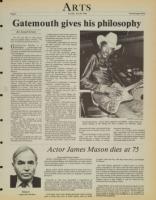
DEBORAH LEWIS/Daily
Gatemouth Brown, veteran blues guitarist and fiddler, talked about his
unique outlook on life during his show at Rick's on Thursday night.
rehearsed with them, only played in the paniment sometimes.
five gigs since he became a part of the After it all, it seems pretty doubtful
band. that Gatemouth will end up teaching
"Some of the things (we do) are fairly Philosophy 101, but it is certain that
easy," he said, but admitted that he'll keep on playing his unique blend of
Gatemouth has a unique syncopation music for a long time to come - with a
that is difficult to follow on accom- little philosophy on the side.
Actor James Mason dies at 75
From staff and wire reports
VEVEY, SWITZERLAND - Funeral services for British-
born actor James Mason, who died Friday of a heart attack,
will be held here Tuesday in a small church a few minutes
walk from Lake Geneva.
Mason, whose career spanned some 50 years and over a
hundred films, suffered a heart attack at his home in Cor-
seaux and died a short time later at a hospital in Lausanne.
He was 75.
Featured in roles that demanded a combination of
emotional intensity and debonaire manner, Mason is best
known for starring as General Erwin Rommel in The Desert
Fox, as Brutus in Julius Caesar, as Norman Maine, the
drunk husband of Judy Garland in A Star is Born, and as the
infatuated Humbert Humbert in Lolita.
In his more recent roles, Mason garnered critical acclaim
even in films that were of lesser quality such as 20,000
Leagues Under the Sea, The Boys from Brazil, and Murder
by Decree.
But when Mason appeared in quality films, he almost
always managed to rise above even the best material and
demonstrate a talent for characterization and frailty in any
role. In North By Northeast he played an evil Russan agent;
in Georgy Girl, an aging businessman looking for a mistress;
and more recently as the almost too suave, etheral Mr. Jor-
dan, in Warren Beatty's Heaven Can Wait and the insidious,
slippery lawyer in The Verdict, a role for which he was
nominated for an Academy Award.
Though Mason never achieved the greatest honors or the
highest star stature, he was always known for his ability to
make even his poorest work seem special. Whether playing
with his suave, urbane style or against it, he managed to
bringa spark of integrity and intelligence to any project with
which he was connected.
Mason
... appeared in 100 films
Scanned image of the page. Keyboard directions: use + to zoom in, - to zoom out, arrow keys to pan inside the viewer.
July 29, 1984 (vol. 94, iss. 30) - Image 7
- Resource type:
- Text
- Publication:
- Michigan Daily, 1984-07-29
Disclaimer: Computer generated plain text may have errors. Read more about this.