
Page 8 - The Michigan Daily - Friday, July 20, 1984
JOURNEY TO SAN FRANCISCO WAS TOUGH ON CANDIDATES
Delegate race took its toll
WASHINGTON (AP) - For Walter
Mondale, the road to San Francisco
began 17 months ago in St. Paul, Minn.,
where he announced his candidacy in
the chamber of the State House of
Representatives with the declaration,
"I have the experience ... I am ready
to be president of the United States."
It proved to be an arduous journey
over rugged political terrain that was
rougher still for the seven Democrats
who challenged Mondale for the
nomination.
ONLY TWO, Sen. Gary Hart of
Colorado and the Rev. Jesse Jackson,
stayed the course. The others fell by the
wayside months ago, overcome by a
surfeit of debts and a paucity of votes.
The status of front-runner proved a
heavy burden for Mondale, as it had in
where the Granite State's 101,129 voters
had left the state two days early to hob-
nob with governors in Washington,
likened it to "a cold shower." A jubilant
Hart boasted, "Tonight we buried the
label 'dark horse."'
Jackson, who had waited until
November to make the leap from civil
rights activist to full-fledged politician,
finished fourth with 5 percent of the
vote after confessing on the eye of the
primary at a Manchester synagogue
that he had used the word "Hymie" to
refer to Jews.
Jackson, after nearly losing federal
matching funds due to his poor showing
in New England, would go on to win 18
percent of the votes nationwide and
nearly 10 percent of the delegates, in-
cluding triumphs in the District of
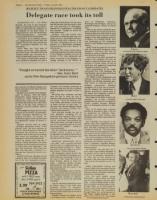
'Tonight we buried the label "dark horse."'
- Sen. Gary Hart
on his New Hampshire primary victory
past elections for Edmund Muskie and
others deemed favorites before the first
lever was pulled.
Mondale never trailed in the delegate
count. In January, when the House
Democratic caucus named 164 of its
members as "super" delegates, 75 an-
nounced they would vote for Mondale.
Seventeen declared for Sen. John Glenn
of Ohio, 11 for Sen. Alan Cranston of
California, seven for Jackson and five
for Hart.
BUT OTHER triumphs did not come
so easily for the former vice president,
whose campaign afforded by his
bulging warchest, his closely or-
chestrated support from big labor and
an organization ranked as second to
none.
Mondale savored what he called
"perhaps a spectacular victory" in the
premier event, the Iowa caucuses on
Feb. 20, when 49 percent of the 85,000
Democrats who turned out moved to
Mondale's side of the room at meetings
held across the snowbound state in
firehouses, church halls and schools.
Hart, his nearest rival, had only 17
percent. George McGovern, the peace
candidate who had implored Iowans not
to "throw away your conscience," was
third with 10 percent, while Glenn was
fifth with less than 4 percent in a
showing that doomed his centrist can-
didacy.
EIGHT DAYS later, Mondale was left
reeling by Hart's 37-to-29 percent upset
win in the New Hampshire primary,
FULL TRAY FULL TRAY FULL TRAY
n evJ~ i l ian m
PIZZA
a with 2 FREE items %
Splus2 FREE quarts
769-2422 m
- r
PIZZA EXCHANGE M
. & SUB EXPRESS
.;1 i~n Ays1inj AvsilT1nj
Columbia and Louisiana primaries in
May that made him the only candidate
besides Mondale and Hart to carry a
state.
ON LEAP Day, Cranston, who had
been the first to enter the race in
February 1983, became the first to drop
out, saying "I know the difference bet-
ween reality and dreams. I know when
to dream and how to count votes." A
day later, Sen. Ernest Hollings of South
Carolina and former Florida Gov.
Reubin Askew bowed out.
Hart marched through the rest of
New England, sweeping all its
primaries and caucuses. With a style
borrowed from John Kennedy, Hart
and his "new ideas" were suddenly the
talk of the nation. The bulk of the sup-
port for his exploding political fortunes
came from the "yuppies" - young, ur-
ban professionals.,
But the newfound prominence also
brought intense scrutiny of Hart's
background, including his shortening of
the family name from Hartpence and
shaving a year off his age.
MONDALE RIDICULED Hart's
"new ideas" with a one-line delivered
with the force of a sledge-hammer at a
debate in Atlanta on March 11: "When I
hear about your new ideas, I'm remin-
ded of the ad, "Where's the beef?"'
The hamburger slogan became the
battle cry of Mondale's campaign, even
while aides were preparing to throw in
the towel if Hart swept the South on
Super Tuesday, March 13, when five
states - Alabama, Florida, Georgia,
Massachusetts and Rhode Island -
held primaries and four states in the
West held caucuses.
Hart won the popular vote in Florida,
as well as all four caucuses and the two
New England primaries, but Mondale
scored crucial victories in Alabama
and Georgia to revive his sputtering
campaign.
GLENN, HIS debts ballooning toward
$3 million, threw in the towel after
finishing second in Alabama.
McGovern kept a promise to withdraw
after he failed to finish first or second in
Massachusetts.
Mondale widened his delegate leads
in mid-March with a string of caucus
wins in Delaware, Arkansas,
Mississippi and Michigan, and an un-
contested primary victory in Puerto
Rico.
Then, in the nation's industrial hear-
tland, Mondale won major primaries in
Illinois on March 20, New York on April
3 and Pennsylvania on April 10, and his
delegate count kept spinning upwards.
In Illinois, as in Florida earlier, Hart
was hamstrung by his campaign's
failure to field delegate slates in every
district.
HART ALSO damaged his own cause
with the unfounded complaints about
Mondale's television ads and his
inability to yank an offensive ad of his
own off the ir in Chicago.
And in New York, Hart tarnished his
image as the candidate who was not
captive to special interests when, in an
overture to Jewish voters, he did an
about-face and supported recognizing
Jerusalem as Israel's capital.
Hart's post-mortem on the rough-
and-tumble New York campaign was
that Mondale "got me down on his level
. . He won't do that again."
ON APRIL 6, Hart complained to the
Federal Election Commission that
Mondale was flouting campaign spen-
ding limits by allowing unions to
delegate committees. Mondale
shrugged it off at first, but by month's
end he ordered the committees to
disband, promised to refund much of
the money and voluntarily counted it
against his own spending ceiling.
Hart looked to the West to revive his
candidacy, but on May 5 Mondale
whipped him by nearly a 2-1 margin in
Texas's complex caucuses. Mondale'
also won Tennessee's primary on May
Day.
Hart, in his home state, trounced
Mondale in caucuses on May 7, the eve
of primaries in Indiana, Ohio,
Maryland, and North Carolina that
Mondale hoped would at last propel him
to victory.
BUT VICTORY was delayed, if not
denied, when Hart registered narrow
wins in the Indiana and Ohio primaries.
Hart, who had a weakness for football
metaphors, declared, "The Democrats
of this nation are not prepared to have
this contest and this debate end at this
time. Welcome to the fourth quarter."
Hart did exceedingly well in the four-
th quarter, winning nine of the final 13
primaries'and caucuses from May 7 to
June 5, including a lopsided delegate
win in California on the final day of the
primary season.
But Mondale, who shut Hart out in
New Jersey, kept adding delegates to
his column, and on June 6, precisely at
11:59 a.m. as promised, announced in
St. Paul that he had secured the
necessary 1,967 votes to go over the top.
"The race for the majority is over," he
said.
HART CONCEDED nothing and
vowed to fight to the convention, but the
wind fell from his sails and the media's
attention shifted to Mondale's laborious
search for a running mate.
Over the next month, seven
Democrats - three women, two black
men and one Hispanic and one white
male - made the pilgrimmage to Mon-
dale's secluded suburban home in Nor-
th Oaks, Minn., to be interviewed for
the job, much in the manner of Jimmy
Carter's trooping his candidates
through Plains, Ga., in the summer of
1976 before tapping Mondale. A few
others. Hart smnna them were under
See CANDIDATES, Page 17
... vowed to fight to the end
a
I
I
Mondale
... continued to add delegates
Scanned image of the page. Keyboard directions: use + to zoom in, - to zoom out, arrow keys to pan inside the viewer.
July 20, 1984 (vol. 94, iss. 26) - Image 8
- Resource type:
- Text
- Publication:
- Michigan Daily, 1984-07-20
Disclaimer: Computer generated plain text may have errors. Read more about this.