
The Michigan Daily - Sunday, May 6, 1984 - Page 11
Common Ground triumphs with 'Junkie'
By Joseph Kraus
STOP FOR A MOMENT AND
think about what local theater can
accomplish.
At its worst it is self-serving mean-
dering about on stage. At its best it
celebrates the best of what a com-
munity has to offer in the way of
musical and dramatic talent.
Common Ground's production of
Junkie: Portraits of Women and Tran-
sition is one of those celebrations.
Uniting on stage six talented perfor-
mers, the play goes beyond simple en-
tertainment by presenting the impor-
tant issue of addiction in its different
forms and by hammering it home
through skilled performances and
audience participation.
Essentially, the play presents five
women, played by Loni Williams, D.
Farrow Halstead, Sharon Plaster,
Beatriz Hernandez and Ellen Joyce
Rabinowitz, who are junkies.
Each woman begins by telling a bit of
her background, hinting at or telling
outright how she came to be addicted to
her particular "junk." As the play
progresses, each displays moments "on
center stage" in which she suffers from
her habit, while the others play sup-
porting roles. The turnover is rapid
enough that none of the five ever seems
to dominate the show.
Linda Ignasiak plays a sixth charac-
ter, Esther, God's favorite. Esther is
aware of the extent to which the others
are addicted to their particulars, which
range from food and work to marijuana
and heroin, and tries at various times to
help them stop. She is made up in white
face with bright red cheeks and has a
balloon tied to her back. At one point,
the other women become so upset with
her efforts to help them, that they untie
her balloon and wipe off her makeup,
vividly demonstrating the "lows" of
being a junkie.
The most exciting scenes, however,
are those in which the entire cast acts
as a whole. At various times, the five,
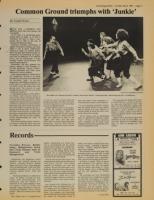
Daily Photo by REBECCA KNIGHT
The addicts in Common Ground's 'Junkie' chase down Esther (Linda Ignasiak), illustrating the lows of addiction.
or even six, move to center stage and
perform ensemble. The effect is similar
to a three ring circus-more action than
you can completely take in.
Another effective part of the produc-
tion was the audience participation.
Before the show began, ushers cir-
culated and collected surveys asking
audience members to briefly describe
their own addictions in terms of the
"highs" and "lows" that they give
them. Then at various times during the
production, director Elise Bryant
would stand up from her front row seat
and read some of the responses, at-
tributing them broadly to the audience.
It was extremely powerful to know
that the people sitting in front, behind
and all around you, were addicted to
various things in much the same ways
as the characters on stage.
All six women were so outstanding
that it is impossible to identify a single
"star." Bryant certainly deserves
some recognition for the finely tuned
stagings, but the entire production crew
was accomplished as well.
Records]
Veronika Kineses, Bellini
Songs, (Hungaroton) Sylvia
Sass, Great Soprano Arias of
Donizetti and Verdi
(Hungaroton)
Hungaroton, the Hungarian record
producer, has recently pressed two
albums, Veronika Kinsces' Bellini
Songs and Sylvia Sass' Great Soprano
Arias of Donizetti and Verdi, that offer
excellent examples of the two basic,
classical soprano forms: lieder and
operatic.
The Kinsces album is a collection of
songs by Bellini, covering his brief
career both chronologically and
stylistically. Side one consists of a
collection of six songs ranging in tone
and quality from the lovely and
nostalgic "Sogno d'infanzia" to the in-
teresting but muddled "Torna, vezzosa
Fillide." Side two consists of two song
cycles.
The album has a stripped-down
quality, reminiscent of a recital. Kin-
sces is accompanied only by pianist
Lorant Szucs, typical for a lieder per-
formance. Szucs does a good job but
tends to cut the ending chords short.
Granted, he is accompanying not
soloing, but even when accompanying
one must let the notes speak.
Kinsces does let the notes speak. Her
interpretations bring out the nuances of
each piece, and her voice seems
capable of handling any task she
assigns it. Kinsces has done opera, but I
think she would do well to remain with
lieder. Her voice has a light and lilting
touch which is better suited to the latter
than the former. While not in Elly
Ameling's league, Kinsces would be a
welcome addition to the ranks of lieder
sopranos.
Sass' album is of a different sort. To
begin with, she is accompanied by Er-
vin Lukacs and the Hungarian State
Opera Orchestra. And the music is dif-
ferent: the complex and demanding
arias of Donizetti and Verdi rather than
the simple but demanding songs of
Bellini. The album contains arias from
several operas, including a personal
favorite: "Willow Song/Ave Maria"
from Verdi's Othello.
The orchestra sounds quite good. This
recording made me wish that I could
get one of the orchestra's own albums.
There is a problem with a persistent
echo, but the musicianship is first rate.
And Sass is superb. There is power
and confidence in her delivery; she is
on top of every note. She can handle
both the Sturm and Drang of "Ecco
l'orrido campo" from A Masked Ball
and the soft subtleties of "Willow
Song."
The pressings and vinyl themselves
are well above par, thought not as good
as Deutsche Gramaphon or London.
The liner notes are in Hungarian, Fren-
ch, German, Russian, and English. Un-
fortunately, the lyrics are only in
Hungarian and the original Italian.
This small setback should not prevent
you from purchasing two fine albums.
- Knute Rife
The message that Junkie has to give
is a powerful one - one that is far bet-
ter seen and experienced than read
about. For the Broadway regular, this
play may not be great theater, but for
anybody it most certainly is great
drama. In short, Junkie is the best of
what local theater can be, and it should
not be missed.
Junkie will be performed again this
afternoon at 2:00, as well as May 11-13
and 18-20. Tickets are available at the
door, as well as through the CTC
outlets.
i D DUAL.THEATRES
.,bvtt a y 791 9700
DAILY 1 00 P.M. SHOWS
$2 00SHOWS TIL 6:00 P.M
EXUBERANTI
GOLDIE
HAWN
LAST 11 DAYS!
MON. 100, 7:00, 9:00
SUN. 00, 3:00, 5:00, 7:00, 9:00
ACADEMY AWARD
NOMINEE
9FT FOREIGN FILM
ISABELLE
HUPPERT
:.1(R)
MON. 1 00, 7:20, 9:30
SUN. 12:50, 3:00, 5:10, 7:20, 9:30
Scanned image of the page. Keyboard directions: use + to zoom in, - to zoom out, arrow keys to pan inside the viewer.
May 06, 1984 (vol. 94, iss. 2) - Image 11
- Resource type:
- Text
- Publication:
- Michigan Daily, 1984-05-06
Disclaimer: Computer generated plain text may have errors. Read more about this.