Scholar
says comet
may bring
disease
CARDIFF, Wales (UPI)-That "dir-
ty snowball" that shot over Ann Arbor
this week may be the cause of the next
plague. A Cardiff University
Astronomer claims the Iras-Araki-
Alcock comet may deposit
microorganisms in Earth's atmosphere
that could cause deadly epidemics.
"Throughout history there has
always been a link between plagues like
the Black Death and comets,"
professor Chandra Wickramasinghe,
co-author of "Diseases from Space,"
said Thursday.
"I don't want to start any undue
alarm. It all depends what kind of bac-
teria are in the comet," he said.
"They could be completely harmless,
but it is possible they could be new to us
and cause epidemics like the plague
and smallpox."
He said most likely a flu epidemic
worldwide could occur by July in the
Southern Hemisphere and spread north
next January and February.
The comet came within 3.1 million
miles of Earth Wednesday. Still visible
through today, the comet is thought to
be about 40,000 miles across with a
nucleus of frozen water, carbon dioxide
and methane about a mile in diameter.
4
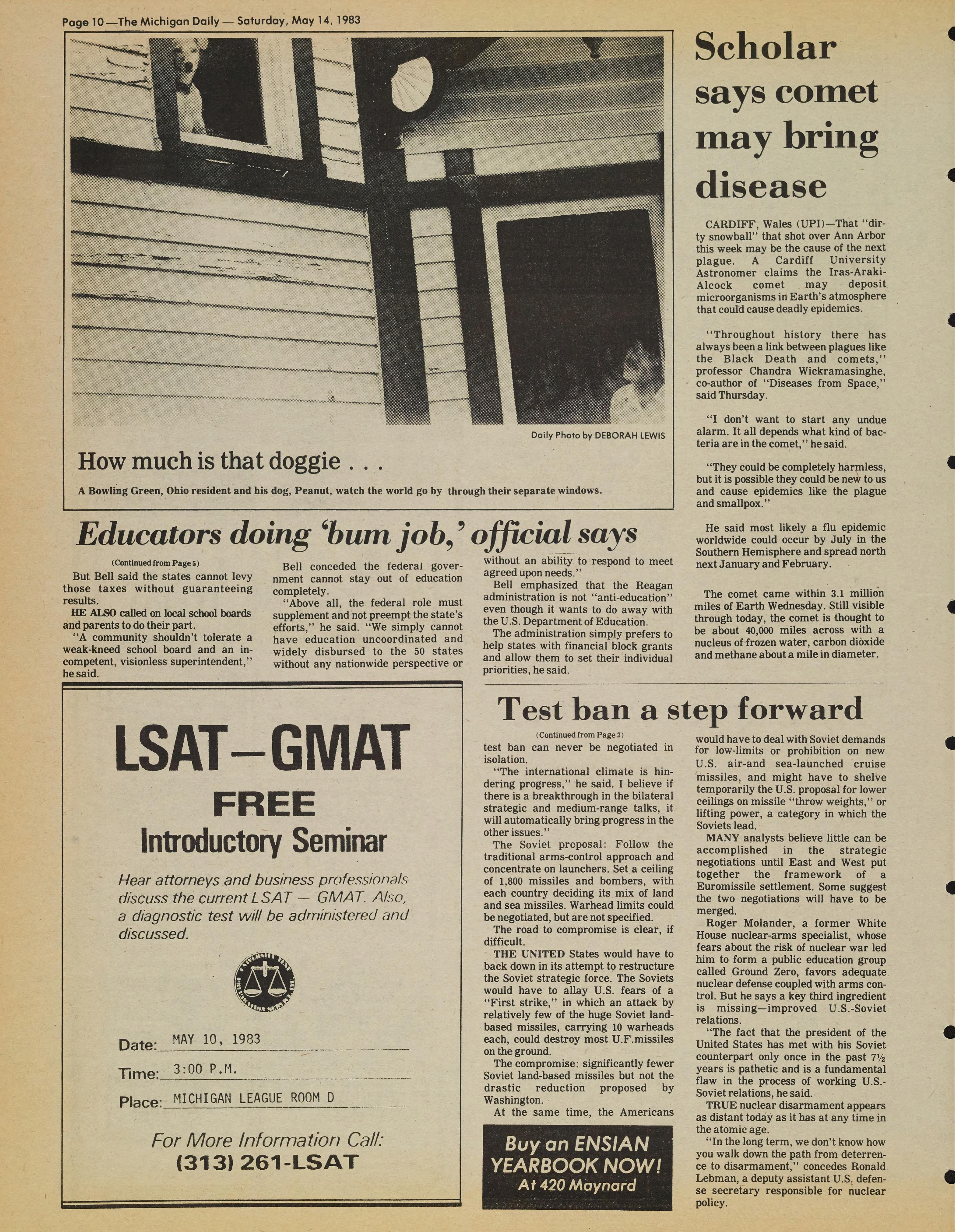
Daily Photo by DEBORAH LEWIS
How much is that doggie,. ..
A Bowling Green, Ohio resident and his dog, Peanut, watch the world go by through their separate windows.
Educators doing 'bum job,'official says
with b o ut nd tos meet
(ContinuedfromPages) Bell conceded the federal gover- without an ability to respond to meet
But Bell said the states cannot levy nment cannot stay out of education agreed upon needs."
those taxes without guaranteeing completely. Bell emphasized that the Reagan
results. "Above all, the federal role must administration is not "anti-education"
HE ALSO called on local school boards supplement and not preempt the state's the U.S Department of Eduaway with
and parents to do their part. efforts," he said. "We simply cannot . . cation.
"A community shouldn't tolerate a have education uncoordinated and he adsmiistat innsimly prefers to
weak-kneed school board and an in- widely disbursed to the 50 states help states with financial block grants
competent, visionless superintendent," without any nationwide perspective or and ow them to set their dividual
he said.
Test ban a step forward
LSAT- G
FREE
Introductory Seminar
Hear attorneys and business professionas
discuss the current L SAT - GMAT A/so,
a diagnostic test will be administered and
discussed.
Date: MAY 10, 1983
Time: 3:00 P. M.
Place: MICHIGAN LEAGUE ROOM
For More Information Ca/:f
(313) 261-LSAT
(Continued from Page7)
test ban can never be negotiated in
isolation.
"The international climate is hin-
dering progress," he said. I believe if
there is a breakthrough in the bilateral
strategic and medium-range talks, it
will automatically bring progress in the
other issues."
The Soviet proposal: Follow the
traditional arms-control approach and
concentrate on launchers. Set a ceiling
of 1,800 missiles and bombers, with
each country deciding its, mix of land
and sea missiles. Warhead limits could
be negotiated, but are not specified.
The road to compromise is clear, if
difficult.
THE UNITED States would have to
back down in its attempt to restructure
the Soviet strategic force. The Soviets
would have to allay U.S. fears of a
"First strike," in which an attack by
relatively few of the huge Soviet land-
based missiles, carrying 10 warheads
each, could destroy most U.F.missiles
on the ground.
The compromise: significantly fewer
Soviet land-based missiles but not the
drastic reduction proposed by
Washington.
At the same time, the Americans
would have to deal with Soviet demands
for low-limits or prohibition on new
U.S. air-and sea-launched cruise
missiles, and might have to shelve
temporarily the U.S. proposal for lower
ceilings on missile "throw weights," or
lifting power, a category in which the
Soviets lead.
MANY analysts believe little can be
accomplished in the strategic
negotiations until East and West put
together the framework of a
Euromissiletsettlement. Some suggest
the two negotiations will have to be
merged.
Roger Molander, a former White
House nuclear-arms specialist, whose
fears about the risk of nuclear war led
him to form a public education group
called Ground Zero, favors adequate
nuclear defense coupled with arms con-
trol. But he says a key third ingredient
is missing-improved U.S.-Soviet
relations.
"The fact that the president of the
United States has met with his Soviet
counterpart only once in the past 7
years is pathetic and is a fundamental
flaw in the process of working U.S.-
Soviet relations, he said.
TRUE nuclear disarmament appears
as distant today as it has at any time in
the atomic age.
"In the long term, we don't know how
you walk down the path from deterren-
ce to disarmament," concedes Ronald
Lebman, a deputy assistant U.S. defen-
se secretary responsible for nuclear
policy.
4
i
I

Scanned image of the page. Keyboard directions: use + to zoom in, - to zoom out, arrow keys to pan inside the viewer.
May 14, 1983 (vol. 93, iss. 5) - Image 10
- Resource type:
- Text
- Publication:
- Michigan Daily, 1983-05-14
Disclaimer: Computer generated plain text may have errors. Read more about this.