
The Michigan Daily - Saturday, June 18, 1983 - Page 3
African King
visits campus
on U.S. tour
By KAREN TENSA
Dressed in their colorful native
garb, a Nigerian king and three of
his chiefs toured the University
campus yesterday.
High Highness the Alaperu of
Iperu Oba Kabiyesi and his en-
tourage visited the School of
Education, the biochemistry
laboratories in C. C. Little, the
CCRB, and the School of Public
Health facilities on their trip to Ann
Arbor, a part of a week-long stay in
southeastern Michigan.
THE ALAPERU is the ruler of his
ethnic group in the town of Iperu,
located approximately 50 miles from
Lagos, the Nigerian capitol. He is
touring the United States while on
vacation.
The reserved but polite king said
he found Ann Arbor to be "clean, and
very nice." He plans 'to stay in
Michigan until tomorrow.
The group stopped in Detroit to
meet with black leaders, but came to
Ann Arbor to visit Ebenezer Soyom-
bo, a graduate student in the School
of Public Health whose father Seriki
Soyombo is one of the Alaperu's
chiefs.
SOYOMBO said he was very hap-
py that his son is studying in the
United States because colleges here
have a wider choice of academic
disciplines.
Ebenezer Soyombo said he plans
to return to Nigeria to use his skills
to help the people in his homeland.
Many Nigerian students study
abroad because the colleges are
older and more established in other
countries, he said.
The Alaperu and his party will
meet today with Detroit Mayor
Coleman Young for a conference on
crime prevention at Cobo Hall.
Earlier this week, they toured the
Renaissance Center, Detroit City
Hall, and the Detroit Zoo.
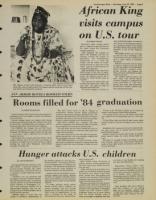
Daily Photo by ELIZABETH SCC
The Alaperu of Iperu Oba Kebiyesi, a Nigerian king, relaxes in his hotel
room after a day of sight-seeing. The Alaperu and his entourage will be in the
Ann Arbor area through the weekend.
ANN ARBOR HOTELS BOOKED SOLID:
Rooms filled for '84 graduation
By MIKE WILKINSON
Parents trying to find a hotel room near campus for
graduation next year might be better off pitching a
tent in the Diag.
.Several campus hotels are booked solid during
graduation weekend through 1985. Almost every hotel
in Ann Arbor, including those off campus, will be
full one month before commencement weekend.
ON CAMPUS, the Campus Inn and Bell Tower
hotels are completely full for next year's graduation
weekend. The Michigan League's hotel will also post
a "no vacancy" sign in 1984 since all 21 rooms are
already reserved.
The Campus Inn at Huron and State Street, which
usually reserves 20 of its 205 rooms for parents of
graduates, is booked for two years and has a lengthy
waiting list, said Julie Ranspach, reservations
manager at Campus Inn.
The Bell Tower Hotel at 300 S. Thayer is
traditionally booked months before graduation
weekend, said General Manager Ron Breznicky. The
66 rooms in the Bell Tower are reserved for orchestra
members who come to Ann Arbor for the annual May
Festival, which coincides with commencement.
THE BELL TOWER has a contract with May
Festival organizers and Breznicky said he expects
the arrangement to continue for several years.
The Ann Arbor Inn on Fourth Avenue has only six
rooms left for graduation weekend in 1984, said Chris
Crane, office manager.
The hotel reserves 40 of the 190 rooms for parents.
Alumni groups that visit on graduation weekend fill
the remaining 150 rooms, Crane said.
THE 50TH anniversary of each University class
takes place graduation weekend, bringing about 600
alumni to town who reserve blocks of rooms in local
hotels.
Rooms in the Michigan League are'all taken by
alumni, said financial clerk Patricia Shemel.
Off campus hotels such as the Hilton Briarwood
Inn, expect to be turning people away in a few mon-
ths.
At the Hilton there are only-S0 open rooms which.
should be gone by the end of August, said a hotel of-
ficial.
WEBER'S INN, located at 1-94 and Jackson Road,
has open rooms, but an official said the hotel is
usually full by January.
Another reason for scarce hotel rooms is airlines
which reserve rooms for crews during flight lay
overs.
But there is a simple solution according to local
hotel officials: Book early. Reservations should be
made at least eight months in advance, said the of-
ficial at the Hilton.
Hunger attacks U.S. children
v
By JAYNE HENDEL
Starving children don't just live in the
Third World - American children in
poverty-stricken families also suffer
from malnutrition, said the director of
a national hunger-fighting group,
yesterday.
"Children are not growing and
developing normally because families
don't have money for food," said Nancy
Amidei, director of the Food Research
Action Coalition in Washington, D.C.
One in four American children live in
impoverished families, who are suf-
fering because of federal budget cuts in
social services, she said.
AMIDEI spoke to more than 100
people in Rackham Amphitheater in
the keynote address of a two day con-
ference entitled, "The Impact of Pover-
ty and Unemployment on Children and
Families." The conference is sponsored
by the University's Bush Program in
Child Development and Social Policy.
Amidei said that the problem of mal-
nutrition begins even before children
are born, as mothers with little money
often cannot afford to eat the nutritious
food they need in order to bear healthy
children.
To make matters worse, public
health centers where mothers can
receive prenatal care are turning
people away if they don't have cash up-
front to pay for appointments. In one
case, a woman on the verge of
delivering her baby was refused treat-
ment, Amidei said.
BUT WITH recent decreases in
welfare, poverty stricken people don't
have the cash to pay health care cen-
ters, she said.
Along with the lack of prenatal care,
babies are fed diluted formula because
the parents can't afford to give them
more, Amidei said. This problem has
received wide attention in Third World
countries, but many American children
suffer from the same practice.
The lack of prenatal care and the poor
nutrition after birth has resulted in a
drastic increase in the country's infant
mortality rate, especially in Michigan,
Amadei said. This "failure to thrive"
syndrome shows up in many infants
from low income families, some . of
whom are brought to hospitals when they
are three or four months old weighing
less than they did at birth.
TREATING these babies costs
hospitals an average of $1,000 a day, she
said, in contrast to the $450 it would cost
to provide preventative prenatal care
in a health clinic. Lifetime in-
stitutionalization for children who have
irreversible problems due to poor care
could cost the taxpayer $3 million, she
said.
Some families who can't afford to
feed their children are now putting
them up for adoption, Amidei said.
"People don't want their children to go
through the winter living in the car,"
she said.
Scanned image of the page. Keyboard directions: use + to zoom in, - to zoom out, arrow keys to pan inside the viewer.
June 18, 1983 (vol. 93, iss. 18) - Image 3
- Resource type:
- Text
- Publication:
- Michigan Daily, 1983-06-18
Disclaimer: Computer generated plain text may have errors. Read more about this.