

ARTS
Page 8 Tuesday, June 7, 1983 The Michigan Daily
Danse Orientale troupe triumphs
4
4
By Ellen Rieser
S ATURDAY EVENING at Huron High
School Auditorium, Troupe
Ta'Amullat, Ann Arbor's resident Dan-
se Orientale company, held its tenth
annual Rites of Spring performance. To
celebrate the gala occasion, the troupe
performed some of its best group dan-
ces from the past decade and presented
premieres of three solos. Three
nationally noted ethnic dance guest ar-
tists also joined Troupe Ta'Amullat in
this retrospective performance.
As five African drummers and per-
cussionists played and chanted a "Call
to Celebration" melody from Mali, the
members of Troupe Ta'Amullat danced
through the audience to reach the stage
and start the performance.
A "Tunisian Scarf Dance"
(choreography by Mary Weed) was the
first dance on the program. The dance
was a lively one featuring four dancers
waving scarves and moving sideways
with small kicks of their feet.
"Yemenite" (adapted by Pauline
Costianes) was the second dance on the
program. To a lilting melody, six mem-
bers of Troupe Ta'Amullat snapped
their fingers, waved their arms above
their heads, and skipped through this
cheerful dance.
The third dance on the program was a
solo featuring Mary Weed, a principal
dancer with Troupe Ta'Amullat.
Coming out in a traditional belly dance
costume, Weed fluidly rippled her way
through "Lebanese Orientale," a dance
she also choreographed. A gifted and
natural performer, Weed looked as if
she were enjoying her performance as
much as the audience was.
The breadth of what is encompassed
by Danse Orientale was revealed by
Troupe Ta'Amullat's fourth dance,
"Moorish Gypsies," (choreography by
K. McGowan and Nancy Goings). This
dance to guitar music with its sultry
arm and shoulder movements, foot
stamping, and deep back bends showed
a blend of Moorish and flamenco style
dancing. Of the trio of dancers (Nancy
Goings, Darcy Gayton, and Patricia
Cranmer), Nancy Goings showed a
special flair for this unusual type of
dance.
After "Moorish Gypsies" came what
most of the audience (to judge by wild
Arabian trills and cries of approval)
had been waiting for. Ibrahim Farrah,
guest artist from New York City, came
out and strutted his stuff. Farrah, who
ig also a noted dance ethnographer and
teacher of Danse Orientale, revealed
strong and exquisitely precise hip,
stomach, and back control. After one
series of particularly vigorous
muscular contractions, he actually ap-
peared to have foreshortened his torso.
Alternately twirling a cane and using
finger cymbals, Farrah, an ebullient
performer to say the least, had the en-
thusiastic audience clapping and
shouting along to his dance.
"Ya Abud Debke" (adapted by
Pauline Costianes), a six woman line
dance stressing stamping steps,
followed Farrah's solo. The dance was
done precisely and with considerable
verve. "Danse Kallista"
(choreography by Kathy Rude) with its
slow movements, provided a change of
pace from the breathlessness of "Ya
Abud Debke." Rude's long arabasques
and supple arms gave a stylish polish to
her performance. It would help,
however, if she smiled.
"Ouled Nail," an Algerian-based
dance drama (choreography by Cyn-
thia Adams, Nancy Goings, and Mary
Weed) followed. Goings and Weed were
suitably "available" as the dowery
seeking maidens. Cynthia Adams, dan-
cing the role of the older "presenter" of
the girls, danced an impressive sword
dance with real swords. Commented
Adams at a rehearsal about the rigors
of the role, "I've lost some feathers off
my head-dress, and some ferns at
home, and a hole in the tablecloth -
and I stabbed Mary." Nevertheless, in
performance the dance went without a
hitch as Adams twirled her weapons
and forced her companions to dance
between her blades.
"Ahouch," an intricate line dance
from Morocco (choreography by Nancy
Goings) was next on the program.
Although based on one step, the dance
took its interest from the many
geometric patterns created by the dan-
cers.
After the straight lines and simple
rhythms of "Ahouch" came "Dance of
Shiva," an Indian dance choreographed
and danced by Malini Srirama, a
locally-based classical Indian dancer.
Dedicated to the god Shiva, the work
featured delicate foot work and
frequent rhythm changes. Srirama
showed smoothness and control as she
suddenly froze into gestures and poses
from famous sculptural figures of In-
dian temples.
A cane dance, "Raqs Assaya"
(choreography by Pauline Costianes)
followed "Dance of Shiva." Despite
being encumbered with canes balanced
on shoulders and heads, Pauline
Costianes, Connie Peltier, and Sharon
Gordon managed to look relaxed and
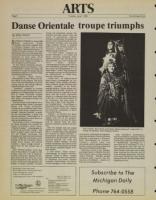
Nancy Goings, Mary Weed, and Cynthia Adams performed "zouled Nail" at
Troupe Ta'Amullets 'Rites of Spring' festival.
even bouncy in this quick moving piece.
After the cane dance, Patricia Cranmer
presented a lamp dance in Pharaonic
style (choreography by Cranmer).
Cranmer's stylized linear arm
movements and her repeated sweeps of
the floor created a series of profiles that
had a powerful otherworldly effect.
Following Cranmer's solo, Phaedra,
a principal dancer in Ibrahim Farrah's
Near Eastern Dance Group, presented
"Dance Phaedra." Phaedra seemed
technically adept; however, her dan-
cing was a bit subdued - almost as if
she were not dancing full out.
After Phaedra's performance,
Farrah returned for a long solo. Farrah
proved that it is indeed possible to dan-
ce gracefully while one's middle section
is rhythmically quivering in a
prescribed set of movements. It was a
very impressive solo and was en-
thusiastically received by the audience.
After Farrah's solo there was a short
finale featuring the drummers and all
of the evening's performers. And then,
all too soon, with one last clink of beads
and tap of drum, the tenth annual Rites
of Spring was over.
4
By the light of the silvery mean
Bid a knight (errant: lanced a pig) swoon.
Cried a streetperson, soused,
"Why, sir, surely you jousti
To the League with a fork, knife and spoon " Lunch 11:30 to 1:15
R. S. Dinner 5:00 to 7:15
SPtCIAL LOW PRICES FOR
UFM STUDENTS
c g Send your League Limerick to:
The ichigaan1 7Manager, Michigan League
227 South Ingalls
PL a(Jl Next to Hill Auditorium You will receive 2 free dinner
Located in the heart of the campus. tickets if your limerick is used in
It is the heart of the campus. one of our ads.
Subscribe to The
Michigan Daily
Phone 764-0558
I
I