
The Michigan Daily --Tuesday, May 24, 1983 - Page 7
OBJECT OF ADMIRATION, OBJECT OF SCORN
ROTC's man on campus
By LOU FINTOR
A military career spanning 27 years
may seem a bit ironic for the son of an
Episcopal clergyman, but as director of
the University's Air Force Officer
Education Program, Colonel Robert
Shellenberger says he's answered the
"calling" of a different kind.
Nestled between the Dental School
and Natural History Museum, it's easy
to overlook aging North Hall - the
ROTC Building where Shellenberger
has worked for a little more than a
year.
NUMEROUS military awards and
citations line the walls surrounding his
neat desk where a small United States
flag is prominently positioned.
PROFILE
At 46, Shellenberger leans back in his
chair to peer out the bay window at
campus streets which little more than a
decade ago were filled with thousands
of angry students protesting the
philosophy he represents. It is those
turbulent days that Shellenberger
remembers most vividly.
"I remember the first time I came to
North Hall in 1966 as an Air Force
graduate student," Shellenberger said.
"One of the first things they told us was
not to wear your uniform on campus. In
those days it didn't pay to wear the
uniform on campus and provoke
anything. People felt that anyone in
uniform was just chomping at the bit,
ready to go to war."
EVEN TODAY the Air Force con-
siders Shellenberger to be on "active
duty," subject to frontline combat in a
national emergency.
But in that event, Shellenberger
would not be a novice at war.
During the Vietnam war, Shellen-
berger flew C-130 troop transports to
Vietnam and Thailand. His cargo at
various times included support sup-
plies, amminition, troops, prisoners,
and occasionally, the bodies of the
wounded and dead.
"The old cliche of 'war is hell' was
true and it's still true. It wasn't a nice
feeling, but the job had to be done," he
said.
THIRTEEN years later and hun-
dreds of miles from Southeast Asia,
Shellenberger now draws from a
lifetime of experience to prepare 125
University ROTC cadets with skills he
hopes they will never have to use.
As program director, Shellenberger
designs and develops a curriculum of
courses that includes Air Force
organization, strategic air command,
an overview of Soviet military
organization, and ethics relative to
military duty.
"I am very disturbed when someone
who should know better says we are on
campus teaching maiming and
killing," Shellenberger said. "What we
are doing is teaching young folks who
want to be officers how to be
professionals."
SHELLENBERGER feels that anti-
ROTC sentiment on campus has
decreased and is now optimistic for the
program's future as cadet applications
continue on the rise. There have been
only two anti-ROTC demonstrations in
front of his office during the past two
years - both staged by the Latin
American Solidarity Committee.
In contrast, during the early 1970's,
there were several attempts to burn the
building, a bomb was planted in a car
which was parked next to the building
which then exploded. Despite this
violent resentment, Shellenberger
defends the protest demonstrations as
"one of the privileges of living in a free
society."
"Time is certainly a factor,"
Shellenberger said, "Vietnam is behind
us by 10 years."
THERE WAS a timewhen the
military won the respect and ad-
miration of an American public who,
feeling drained but victorious following
a depression, and tremendous personal
sacrifices for the war effort, were
grateful that freedom had been guaran-
teed.
Born in New York City, his father
served as a Civil Defense chaplain
during the war years. His mother, a
housewife, helped the clergyman with
war effort concerns and both helped in-
still a strong sense of patriotism and
love of freedom which Shellenberger
still maintains.
"I can remember the air raid drills in
school and the blackouts during
evenings at home," Shellenberger said.
"I remember clearly the day the war
ended. We could hear fire sirens and
church bells ringing. More importantly,
I remember the things we were fighting
against."
HIS BOYHOOD experiences and
patriotism during the war combined
with almost no money to pay for a
college education provided the impetus
for Shellenberger to devote a lifetime to
military service. "I still get chills up
and down my spine when I see the
flag," he added.
Graduating from the United States
Military Academy at West Point in
1958, Shellenberger immediately en-
tered duty training as a student pilot at
bases in Texas, Mississippi, Georgia,
Nevada, California, and Kansas.
"Life at West Point was very
regimented. You're in a military at-
mosphere 24 hours a day," Shellen-
berger said. "West Point has tough
standards of discipline. It was a tough
physical grind and a tough mental
grind.
"We got up at 10 minutes to 6 every
morning except Sunday and fell out for
reveille. It was mandatory at that time
to attend chapel and then we would eat
in a dining hall where they could feed
2400 of us in 30 minutes," he added with
a chuckle.
FOLLOWING certification as a B-52
bomber co-pilot at Robins Air Force
Base in Georgia, Shellenberger made
his first to earn a masters degree in
Aerospace Engineering in 1968.
A short stint as a Vice-Commander of
Andrews Air Force base in Maryland
from 1980-81, provided Shellenberger
the opportunity to welcome visiting
foreign dignitaries, the Pentagon's
Generals and the American hostages
returning from Iran. In addition, he
was a member of President Reagan's
inaugural comittee.
Shellenberger also defends the role of
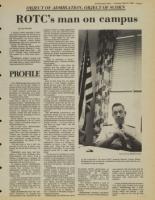
Doily Photo by DEBORAH LEWIS
As the University's Air Force ROTC program director, Colonel Robert
Shellenberger has weathered a good deal of controversy and criticism over
the military's role on campus.
on-campus military preparation, as
maintaining 'peace through strength'
demonstrating his religious
background by quoting the biblical
scripture, "Blessed are the
peacemakers for they shall be the
children of God."
"The military requires a kind of
'calling,' the same as a clergyman.
"Freedom of religion is one of the
things we dedicate ourselves to defend,"
he said.
Shellenberger attributes anti-ROTC
sentiment to a lack of understanding by
most students. The University unit, for
example, is involved in several com-
munity service organizations and is
now assisting with area plans for
Memorial Day observance this
weekend.
"I enjoy teaching, basically because I
very much enjoy working with young
people," Shellenberger said. "I know
I'll never make a big splash in the
history books, but maybe - just
maybe, a piece of me will go with
them."
Scanned image of the page. Keyboard directions: use + to zoom in, - to zoom out, arrow keys to pan inside the viewer.
May 24, 1983 (vol. 93, iss. 9) - Image 7
- Resource type:
- Text
- Publication:
- Michigan Daily, 1983-05-24
Disclaimer: Computer generated plain text may have errors. Read more about this.