
Arts
r
The Michigan Doily Thursday, May 6, 1982
Ormandy returns for May Fest
Page 7
By Jane Carl
FEW SMALL, midwestern cities are
fortunate enough to have a major
symphony orchestra in residence for a
week, but this year marked the 46th an-
niversary of the Philadelphia Or-
chestra's annual trek to Ann Arbor. As
usual, the city turned out in full force
for this musical and social event, as it
rarely does at events less prestigious
than the 89th annual May Festival.
The festival opened with Brahms'
Academic Festival Overture, Op. 80,
under the direction of conductor
laureate Eugene Ormandy, who was
also marking his 46th -year of May
Festivals in Ann Arbor. The not-so-
academic overture was written for an
honorary doctorate that Brahms
received and was based upon some.
school themes. Lacking some of the
customary Brahmsian lushness and
sobriety, it was given a pleasant per-
formance.
The Kabalevsky Concerto No. 1 in G
minor, Opus 49, for Cello and Or-
chestra, followed with Yo-Yo Ma as
soloist. Another less serious work, it
was dedicated to the Soviet Youth and
incorporated folk song material. The
young Ma, who gave his first recital in
Paris at age six, gave a brilliant and
heartfelt performance marred only by
the work itself and the orchestra's oc-
casional insecurity.
The last work of the evening, Sym-
phony No. 2 in D major, Op. 73, by
Brahms, promised the most and
delivered the least of any performance
all week. A pastoral work, most of its
romanticism was destroyed by Orman-
dy's dry interpretaion. The last two
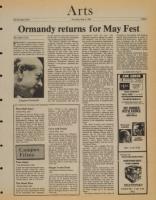
Eugene Ormandy
---A selection of campusfilm highlights
West Side Story
(Robert Wise, 1961)
For those of you not going to the
Stratford festival there is West Side
Story, a musical romp thorugh
Shakespeare's Romeo and Juliet.
Instead of renaissance Italy you'll
see '5fs New York; in the place of
two feuding families, two teenage
gangs at war. Even though Natalie
Wood didn't do her own singing, she
is still able to capture the sparks of
pubescent love. With all those great
songs "There's a Place For Us," "I
Feel Pretty,"and "I Want to Live In
America." (Thursday, May 6; Lorch
Hall, 7:00, 9:45).
Peter O'Toole is the enigmatic
director - you never know if he's
trying to kill the escapee, or save
him. The swift switches between
reality and fiction provide the basis
for much of the film's fun, but the
whole movie is the kind that is only
as good as its theme song. (Satur-
day, May8; Aud. A, 7:00, 9:15).
Love and Death
(Woody Allen, 1975)
Stiff-arming Dostoevsky, Tchaikov-
sky, and any other Russian-types,
Woody Allen starred in and directed
yet another laugh-a-minute film.
This is one of his early, funny films
- not as good as Annie Hall, nor as
insistently meaningful as Interiors,
nor as introspective as Stardust
Memories. Sticking to his forte of
strong, intellectual humor and still
portraying the '70s answer to
Chaplin's Little Tramp, Allen is
the perennial loser who doesn't
really understand what it all means.
(Saturday, May 8; Lorch Hall, 7:00.
8:40,9:20).
Singin' in the Rain
(Gene Kelly and Stanley Donen,
1952)
I can't believe that there is anyone
who hasn't heard of Kelly dancing in
the rain, or of Donald O'Connor
doing backflips off of walls. If you
haven't seen this movie already, you
owe it to yourself to see it the way it
was meant to be seen - on a big
screen in a real theater. (Sunday,
May 9; Michigan Theatre, 3:00, 5:00,
7:00,9:00).
--compiled by Richard Campbell-
movements fared the best. The
Allegretto grazioso retained its charm
and simplicity, and the final Allegro
con spirito was properly inspirational.
The second evening was the best of
the festival's four, with Aldo Ceccato
conducting and with Susan Starr as
pianist. The concert's first half con-
sisted of Bernstein's Symphony No. 2
for Piano and Orchestra, "The Age of
Anxiety." A personal and program-
matic piece, based on W. H. Auden's
poem of the same name, it depicts
humanity's quest for faith through the
drunken tale of three men and a girl ina
Third Avenue bar.
Probably Bernstein's bes effort, the
work began with an echotone clarinet
duet that was introspective and a
premonition of the events to follow. The
Masque, a jazz scherzo for piano and
percussion, was especially well per
formed. In a return to the original
feeling of loneliness, a mood which
Starr portrayed well, the Epilogue left
the work on a positive note with an
uplifting, ascending chorale.
The second half consisted of
Tchaikovsky's Symphony No. 4 in F
minor, Op. 36, which was the most
stirring performance of the week. Cec-
cato's manic, feverish movements lent
fire to what could have been just
another performance of Tchaikovsky's
Fourth.
The powerful Fate theme was ham-
mered out masterfully by the trumpets
and horns throughout the work. In a
retrospective vein, the second
movement contained a touching oboe
solo. The capricious third movement
was a lighthearted relief from its more
somber predecessors, and in complete
contrast to the delightfully bombastic
finale.
The third evening also featured
Maestro Ceccato, former conductor of
the Detroit Symphony Orchestra, direc-
ting Mendelssohn's Elijah, A Dramatic
Oratorio for Soloists, Chorus, and Or-
chestra, Op. 70. The work featured
baritone Sherrill Milnes, soprano
Louise Russell, mezzo-soprano Lorna
Meyers, tenor Henry Price, boy
soprano Bejun Mehta, and the Univer-
sity Choral Union.
Milnes was truly a delight. His rich,
resonant voice projected at all
dynamics and seemed to transform the
imposing performer into the prophet
Elijah. The Choral Union sounded and
looked impressive, as usual, but
seemed weak in the tenor section.
Tenor Price was musical and had a
pleagant voice, but often seemed to be
straining to be heard which adversely
affected his pitch.
Russell lacked enunciation and
projection, and the mezzo-soprano's
voice was generally too heavy and pon-
derous. Ann Arbor's own Bejun Mehta
presented the same pure, ethereal
quality he displays in each year's
Messiah presentation. He stole the
show from everyone but Nilnes. Cec-
cato's dictatorial manner had little ef-
fect on the sluggish orchestra at the on-
slaught of the work, but by the end, they
too were cought up in the glorious
finale.
The final evening saw the return of
Ormandy to the podium with Russian
pianist BelIa Davidovich as soloist. It
opened with Beethoven's tragic Over-
ture to Egmont, Op. 84. The under-
stated Ormandy drew an excellent per-
formance of the brooding, heroic over-
ture based on Goethe's Egmont. Here,-
the exceptional Philadelphia strings
were at their finest.
Bella Davidovich performed Rach-
maninoff's Concerto No. 1 in F-sharp
minor, Op. 1, for Piano and Orchestra,
with flawless virtuosity and passionate
dedication. Composed when Rach-
maninoff was eighteen, the work con-
tains many nationalistic and Tchiakov-
skian influences. The four-note motif
grows into three distinct entities during
See ORMANDY, Page8
INDIVIDUAL THEATRES
WEDSAT5UN
ony51.50
showsbefore
ENDS TONIGHT!
"BEALL PERE" 7:10, 9:10
STARTS FRIDAY!
"A UNIQUE BRILLIANT FILM"
-ROGER EBERT, CHICAGOSUN TIMES
MY DINNER
WITH ANDRE
DIRECTEDBY
LOUIS MALLE
FRI-7:15, 9:20
FOOLED YA!
HELD ONE MORE WEEK!
CHRISTOPHER REEVE
DYAN CANNON
Tom Jones
(Tony Richardson, 1961)
A film that broke through the boun-
daries of good, clean fun. Albert
Finney has the run of England as he
'loves-'em-and-leaves-'em all over
the place in this costume classic.
For romantics and cynics alike.
(Friday, May 7; Aud. A, 7:00,9:20).
The Stunt Man
(Richard Rush, 1980)
A man on the run from the police
hides out in the make believe world
of an on-location film company.
DEATHTRAP
THURS-FRI--7:30, 9:40
(PG)
Scanned image of the page. Keyboard directions: use + to zoom in, - to zoom out, arrow keys to pan inside the viewer.
May 06, 1982 (vol. 92, iss. 2) - Image 7
- Resource type:
- Text
- Publication:
- Michigan Daily, 1982-05-06
Disclaimer: Computer generated plain text may have errors. Read more about this.