
The Michigan Daily-Tuesday, August 5, 1980-Page 5
Minimal voter
turnout expected
today in Mich.
primary election
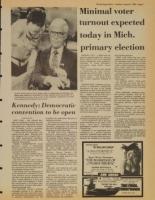
STAGE MANAGER NANCY Kaplan directs independent presidential can-
didate John Anderson's attention to various monitors on the set of ABC-TV's
Good Morning America show in New York yesterday. Anderson was in the
city to address the National Urban League.
Kennedy: Democratic
convention to be open
DETROIT (UPI) - A light voter tur-
nout was expected today in a primary
which offered little real suspense
beyond independent John Anderson's
challenge to crack Michigan's
notoriously tough ballot access
barriers.
State election officials were making
no predictions on voter turnout,
although they noted in 1968 - the last
primary with no senatorial or guber-
natorial contest - only about 23 per
cent of those registered bothered to
vote.
MINOR PARTY candidates and sup-
porters of Anderson's independent
presidential bid hope to get enough
signatures in today's state primary to
advance to the November general elec-
tion - despite a statute they say is
designed to keep them off the ballot.
Michigan, with 21 electoral votes and
a large bloc of independents, is central
to Anderson's campaign strategy.
A four-year-old state law requires
minor parties to collect nominating
signatures and then to garner about
4,060 votes in the primary to win a spot
on the November ballot.
NO MINOR party ever has survived
the rigorous qualifying requirements.
"In my experience, this is the most
severe restriction of any state in the
union," said Barry Commoner,
presidential candidate of the liberal
Citizens Party.
Commoner, in an impromptu news
conference on a Detroit sidewalk
yesterday, predicted many ballots will
be thrown out because voters do not un-
derstand the.mechanics of the third-
party ballot access law.
THAT LAW states that any voter
wishing to give a minor party a spot on
the November ballot may not vote for
any other partisan candidate. In other
words, a citizen voting for Commoner's
party today could not vote in the
primaries for state House, Congress, or
partisan local races.
Libertarian Party presidential can-
didate Ed Clark called the ballot access
statute "the most vicious law in the
whole country:
"It confuses voters," Clark said.
"The idea that you can't vote for a
county commissioner at the same time
you vote for a political party is purely
irrational."
PAUL SIERACKI, Anderson's Mid-
west political director, said the in-
dependent candidate considers the
statute an effort to "eliminate indepen-
dent and third party candidates from
successfully getting a place on the
ballot."
Anderson backers are "hopeful" the
Republican dropout will survive
today's primary but are not over-
playing their chances - lest voters take
the primary for granted and fail to
show up at the polls.
"It would be a travesty if in the state
of Michigan John Anderson would not
be able to be on this November ballot"
said Jay Heck, a field organizer for the
Anderson campaign.
Heck conceded the statute makes it
tough for independents and third party
candidates to get on the November
ballot, but said he does not believe the
system is "unbeatable."
From AP and UPI
NEW YORK - Sen. Edward Ken-
nedy said yesterday his forces have the
votes to turn the Democratic National'
Convention into a free-for-all contest,
but President Carter's campaign
chairman called the claim "baloney."
"I believe that the Democratic con-
vention will be open," Kennedy said,
with delegates free to support him or
any other presidential candidate,
regardless of the commitments made
when they were elected.
THOSE COMMITMENTS would
guarantee Carter a nominating
majority, and the first test of strength
at next week's convention will come on
a proposed rule to enforce them.
Kennedy said he is confident that in
an open convention he can wrest the
nomination from Carter.
But Robert Strauss said Carter's
majority is solid and won't be shaken
by the open convention challenge, a
rebellion that has gained headway amid
the controversy over the Libyan ties of
the president's brother, Billy.
ONE WEEK from the opening gavel
of the Democratic convention in New
York, Kennedy and his spokespersons
said they were gaining strength in the
effort to block adoption of a party rule
which would bind delegates to follow
the commitments of the primary elec-
tions and party caucuses which appor-
tioned nominating votes.
IN DENVER, Carter's political
strategists decided to be "gracious"
yesterday and came away from a hud-
dle with Democratic governors without-
a renewed endorsement for the
president the week before tile party's
national convention.
The Democratic governors, meeting
at the annual convention of the National
Governors' Association, also chose to
stay out of the fight between Carter and
Kennedy over convention rules.
AT THE same time, Republican
governors unanimously adopted a
resolution of support for GOP presiden-
tial nominee Ronald Reagan and ac-
cused Carter of "failure of leadership."
Also yesterday, Kennedy and in-
dependent presidential candidate John
Anderson addressed the convention of
the Urban League. Reagan paid a
hospital visit to the League's executive
director, Vernon Jordan, still
recovering from gunshot wounds suf-
fered during a sniper attack in Fort
Wayne, Ind., last month.
Reagan will address the league con-
vention today and Carter is scheduled
to speak to the group tomorrow mor-
ning.
Kennedy and Anderson got only
lukewarm 'receptions as they courted
black voters.
KENNEDY GOT his best response
when he attacked fellow members of
Congress for accepting free medical
care "for the slightest case of sniffles"
but opposing national health insurance
for the general public.
Independent candidate Anderson got
his warmest reception when he
criticized Carter, saying the country
needs a president who is "a vigorous
problem solver, not a tinkerer.. . a
real moralleader, not a moralizer."
Scanned image of the page. Keyboard directions: use + to zoom in, - to zoom out, arrow keys to pan inside the viewer.
August 05, 1980 (vol. 90, iss. 53) - Image 5
- Resource type:
- Text
- Publication:
- Michigan Daily, 1980-08-05
Disclaimer: Computer generated plain text may have errors. Read more about this.