
AIL M&
0
a
M
a
For Devin Funchess, a move out
wide and into football's future
By ZACH HELFAND
Daily Sports Editor
When Devin Funchess wasn't
busy leading his high-school team
to a Michigan Division II state
title, he was driving his coaches
crazy. On the field, Funchess was
budding into the versatile, multi-
purpose weapon that the Michi-
gan football team began to see
midway through the 2013 season.
But when he got to the sideline, his
mind would seem elsewhere.
After a series, John Herrington
- the coach of Harrison High
School in Farmington Hills, Mich.
- says that he'd mug for the cheer-
leaders. When the play called for
Funchess to block, Herrington
never knew what he would get.
"When he wanted to, when he
wanted to block, he could come
down and could really block," Her-
rington said. "When he wanted to.
He envisioned himself as more of
a split end, to be honest with you."
It took years, but Funchess
finally has his chance at Michigan.
The depth chart says he's the start-
ing tight end, but Michigan coach
Brady Hoke allows that he's "not
yet a traditional tight end." More
often than not, against Minnesota
and Penn State, Funchess was split
out wide as a receiver. Funchess
himself has pretty much stayed
loyal to the company line. He has
been pressed, but he has refused to
say he prefers one position to the
other.
"Personally, I just wanna help
the team," he has said.
Whatever he has become, this
much is without dispute: Funchess
has emerged as one of Michigan's
most dangerous offensive weap-
ons. Opposite fifth-year senior
Jeremy Gallon, he provides a big
presence and another top option
for redshirt junior quarterback
Devin Gardner. Funchess is listed
at 6-foot-5 and 235 pounds, but
that's likely an underestimate.
Hoke recently described him as
6-foot-6 or 6-foot-7.
In the two games he primar-
ily played split wide, Funchess
has 11 receptions for 263 yards
and three touchdowns, stretch-
ing the defense in the process.
Against Minnesota, he gashed the
secondary for a 46-yard reception.
Against Penn State, he beat the
safety for a 59-yard score.
The success has made the move
seem obvious. As a blocker, Funch-
ess still needs time to mature. He
had become a burden to the run
game and a liability in pass pro-
tection. He is not yet big or strong
enough, Hoke said, and "you don't
want to puta square peg in a round
between tight end and receiver.
What they all share is a freak-
ish athletic ability - big enough
to be adequate blockers yet fast
and nimble enough to beat any
defender in the secondary. And so
NFL teams began cherry-picking
college basketball players who fit
that mold.
point stance any more. Everyone's
spread out."
"We're starting to inherit a dif-
ferent type of athlete from the
college ranks," Barone said. "It
isn't like the old days when those
guys were big, thick, square-body
blockers or guys that maybe played
linebacker in high school and col-
said. But by then, his position had
already begun to change.
Funchess played on defense,
mostly at defensive end. On
offense, he played at traditional
tight end on occasion, but he often
split out in what Herrington called
the "slot loose" formation. From
there, Harrison would throw to
him on a backside seam.
When Harrison split out four
receivers, Funchess was one of
them. Near the goal line, Her-
rington would put Funchess wide
on one side and Aaron Burbridge,
now a Michigan State receiver, on
the other. Either way Herrington
called, Harrison would have an
easy fade.
"He was really tough to cover as
a tightend when we sent him down
the field, you can imagine, against
a linebacker," Herrington said.
"Really no one at the high-school
level could defend against him."
The idea, then and now at
Michigan, is the same one behind
the new wave of NFL hybrid tight
ends. Against linebackers, Funch-
ess is too fast. When split out wide,
cornerbacks give up upward of five
or six inches.
In fact, Hoke said Funchess
matches up best against a corner-
back or safety. Against Minnesota,
Gardner boxed out a defender
six inches shorter than him for a
touchdown. On a 46-yard comple-
tion to Funchess later in the game,
Gardner easily threw over a cor-
nerback five inches shorter than
Funchess.
"It's kind of like pick your poi-
son," said fifth-year senior safety
Thomas Gordon, who has the
occasional pleasure of defending
Funchess in practice.
That suits Michigan just fine.
When sophomore receiver Amara
Darboh suffered a season-ending
injury in the preseason, the Wol-
verines scrambled to find a No. 2
option. After six games, the run-
ning game has failed to establish
any continued success.
And so more recently, the big
plays have come over the top to
Funchess. In the end, when he
has streaked past safeties for easy
scores, it doesn't matter what posi-
tion you call him.
Information from Arnie Staple-
ton of The Associated Press was
used in this report.
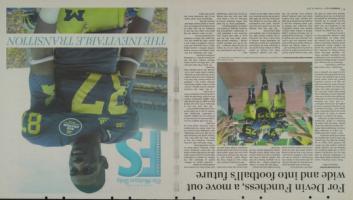
ADAM GLANZMAN/Daily
Sophomore tight end Devin Funchess has 11 receptions for 263 yards and three touchdowns in two games as a split wide out.
hole." But as a pass catcher, Funch-
ess has always excelled. So whytry
to make him something he's not?
In reality, though, the wheels
of change began lurching forward
when Funchess was still in pee-
wee, playing in the same league as
Gardner - his future quarterback.
As the National Football League
shifted to smaller, faster players,
hybrids have gained popularity.
Tony Gonzalez, who debuted in
1997, when Funchess was just 3,
changed the perception of the tight
end position. After him, Antonio
Gates and, more recently, Jimmy
Graham have blurred the line
And sure enough, Gonzalez,
Gates and Graham all played
hoops in college. (Gates spent time
at Michigan State for football and
basketball, and Eastern Michigan
for basketball before settling at
Kent State.) Soon, the prototype
of the modern hybrid tight end
trickled down to the collegiate and
high-school levels.
The NFL this year, through
the first five weeks, had the most
catches, yards and touchdowns
by tight ends ever. In college now,
said Clancy Barone, the tight ends
coach for the Denver Broncos, "It's
hard to find a tight end in a three-
lege."
As Gates had transformed into
the best tight end in the league
for the San Diego Chargers - and
one of the best offensive players
overall - Funchess entered high
school. Back then, like the new
wave of tight ends before him,
Funchess was a basketball play-
er. Herrington remembered that
Funchess thought of himself pri-
marily as a basketball player.
Basketball better fit his body
type. When Funchess arrived at
Harrison, he was a lanky teen-
ager who was "not very strong,
to tell you the truth," Herrington
4 FootballSaturday - October 19, 2013
Scanned image of the page. Keyboard directions: use + to zoom in, - to zoom out, arrow keys to pan inside the viewer.
October 18, 2013 (vol. 124, iss. 13) - Image 9
- Resource type:
- Text
- Publication:
- The Michigan Daily, 2013-10-18
- Note:
- This is a tabloid page
Disclaimer: Computer generated plain text may have errors. Read more about this.