
The Michigan Daily - michigandaily.com
Thursday, September 27, 2012 - 5A
The Michigan Daily - michigandailycomThursday, September 27, 2012 -
Election fever
missing on many
college campuses
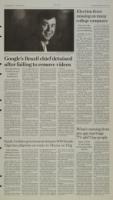
In this Nov. 22, 2011 photo, Google executive Fabio Jose Silva Coelho poses for a portrait in Sao Paulo, Brazil. Google Inc.'s head of operations in Brazil was detained
by the country's federal police on Wednesday after the company failed to heed a judge's order to take down YouTube videos that the court ruled were illegal.
Google's Brazil chief detained
afr f g
aO feSrZ al ormv ies
Anti-Islam film on
YouTube deemed
a violation of
Brazilian law
RIO DE JANEIRO (AP) -
Google Inc.'s head of operations
in Brazil was detained by the
country's federal police Wednes-
day after the company failed to
heed a judge's order to take down
YouTube videos that the court
ruled violate Brazilian electoral
law.
The detention came as another
court ordered YouTube to remove
clips of an anti-Islam film that has
been blamed for deadly protests
by Muslims around the globe,
both joining a spate of court-
ordered content-removal cases
against Google's video-sharing
website in Brazil.,
The arrest of Google execu-
tive Fabio Jose Silva Coelho was
announced in Sao Paulo. A press
release issued by the federal
police said he was not expected
to remain in jail and should be
released later in the day after
signing a document promising to
appear in court.
Brazil's strict electoral laws
limit what critics can say on
television, radio and the Inter-
net about candidates for office.
Ahead of municipal elections
next month, Google has received
repeated requests to remove Web
videos that allegedly violate those
restrictions.
A judge in Mato Grosso do
Sul state ordered Coelho's arrest
Tuesday because the company
had not removed YouTube videos
that make incendiary comments
about an alleged paternity suit
aimed at Alcides Bernal, who is
running for mayor of the city of
Campo Grande. That ruling also
included a statewide, 24-hour
suspension of Google and You-
Tube. It was not immediately
clear if and how that aspect of the
ruling mightbe carried out.
Google said Tuesday that
it was appealing the decision.
"Being a platform, Google is not
responsible for the content posted
on its site," the company said in
an emailed statement from Sao
Paulo.
A judge in the southern state
of Parana earlier ordered Google
to pay $500,000 for each day that
it balked at fulfilling an order to
remove other videos criticizing
a candidate. In the northeastern
state of Paraiba, a judge ordered
the imprisonment of another
Google executive in Brazil, also
for not removing videos from
YouTube attacking a mayoral
candidate, but that order was
overruled by a higher court.
Eva Galperin of the Electronic
Frontier Foundation, which pro-
motes digital freedom, said the
rash of Brazilian cases was "dis-
appointing, but not surprising"
ahead of the country's nationwide
municipal elections on Oct. 7 and
Oct. 28.
"The Internet is global, but
laws are made nation by nation,"
she said. "There is a struggle
between nation states and their
laws and the freedom of expres-
sion policies of companies that
host content all over the globe."
In a separate case pending
against Google, Sao Paulo-based
judge Gilson Delgado Miranda
gave the site 10 days to remove
video clips from "Innocence of
Muslims," which has angered
many Muslims around the world
by its depiction of the Prophet
Mohammed and his followers as
thugs. After the 10-day window,
Google will face fines of $5,000 a
day for every day the clips remain
accessible in Brazil, according to
the statement on the court's web-
site.
The company did not respond
to requests Wednesday for com-
ment about the case.
The "Innocence of Muslims"
ruling resulted from a lawsuit
by a group representing Brazil's
Muslim community, the National
Union of Islamic Entities, which
claimed the film violates the coun-
try's constitutional guarantee of
religious freedom for all faiths.
In a statement on the group's
website, Mohamad al Bukai, the
head of religious matters for the
Sao Paulo-based organization,
hailed the ruling.
"Freedom of expression must
not be confused with giving dis-
proportionate and irresponsible
offense, which can provoke seri-
ous consequences for society,".al
Bukai said.
Dozens of people have been
killed in violence linked to pro-
tests over "Innocence of Mus-
lims," which portrays the Prophet
Muhammad as a fraud, a woman-
izer and a child molester.
Attempts by courts and offi-
cials in several countries to
remove the clips have revived the
debate over freedom of expres-
sion.
The judge in the Brazilian
case acknowledged that banning
content from sites like YouTube
is a thorny issue, according to
excerpts of the ruling cited in the
National Union of Islamic Enti-
ties' statement.
"This type of jurisprudence
cannot be confused with censor-
ship," Miranda is quoted as writ-
ing. In the excerpts, the judge
defines censorship as "the undue
restriction of the civic conscious-
ness."
YouTube routinely blocks
video in specific countries if
it violates laws there. It also
removesvideo deemed to infringe
copyrights, show pornography,
contain hate speech or violate
other guidelines. However, none
of those restrictions had been
applied in Brazil to the "Inno-
cence of Muslims."
Google is now selectively
blocking the video clips in coun-
tries that include Libya and
Egypt. Google has said it made
the decision to block the video in
such places due to "the sensitive
situations" there.
Galperin of the Electronic
Frontier Foundation questioned
whether a ban was really neces-
sary in Brazil, which has seen
no protests or rioting that have
swept the Muslim world in recent
weeks.
"The notion that there's a need
to take it down to prevent vio-
lence is ludicrous," she said.
Miranda's ruling came on the
same day that Brazilian President
Dilma Rousseff addressed the
United Nations and urged an end
to prejudice against Muslims.
. Google has said it has been so
inundated by requests from gov-
ernments worldwide to remove
online content that it has begun
releasing a summary of the
demands, most relating to legiti-
mate attempts to enforce laws on
issues ranging from personal pri-
vacy to hate speech.
Four years ago,
youth enthusiasm
was overwhelming
ELMHURST, Ill. (AP) -
What a difference four years
can make.
In 2008, college campuses
were filled with campaign
posters and political ral-
lies - and frenzy. Remember
"Obamamania?" This year, it's
difficult to find a college stu-
dent who's truly excited about
the presidential race.
"Politics has gone back
to that thing you don't want
to bring up," says Abraham
Mulberry. He's a freshman at
Elmhurst College in suburban
Chicago who's trying to start a
club for young Democrats.
Last election, his campus
had an active Students for
Obama chapter, organized well
before the election. But this
time, there's nary a campaign
placard, for either President
Barack Obama or Republican
candidate Mitt Romney.
"I wouldn't say the election
is the No. 1 hot-button issue
here," Mulberry says, disap-
pointedly.
Granted, you don't see many
signs of campaign enthusiasm
in the neighborhoods that
surround his campus, or else-
where for that matter. But it's
telling that, on many college
campuses across the coun-
try - where, in 2008, then-
candidate Obama's messages
of "hope" and "change" easily
took hold - the mood is mark-
edly more subdued.
"Certainly, some (young
people) have stopped believ-
ing," says Molly Andolina, a
political scientist at DePaul
University in Chicago who
tracks young voters. "Maybe
that's inevitable. For structur-
al reasons, it's easier to offer
hope and change as a candidate,
than as a president.".
Excitement was so high, it
really had nowhere to go but
down, she says. This time,
there's also no obvious chance
to make history, as there was
when students helped elect the
country's first African-Ameri-
can president.
"For young voters, it was like
going to Woodstock in 1968,"
says John Della Volpe, the poll-
ing director at Harvard Univer-
sity's Institute of Politics.
Now like a lot of Americans,
they're more worried about
the economy and finding jobs.
Voter ID laws in some states,
which ban or restrict the use
of student IDs at the polls, also
are causing confusion on cam-
puses - at a time when stu-
dents are already weary and
cynical about political bicker-
ing in Washington.
"Lots of people thought
President Obama could go in
and break gridlock and that
didn't happen," says Ethan
Weber, a senior at Miami Uni-
versity in Ohio, who'll be grad-
uating in December. "That's
the scariest thing to a lot of
young people - that nothing is
going to happen."
In 2008, Weber cast a half-
hearted vote for Republican
John McCain, certain Obama
would win. This time, he's vot-
ing for Romney and sees the
election as a "toss-up."
He is still in the minor-
ity in the 18- to 29-year-old
age group, according to polls.
Young people are leaning
strongly Democratic, as they
traditionally do, and favor
Obama by a wide margin -
though some pollsters say the
youngest new voters are show-
ing signs that they may buck
that trend.
An Associated Press-GfK
poll conducted earlier this
month found that 61 percent
of registered voters in the
18-to-29 bracket support the
president, compared with 30
pefcent for Romney.
In 2008, young people
ended up voting for Obama by
a 2-to-1 margin, with just over
half of U.S. citizens, ages 18
to 29, casting a ballot in 2008.
Though older generations
are still more likely to vote -
about two-thirds of citizens
older than 30 did so in 2008,
for instance - youth turnout
was larger than it had been
in recent years, and was par-
ticularly notable because their
wide margin of support helped
lift Obama into office.
It remains to be seen, how-
ever, whether they'll show up at
the polls this time.
A Gallup poll taken Aug.
27-Sept. 16 found that 63 per-
cent of registered voters, ages
18 to 29, said they "definitely"
plan to vote. That Compares
with at least 80 percent of
registered voters in older age
brackets who said the same.
What's missing from
pro-gay marriage
TV ads? Gay people
Saudi Arabian government detains 908 female
Nigerian pilgrims en route to Mecca on lajj
Rule requiring
husband to travel
with women causes
deportation threats
ABUJA, Nigeria (AP) - The
detention of hundreds of female
Nigerian pilgrims heading to
Mecca at Saudi Arabia's busi-
est airport over a rule requiring
them to travel with a husband
or male relative is threatening
to bring a diplomatic dispute
between the two nations.
Saudi authorities are hold-
ing 908 Nigerian women in poor
conditions "with some needing
urgent medical attention" at King
Abdulaziz Airport in Jeddah and
threatened to deport them, the
National Hajj Commission of
Nigeria said in a report submitted
to Nigerian lawmakers Wednes-
day.
The report said female pil-
grims who had landed in a small-
er airport in Medina had been
unaffected.
However, Fuwaiba Muham-
mad, a pilgrim, told an Associ-
ated Press reporter at Mallam
Aminu Kano International Air-
port in the northern Nigerian
city of Kano that she had been
deported Wednesday from the
Saudi Arabian city of Medina,
along with dozens of others.
Uba Mana, a spokesman for
the National Hajj Commission,
said no pilgrim had been deport-
ed by Saudi authorities yet, but
that the commission had asked
for female pilgrims who did not
meet the Saudi immigration offi-
cials' requirements to temporar-
ily be brought back to Nigeria to
avoid deportations.
"Medina is a small airport,"
Mana said, "and if we allow peo-
ple to get deported from there,
the pilgrims won't be able to
return to Saudi Arabia for anoth-
er five years, and by no fault of
their own," he said.
This is the first time pilgrims
have faced the possibility of mass
deportation over the male escort
issue, the commission has said.
Accordingto the report, an agree-
ment between Saudi Arabia and
Nigeria exempts female pilgrims
from requiring a male relative
to escort them for the manda-
tory Hajj pilgrimage, which costs
about $4,000 per person.
Until now, state pilgrimage
officials had been allowed to
stand in the place of a male rela-
tive or husband. Muhammad, for
instance, said that she had been
fraveling with a Hajj official who
is not her relative.
But Saudi authorities have
proven much stricter this year.
They even stopped women who
did travel with their husbands.
"Islam allows wives to bear
the names of their parents and
not necessarily that of their hus-
bands," the report argued.
All able-bodied Muslims who
can afford it are expected to per-
form Hajj at least once in their
lives, leading people to go to
great lengths to make the trip.
Some pilgrims sell their cows
and jewelry and others save for
months or years to pay their own
way to Mecca. Muslim philan-
thropists and politicians in Nige-
ria will typically sponsor some
pilgrims annually.
Mana had said Monday that
the escort situation had been
resolved through diplomatic
channels, but the commission's
report Wednesday said Saudi
authorities have "remained ada-
mant."
The report said top Nigerian
officials had held meetings with
Saudi officials in Nigeria and in
Saudi Arabia in a bid to come to
reach a compromise.
Nigeria's Foreign Ministry
sent a letter of undertaking guar-
anteeing the return of the female
pilgrims after Hajj, it added, but
Saudi authorities still did not
release them.
Nigerian President Goodluck
Jonathan put together a high-
profile delegation late Wednes-
day to travel to Saudi Arabia "as
soon as an appointment is final-
ized with the appropriate author-
ity," a government statement
said.
Saudiofficials couldnotimme-
diately be reached for comment
Wednesday.
Nigeria, a nation of more than
160 million people evenly divided
between Muslims and Chris-
tians, and Saudi Arabia are both
members of the Organization of
Islamic Cooperation, an umbrel-
la organization representing 57
Muslim nations.
Hopes to break
32-state losing
streak in upcoming
election
MINNEAPOLIS (AP) - In
one TV ad, a husband and wife
talk fondly of a lesbian couple
who moved into their neigh-
borhood. In another, a mar-
ried couple speaks of wanting
fair treatment for their lesbian
daughter. A third features a
pastor talking supportively
about gay unions.
Each of these ads ran recent-,
ly in states with gay marriage
issues on the November ballot.
What's missing? Gay people
speaking for themselves.
Four states are voting on
gay marriage this fall, and gay
rights groups are pouring tens
of millions of dollars into key
TV markets in hopes of break-
ing a 32-state losing streak on
the issue. But even as gay peo-
ple and same-sex relationships
gain acceptance through pop
culture staples such as "Mod-
ern Family" and "Glee," the idea
is still seen as dicey by media
strategists involved in the ballot
campaigns, resulting in ads that
usually involve only straight
people talking about the issue.
The decision to keep gays in
the background has been wide-
ly noticed in the gay communi-
ty and debated on gay-oriented
blogs, with some activists com-
plaining that the move contra-
dicts the central message of
the gay rights movement for a
number of years.
"If we don't show ourselves,
people aren't going to get com-
fortable with who we are,"
said Wayne Besen, director
of Vermont-based gay rights
group "Truth Wins Out," one
of many that presses gays to
live openly with pride in who
they are.
But others counsel defer-
ence for the complexities of
public messaging, pointing
out that the ads are designed
to speak to the fears and val-
ues of the heterosexual major-
ity, whose vote will decide the
issue.
"The moderate tough guys
we need to flip to win a cou-
ple of these races are still the
ones who say that gays are
gross," said Andy Szekeres,
a Denver-based fundraising
consultant who has worked on
several state campaigns and
had access to focus group data.
"Pushing people to an uncom-
fortable place, it's something
you can't do in a TV ad," said
Szekeres, who is gay
Scanned image of the page. Keyboard directions: use + to zoom in, - to zoom out, arrow keys to pan inside the viewer.
September 27, 2012 (vol. 123, iss. 18) - Image 5
- Resource type:
- Text
- Publication:
- The Michigan Daily, 2012-09-27
Disclaimer: Computer generated plain text may have errors. Read more about this.