
I
9 9 V ~V
-. a' v w
ormer Michigan linebacker Jarret Irons said it best: "When
great players play with certain numbers they want to give it to
someone who has that type ofpotential."
No one scoffs at Vincent Smith for wearing Charles
Woodson's sacred No. 2. Desmond Howard's No. 21 is worn
by another receiver, Junior Hemingway, but hell isn't raised
over it. And Desmond was kind enough to share his number
with Tim Biakabutuka. History will stumble over itself like
that at a place like Michigan.
Jon Falk, the Michigan equipment manager, has been
around long enough to see his share of that history.
He's just the man I'm looking for this morning. I step into
his office, which is cluttered with memories. You'd figure
that'd happen if you've been around the Michigan football
team since Bo Schembechler coached.
My eyes wander, I'm looking for clues, trying to dig deeper
into the mystery of one of the loneliest traditions at a school
that prides itself on its past.
Why is this jersey so special? How could a singular maize
digit ruin a life and complete it at the same time? Rich Rodri-
guez had been nearly tarred and feathered over it.
Earlier this spring, Braylon Edwards, the last receiver
to wear the No. 1, met with the new Michigan coach Brady
Hoke and gave his blessing to the coach, saying it was up
to Hoke to choose who was worthy of the jersey. After he
was hired, the No. 1jersey was the first thing Hoke and Falk
spoke about. It meant too much to not take precautions.
A jersey doesn't make the player, but where would some
players be without it? Anthony Carter, Derrick Alexander,
Tyrone Butterfield, David Terrell and Braylon Edwards may
have built the legend, but it wasn't without sacrifice. A little
piece of each lives on with it. A price each one paid to wear it.
Anthony Carter was the origin. Without him, there's no
story to tell. Nearly a decade later, Derrick Alexander res-
urrected the jersey, just like he did his own career. Tyrone
Butterfield realized how heavythe weightof the jersey could
be. Nearly everyone thought he had disgraced it. Dave Ter-
rell was handed the jersey, but Michigan wasn't about to
hand him the throne. And then there's Braylon Edwards -
the boy who needed time to understand what it truly meant
to earn his dream.
Falklooks down at a white sheet of paper he had prepared.
It lists every player who's ever worn the jersey at Michigan.
"Well, as you know, the No. 1 jersey has a little bit of his-
torical value here at Michigan," Falks begins. "You can go
through some of the names."
Falk rattled off a few of them - a left tackle, a defensive
back, a kicker, and a few others. None of whom I was looking
for. And I knew Greg McMurtry had also worn the number,
but he isn't a main character.
"Now, and those were all great people," Falk says, "but the
No. 1 gotto be a great deal when Anthony Carter got the No.
1..."
IHow five
BY: TIM R
a jersey it
I
I1
ANTHONY
CARTER
CLASS OF
1982
Every day ofhis life, JohnWangler wakes
up with a sore knee. He can't run on it any-
more or play basketball. It's bone on bone
now, and he knows eventually it'll need to
be replaced. He's lucky to have gotten as
much out of it as he did.
During his last year at Michigan, more
than 30 years ago, his knee was in no shape
to run Bo's option offense, but his arm was
fine.
He had history to make, stories to tell his
kids how hethrewthe ballcto Anthony Cart-
er, the painfully shy, 170-pound, chicken-
legged, magical wide receiver that changed
the way Bo Schembechler played football.
Bo always had a soft spot for Anthony.
Maybe it was because the coach knew
Anthony needed a special touch, so far
away from hishometown in Florida. Maybe
Bo was protective. Anthony left the team
for three days, homesick, before his fresh-
man year even started. His mother prompt-
ly made him go back. So Bo took care of him
on the field, made him comfortable, eyen
called him "Little Schemmy." Like a father
would.
The guys saw how Bo smiled when he
yelled at Anthony. How he teased him. How
he gave the No. 1jersey to Anthony because
he said he wanted the little guy to look big-
ger. And yet, deep down he knew Anthony
was special.
In his first week of practice, Anthony ran
a post route over the middle, and the pass
was thrown well behind him and high in
the air. Mid-stride, he jumped and spun
his body back towards the ball, timing it all
perfectly. It looked like he was flying. After
a split second he came down, still in stride,
and kept running. Everybody else on the
field just stopped.
It was easy for Wangler to trust Anthony.
"He really did some stuff that not a lot of
people walkingthis earth could have done,"
Wangler says.
But Anthony wouldn't open up to just
anyone. He had a few buddies he'd talk to,
and that was it. Luckily, Wangler worked
his way into his circle early on. Anthony
trusted him because the receiver knew deep
down his quarterback cared about him.
"On the field we just had a connection,"
Wangler says now. "He knew
where I wanted to throw the
ball. He'd make the reception
and it'd just work. He was just
one of those guys in your life
that you really sync with him
from day one."
If they were really going
to change the way Michigan
played football, it'd take the
two of them - Bo's favorite
player and one gutsy quarterback.
The year was 1979. Anthony was a fresh-
man and Wangler was the pocket-passing
veteran locked in a quarterback battle with
the option-quarterback wizard B.J. Dickey.
It was a battle of styles - passing the ball
and the power running game versus the
option offense sweeping the college foot-
ball landscape- and Anthony clearly stood
on one side. Through the first eight games
of the season, if Wangler was in the game,
most of the passing plays were designed for
Anthony, who was the team's No. 3 receiver
as a freshman. And at first, Bo just rotated
quarterbacks, going with the hot hand.
Anthony would go only as far as Wangler
did.
But Anthony was too talented for that
to last - talent took matters into its own
hands on acold and rainy afternoon against
Indianaon Oct. 27,1979. Michigan was sup-
posed to dominate the Hoosiers and Dickey
had started the game, but he was injured
in the second quarter. So Wangler had his
shot.
Unexpectedly, the score was tied, 21-21,
with 1:31 left. The stage was set - Wangler
had the ball at the 45-yard line, with Michi-
gan's 7-1 record on the line.
Anthony brought the play into the hud-
dle. It had him running his favorite route,
a post, right over the middle. For some rea-
son linebackers and safeties could never
get a good angle on him - Wangler always
thought it was because Anthony ran just
as fast sideways as he did forward. Now he
would have to score or the game would end
in a tie.
"Throw me the ball," Anthony said confi-
dently as they broke the huddle.
"You better get open," Wangler snapped
back.
Bo took off his blue cap and ran his fin-
gers through his hair before the snap.
Wangler dropped back, faked the hand-
off, stepped up and threw a spiral to Antho-
ny, who caught the ball at the 20-yard line.
Two Hoosiers collided behind him as he
kept his balance like he always did, and
he scooted up field. His chicken legs - the
ones everyone said were too skinny for the
Big Ten - carried him past a diving defend-
er and into the endzone.-
27-21. Anthony was mobbed by his team-
mates. The crowd was delirious.
On the sidelines, Bo jumped up and
down, pumping his fists like a little kid.
The score read: Michigan 7, Washington,
6, but Bo was furious at halftime of the 1981
Rose Bowl. This was Bo's fourth Rose Bowl
in five years, but he had never won the big
game. That monkey on his back was getting
bigger. This was his chance to beat a West
Coast team, win the damn thing. And Wan-
gler wasn't gettingAnthony the ball.
"You've got to get the ball in the air to
Anthony," Bo pleaded with his quarterback.
"He's been covered, you don't want me to
another option quarterback, Rich Hewlett,
ran the offense just the way Bo liked.
Bo thought Wangler's career was fin-
ished anyway. He offered Wangler a spot
as a graduate assistant and the quarterback
shrugged him off. That type of knee injury
like that usually took a year-and-a-half to
recover from in those days, but Wangler was
going to play.
Then that summer, Wangler and Little
Schemmy worked for Jon Falk. In their free
time, they'd play catch.
Bo ultimately gave Wangler a chance in
the second game that season against Notre
Dame, and he made a game of it before
Michigan lost. The next week Wangler
quarterbacked another close loss against
"IF THERE WAS A PASS THROWN
IN (ANTHONY'S) DIRECTION,
EVERYONE IN THE STANDS
STOOD UP BECAUSE THEY KNEW
THERE WAS A GOOD CHANCE
SOMETHING EXCITING WAS
ABOUT TO HAPPEN."
South Carolina loss. Wangler sensed it: "We
haveAnthony. We have receivers. We're com-
mitted to going this direction."
And Wangler was the key to unleashing
Anthony - with him in the game, the coach
grew comfortable with the veteran check-
ing the defense at the line of scrimmage and
airing it out when opponents stacked the
box. Heck, Bo was still coaching the team,
so they'd still pound the ball with Butch
Woolfolk and Stan Edwards. But, this, this
was just a smart move.
"If you've got eight men defending the
run and three defending the pass, that's not
very good odds against Anthony," Carr says.
Bo stuck with Wangler the rest of the sea-
son and Michigan won out, riding the Wan-
gler-to-Anthony connection all the way to
the Rose Bowl.
Now, Bo was in Wangler's face, with the
Rose Bowl on the line. How dare he not get
the ball to Anthony. For the first time all sea-
son he had to make a point of it. Wangler
obliged.
"Look at the legs," a TV announcer mar-
veled. "His thighs are about as big as his
calves. What a move!"
The guy whose jersey draped off his
frame like a curtain was torturing the sec-
ondary. Then, with the ball placed on the
seven-yard line, it appeared there was some
confusion on Michigan's sidelines as to
what play to run.
Anthony stood next to Bo until Bo finally
uttered a few words to him, grabbed his
pads and pushed him onto the field as if to
say, Justgo take care of this for me, okay?
The No. 1 jersey streaked across the end-
zone, through Washington's zoneunguard-
ed, running that post route it loved so much.
Wangler hit Anthony for an easy score.
Butch Woolfolk ran for 182 yards that
day, but it was Little Schemmy that opened
the game for everyone. His stats read: five
catches, 68 yards, one touchdown and four
rushes for another 33 yards, and one defense
scared silly. He proved the perfect weapon,
capping his first of an unimaginable three-
straight All-America seasons.
As the sun set on the picturesque scene
at the Rose Bowl, sitting on the sidelines
with his team ahead 23-6, Wangler finally
allowed himself to reminisce. Wangler-to-
Carter accounted for 12 touchdowns that
season and half of all of Wangler's 1,500-
plus passing yards.
Wangler's last shot, Bo's Rose Bowl ring,
it all wouldn't have been possible without
Anthony, Wangler thought.
"I'm really glad you came back when you
were a freshman," Wangler saidto Anthony,
"because I don't know if anyone would've
known my name if you didn't."
TheMichiganDaily, www.michigandaily.com 7
force it in?" Wangler argued. He had a point
- Anthony had been double teamed for the
majority of the first half. But Bo wasn't hav-
ing any of it. No excuse was good enough for
why Anthony had zero catches at halftime.
"Force the ball to Anthony, will you
please?" Bo said. "He'll do the rest."
Had Bo really just begged Wangler to air
it out? -
So much had changed that season. But
how did he end up here, at the Rose Bowl?
At first it looked like anotherquarterback
was destined to share the spotlight with
Anthony. After the miracle against Indiana,
Wangler was in and out of Bo's good graces
due to the quarterback's inconsistent play.
Then Lawrence Taylor tore nearly every
ligament in Wangler's knee in the Gator
Bowl, right at the end of Anthony's fresh-
man season.
Wangler knew that Bo, in his heart of
hearts, still wanted to run the option. With
Wangler out of the picture that spring,
South Carolina, 17-14. That was a new low -
Michigan had lost five of its last six games.
"Everybody thought Rome was crum-
bling, the dynasty, the whole deal," Wangler
says. "Everyone was questioning Michigan
football, Bo, everybody. It was a mess."
What Bo did next fixed everything: he
rested his offense squarely on the shoulders
of a young, spry Anthony Carter.
One up-and-coming defensive backs'
coach saw the transition unfold from his
seat high above the action in the press box.
"If there was a pass thrown in (Antho-
ny's) direction, everyone in the stands stood
up," says Lloyd Carr, "because they knew
there was a good chance something excit-
ing was really about to happen."
Before Anthony, when a quarterback
would enter the huddle Bo would essential-
ly have him call two plays: a run to the left
and an audible to run to the right, if the QB
didn't like what he saw at the line.
Something shifted inside Bo after that
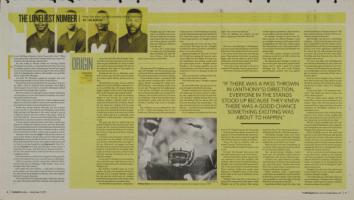
Anthony Carter celebrates after he catches the game-winning touchdown against Indiana in 1979.
6 1 FootballSaturday - September 3, 2011
Scanned image of the page. Keyboard directions: use + to zoom in, - to zoom out, arrow keys to pan inside the viewer.
September 06, 2011 (vol. 122, iss. 152) - Image 64
- Resource type:
- Text
- Publication:
- The Michigan Daily, 2011-09-06
- Note:
- This is a tabloid page
Disclaimer: Computer generated plain text may have errors. Read more about this.