
- Im -M
v
.w
w
.m w
The Nlichigan Dady - Wedriesdav. October 21. 2009
CIPP,
Deferring dreams for anillness
hether we like it or not,
our decisions in life are
often made because of
issues we can't control.
I had to learn this the hard way
when I didn't get to come to the
University of Michigan my fresh-
man year.
It started my senior year of high
school, when my health rapidly
deteriorated. I went from being
an active, athletic teenager to not
being able to climb a flight of stairs
without help.
The first sign of my condition
appeared when my feet seemed to
gain 10 pounds after a workout.
Within days, the swelling crept
up my legs, giving me cankles, a
tragedy for any 17-year-old. When
it was clear the problem wasn't
going away on its own, I showed
my mom.
That's when the never-end-
ing parade of visits to the doctor
began.
First I was told I had "hor-
mones" and to wait it out. When
this didn't work, I was given high
dosage Lasix, or water pills, to
flush out the excess fluid in my
legs, which was what caused the
weight gain. When Lasix didn't
work, I was given more, which
still didn't work. This continued
for over a month, with the doctor
simply telling my mom and me not
to worry so much about my mys-
tery condition. "Stop thinking this
was a zebra when it was really just
a horse," he said.
Meanwhile, I continued to dete-
riorate. Regular doses of water
pills had taken their toll on my
body. The swelling got worse, my
face turned pallid, my hair thinned
and I could never manage to keep
warm.
Watching me grow worse, my
mom became more and more insis-
tent that I see a specialist. First I
visited a cardiologist, who checked
me into the hospital and referred
me to a nephrologist, who prompt-
ly scheduled me for a kidney biopsy
and myriad other tests.
My kidney biopsy was the worst
experience of my life. Instead of
International
Career
PathwayS
International Opportunities Fair
Thursday, October 22, 2009 - 2-6 pm, Michigan Union
Meet representatvesof 55+ arganizations ta explao acptioa sar
intemnships, vlunteering, teaching abraad & international eareers
International Careers Speaker Series
Careers & Internships in U.S Government Foreign Affairs
Thursday October 15, 6:00-7:30 PM, Weil Hal aRoom 1120 (Ford school Bldg)
InternationaclCareers in Climate Change
Wedndesday Otoer 21, 10-2:30 PM, Dana Skid Room 1040
Careers In Global Health
Wednesday Ocba r21, 5:00-6:30 PM, Michigan Union
Global Careers in Engineering & Technology
Wednesday October 21, 6:00-8:00 PM, Chrysler Commons Lobby (N. Campus)
Teaching & Volunteering Abroad
Wednesday October 21, 7:00-8:00 PM, Michigan Union
Peace Corps & Your International Career
Thursday October 22, 7-8:30 PM, Michigan Union
Need more information?
647-2299 naicoverseas@umich.edu a http://internationalcenter.umich.edu/swt
Sponsored by:
Tho Ccoaer Cernter - ea dCanterorlobal annah-Thi Center for Global and Inteaultural Stdy
Calleae of Engineering - Genald R. Frd School a) Public Polcy - Geninanic Laguages and Lieatuires
International Centerhi I ntenationalInstitute
The School of Information ~ The School of Natural Resources and the Environment
The School of Public Health ~ The School of Social Work
being sedated for the procedure,
I was only given something to
relax and a topical anesthetic that
was slathered all over my back. I
was painfully aware as the doc-
tors measured my back and drew
on me with a marker like I was a
poster illustrating the cuts of meat
My college plans
were set - until
my health
started failing.
on a cow. Then, face down, I had
to hold my breath as a needle was
inserted directly into my back. I
learned later that when you hold
your breath your kidneys hold still,
making it easier for the doctor to
get a sample.
After this ordeal, we found out
the sample taken was from the
wrong part of my kidney, so I had
to have the whole procedure done
again. Meanwhile, I got sicker and
sicker, and the things I enjoyed
became harder and harder to do -
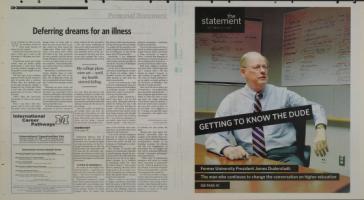
DUDERSTADT
From page 5C
buderstadt believes that it
important for the University to
do what it can to change its public
and state perception. At the Uni-
versity's bicentennial in 2017, he
said he hopes the celebration will
"at least get the university com-
munity and alumni to realize the
impact of this institution goes well
beyond what happens on Saturday
afternoons."
TILTING AT WINDMILLS
His vision of what higher edu-
cation should be - especially at a
place like the University of Michi-
gan - still drives the majority of
Duderstadt's current work.
Duderstadt continues to travel
the country quite frequently. He is
a sought after voice on higher edu-
cation and a popular commence-
ment speaker. Despite his North
Campus office, he admits that
like goingto school, playingsports,
driving and being with my friends.
I no longer felt like myself or even
really recognized the shell of a per-
son I had become. It was not the
senior year I'd bargained for.
Eventually, I was diagnosed
with a rare, chronic kidney disease,
which made accepting my offer to
attend the University of Michigan
out of the question.
In the end, I interviewed for a
full-tuition scholarship at a south-
ern liberal arts college, which I
attended because its small size
made getting to class from my
dorm room possible.
It was by no means easy. I had
to live in a handicapped room, my
classes were moved to the first floor
of buildings because I couldn't
climb stairs, and I was always ill -
I took up to 15 pills a day.
I grieved deeply, something I
hadn't done since I lost my dad
years earlier. I felt guilty and even
selfish for feeling the way I did
because I was only grieving for
myself - the person I used to be
and the future I had wanted. Iwent
from being someone who thought
she knew her path in life to feeling
like I was living in submission to
my health. Some kind of health-
related episode - from food poi-
most of his activities since step-
ping down as president have been
external to the University.
"I do teach and have programs
here, but my influence on higher
education or science or whatever
is not in Ann Arbor," he said. "It's
in Europe or Washington or wher-
ever I happen to be."
The number of lectures and
projects on Duderstadt's schedule
is mind-boggling, though the dry-
erase boards in his office help him
stay on top of it all. As an appro-
priate example, he is involved
in something called the "Save
the World Project." That project
involves defining what the United
States needs to do to create a sci-
entific foundation for addressing
issues like global climate change,
Duderstadt explained.
When it comes to the future
of higher education, Duderstadt
feels the nature of the University
is quickly shifting. Ten years from
now, he said, Michigan could be
enrolling hundreds of thousands
soning to meningitis - constantly
hindered my lifestyle.
Tired of wallowing in self-pity, I
joined an online support group for
people with my disease and found
a large community of support.
There, I learned that diagnosis of
my disease in someone my age is as
rare as finding a four-leaf clover -
just the kind of luck I didn't want.
With time, vigilance, medicine
and hard work, I slowly improved
and I realized what I still had
despite my ordeal. I learned to
take nothing for granted. That's
why when my health stabilized, I
set my sights on finally getting to
the University of Michigan. And
this fall, I transferred here.
After all of the extra work I put
in to get here - not academically,
but emotionally and physically -I
have a poignant appreciation of my
ability to climb the stairs to class
and attain the college education
I fiad always taken for granted. I
know the world works in mysteri-
ous ways, but sooner or later, we
all get where we're supposed to
be. A bumpy journey just makes
the destination that much more
meaningful.
-Ashlyn Gurley is a writer
for The Statement
of students per year across the
globe.
Though that may sound far-
fetched, Duderstadt cited the
example of the British Open Uni-
versity, which offers long-distance
correspondence classes, as an
emerging example. He stresses
that the core competencies of
universities may not change, but
they will be expressed differently
through "immersive technology"
and connectedness
"What kind of spontaneous
emergence will occur in a world
where everybody is connected?"
he said. "What is going to be the
new Google or the new Al-Qaida?
That's an exciting world - one that
I'm not going to be around for."
It will be up to others to figure
out how education, democracy and
intellectual humanity are shaped
in the future. But as long as he is
around, James Duderstadt contin-
ues to have the will, insight and
influence to ensure we at least
know what we're in for.
Scanned image of the page. Keyboard directions: use + to zoom in, - to zoom out, arrow keys to pan inside the viewer.
October 21, 2009 (vol. 120, iss. 30) - Image 15
- Resource type:
- Text
- Publication:
- The Michigan Daily, 2009-10-21
Disclaimer: Computer generated plain text may have errors. Read more about this.