
V V V V V
M- m m m
0
w
9
w w
w
w
w
WensaJnay7 200 - wh ihia a
4 The Michigan Daily -Wednesday, January 7, 2009
Consider these options:
A. Every student shaves his
face or puts on his make-up
before he visits home.
B. Every student shaves their
face or puts on their make-
up before they visit home.
C. Every student shaves hiS
or her face or puts on his or
her make-up before he or she
visits home..
D. Every student shaves hir
face or puts on hir make-up
before ze visits home.
Gender confusion, mismatched ante-
cedents, bulky construction and unrecog-
nizable words - these sentences and their
problems aren't likely to go unnoticed by a
professor's red pen.
There are easy solutions to rectify these
grammatical quandaries: make Sentence
B plural or for Sentence A, use both "his"
and "her" for the coordinating activities
and switch in "visiting" for "he visits."
But those edits evade the fact that the
English language lacks an unquestioned,
singular pronoun that can stand in for an
individual, regardless of gender.
It might seem like a petty issue - some-
thing spawned from political correctness
or academic stuffiness - but once "some-
body rips his panty hose" or a friend asks
whether it is "your sister or brother who
holds his breath the longest," even the
strictest English teacher would have to
admit there is a problem.
Attempts to introduce genderless alter-
natives to the English lexicon like "ze" and
"hir" stretch back to the 1800s. But as can
be seen everywhere from the presidential
election to Facebook News Feed and per-
haps even your last term paper, the gener-
ic-pronoun question still dogs the English
language.
THE PRESIDENCY AND'SHE'
Pronouns were front and center in the
last Democratic primary race, with Sen.
Hillary Clinton (D-NY) forcing "she" into
the presidential candidate discourse.
The linguistic novelty of the situation
tripped up even Clinton herself. At a rally
in Virginia last May, she told a crowd that
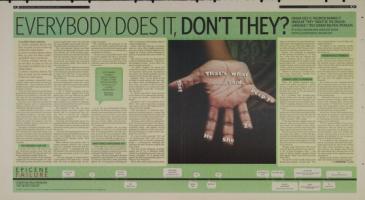
EPICENE
F A I LU R E
issues brought up by voters "are ones that
the next president can actually do some-
thing about if he actually cares about it."
The well-educated Clinton was likely
drawing from long-taught grammar rules
that promote "he" as the standard singu-
lar pronoun before any subconscious belief
that the president must be male. But in
any case, the senator didn't let the slip go
uncorrected. According to the Associated
Press, she quickly added: "More likely, if
she cares about it."
As the Democratic National Convention
approached, Clinton paid close attention
to her pronouns and antecedents, routine-
ly using "she" and "her" in any sentence
she began with "the next president of the
United States."
The pronoun choice expressed confi-
dence that might have swung a few voters,
but what it also did was prove that neither
"he" nor "she" can be detached from the
sexes they represent.
"'She' is marked as female, and 'he'
is marked as male," English Prof. Robin
Queen said. "It's very difficult for people
to actually get a gender neutral read."
The concept of gender-neutral "he"
again cropped up in Clinton's campaign,
as seem in a lawsuit filed last April to keep
Clinton off the Nevada ballot.
The plaintiff of the suit, the Reno
Gazette-Journal reported, argued that
because the U.S. Constitution uses "he"
and "him" to describe the president,
women are constitutionally prohibited
from holding the office.
Ironically, this Reno-based man's rea-
soning parallels that of feminist ideologues
of the 1960s women's movement who also
rejected the notion that "he" could be gen-
der neutral.
"The push back against generic 'he' was
definitely coming out of the feminist move-
ment," said English Prof. Anne Curzan,
co-author of the linguistic guide, "How
English Works."
When someone uses generic "she" or
another pronoun instead of "he," Curzan
said, it's a challenge to the idea that lan-
guage is neutral - a challenge that Eng-
lish speakers have found disturbing, or in
other cases, too petty a point to be taken
seriously.
" 'It's just language, it doesn't matter.'
'Leave it alone. 'It's a silly issue', " Curzan
said. "We want to believe that our lan-
guage is neutral."
But underlining the dismissal of the
generic "he" debate could be the fear that
grammatical rules and social equity might
not be so disconnected as contemporary
sensibilities would like.
"People have strong beliefs about what
is correct English and what is incorrect
English and when you challenge those,
people are surprised and they aren't sure
what they want to do with that challenge,"
Curzan said.
'SHE' IS MARKED
AS FEMALE,
AND 'HE'IS MARKED
AS MALE.IT'S VERY
DIFFICULT FOR PEOPLE
TO ACTUALLY GET
A GENDER
NEUTRAL READ.
ENGLISH PROF.
ROBIN QUEEN
"they" in sentences with singular subjects
without explanation.
Queen said that Murray's correction
came at a time when English grammar-
ians were trying to bolster legitimacy for
English as a formal written language by
making it grammatically more similar to
Latin.
She said part of this was ignoring the
tendency of English speakers - and in sev-
eral incidents, writers - to use "they" as a
generic singular pronoun.
"In spoken English, the plural has
always been around or been around for a
very long time," Queen said. "In respect to
the generic 'he,' people probably saw the
argument that it's not really a generic."
Singular "they" can be found in the
writings of classic authors like Jane Aus-
ten, Mark Twain and Shakespeare, who
used "they" at times to refer to yet-un-
known characters or in conjunction with
general singular nouns like "everybody"
and "someone."
In "Romeo and Juliet," Friar Laurence
warns Romeo of an approaching interlop-
er: "Arise; one knocks ... Hark, how they
knock!"
But generic "he" is no invention of the
1880s. The neuter masculine pronoun
dates back as far as Old English and the
advent of written English.
This discrepancy in historical prec-
edent and common usage is a reason why
the grammatical debate persists today and
why efforts to introduce truly gender-neu-
tral pronouns stretch back for centuries.
Startingasearlyas1850, accordingtothe
book "Grammar and Gender," the alterna-
tive pronoun "hiser" has been championed
repeatedly (albeit, with slightly varying
spellings) by different writers and gram-
marians looking for a single word to sup-
plant "his" and "her."
In a more recent movement, "hir" and
"ze" (pronounced "here" and "zee") are
sometimes used to describe transgender
people ~ a contemporary challenge that
confronts the idea of epicene English like
never before.
Then there is the colloquial, seemingly
organic rise of "yo" in Baltimore public
schools as a catchall pronoun for men and
women. Examples: "Yo is passing back
papers" for "She is passing back papers" or
"Peep yo" for "Peep him."
But as 19th century grammarian James
Rogers wrote about the experimental pro-
noun "thon," the nongender pronouns "ze"
and "hir" and any other that might arise
are likely doomed to fail "because every-
one has to be told how to pronounce it."
Rogers, who attempted to propagate
his own pronoun inventions "e," "es" and
"em," wrote that only the "shortest and
easiest" pronouns stand a chance. But
changing language isn't as simple as find-
ing the right word - it means convincing
people at large to use it in both speech and
writing, which is something even Murray
couldn't fully achieve with generic "he."
"Efforts to introduce an artificial pro-
noun have historically, soundly been
unsuccessful," Curzan said.
OBAMA'S GUIDE TO GRAMMAR
Today, the English language leaves
writers and public speakers in a pickle,
having to attach their singular nouns to
the potentially alienating "he," the cum-
bersome "he or she" or the conventionally
ungrammatical "they."
It's a problem that President-elect
Barack Obama also ran into during his
campaign. Known as the "articulate" can-
didate, or by some the "too-intellectual" or
"elitist" candidate, Obama's syntax choic-
es were up for more than just grammatical
scrutiny.
The conscientious politician must have
been aware of the criticism he risked if the
media's hyper-scrutiny ever fell upon his
singular pronoun usage: "he," sexist; "he
- or she," academic; "they," dumb.
To the close listener, a single sentence in
Obama's half-hour pre-election commer-
cial exposes his thoughts on the matter:
"Every parent in America wants the same
thing. A good education for their child."
The inaccurate pronoun wasn't notedby
any major news outlets - in fact, the gen-
eral watcher probably didn't notice it at all,
which is exactly why the Obama campaign
must have found it advantageous to script
the grammatical error into the prerecord-
ed commercial.
Obama's usage falls in line with recent
research showinga decline in use of gener-
ic "he" in favor of singular "they" - one
study of British English speakers found
that singular "they" was used 95 percent
of the time.
"To use 'he' or 'she' would sound overly
formal and scripted," Curzan said. "If it
was a scripted choice, it was to follow the
spoken standard."
To appeal to the Amerigan people,
Obama must have reasoned, it was best to
sound like them, no matter what the gram-
mar books say.
FACEBOOK KILLS'THEMSELF'
But whereas Obama goes in for populist
syntax, Facebook.com, another favorite of
the youthful masses, eradicated singular
"they" from its News Feed and Mini Feed
operations last summer.
It used to be that Facebook referred to
users who didn't list a sex on their profiles
as "them," which led to such News Feed
stories as "John Doe edited their About
Me" and "Jane Doe tagged a picture of
themself." '
But starting in June, Facebook forced
their unassigned users to choose a sex. A
prompt appeared when these users signed
on telling them that while they didn't have
to list a sex in their profile, they must select
to be referred to as either a male or female
in feed publications.
"'Themself' isn't even a real word,"
Facebook product manager Naomi Gleit
wrote in the company blog. "We've used
that in place of 'himself or herself.' We
made that grammatical choice in order
to respect people who haven't, until now,
selected their sex on their profile."
In the June 27 post, Gleit explained that
the change was made to avoid the awk-
wardness of "themself" and confusion
in translating feed stories into other lan-
guages used on Facebook.
"(W)e've gotten feedback from trans-
lators and users in other countries that
translations wind up being too confus-
ing when people have not specified a sex
on their profiles," Gleit said. "People who
haven't selected what sex they are fre-
quently get defaulted to the wrong sex
entirely in Mini-Feed stories."
It is suspicious how Facebook's new
stance on grammar coincided with adver-
tising spots along the side of the website
that target users according to age, sex
and interests. But despite other factors,
the networking site's decision hits on all
the major points of the singular-pronoun
conundrum.
Ruling out the clumsy "himself or her-
self," the website first turned to singular
See PRONOUNS, Page 6C
As for the case challenging Clinton's
candidacy, the Nevada court threw out the
lawsuit, asserting that the use of"he"in the
constitution is not specific to men alone.
But this reaffirmation of gender-neutral
"he" more likely stems from modern-day
ideas of women's rights and interpreta-
tion of the constitution than the belief that
"he" is epicene.
Since women couldn't vote, let alone
hold office, in 1787, it's not unbelievable
that the founding fathers did only have
men in mind for the presidential office.
And of course, there's the fact that generic
"he" was never officially recognized as a
grammatical rule in English before 1794.
WHAT WOULD SHAKESPEARE SAY?
Lindley Murray, anAmericangraimar-
ian, is thought to have first promoted "he"
as a generic singular pronoun in his widely
circulated "English Reader" in 1974.
Murray, who also disparaged dangling
prepositions and endorsed "it" as the prop-
er pronoun to describe a child, prescribed
generic "he" in his guide by switching out
ne, nis, nim;
hiser
le, lis,rlim
emulates French
hee, hirnt,
his'er, his'er's
from Chicago Tribune artice
s/he, him/er, his- shev, shem, sheir
or-her
ala, alan.alis
emulatesLatin"ar' for "other"and Hawaiian epicene
pronouns "oia" and "ia"
en
thir
hse
g O
originated colloquially i Blmoe,
GENDER-NEUTRAL PRONOUNS
THAT NEVER TOOK OFF
SOURCE: "The Epicene Pronouns: A Chronology of the Word that Failed" and the University of Pennsylvania's blog, The Language Log
ons
derivedfrom"one-
ha, hez,
hem
se, Sim, ss
ho, hom
hos, homself
derived from"homoL.atin for"human"
ghach
created frcio,55,, nallnuge Vulman in the
"5StrTek"TV so
hu
pronounced"huh"
Scanned image of the page. Keyboard directions: use + to zoom in, - to zoom out, arrow keys to pan inside the viewer.
January 07, 2009 (vol. 119, iss. 68) - Image 16
- Resource type:
- Text
- Publication:
- The Michigan Daily, 2009-01-07
Disclaimer: Computer generated plain text may have errors. Read more about this.