
0
0 0
a .S
0
a "
V~dnsay ovmbr 208Dal
4B he ic iga Diy ededaNoe be 60
Near the forest-enclosed man-
sions of Barton - Drive, one of
Ann Arbor's wealthiest neigh-
borhoods, stands a17,000 square
foot warehouse holding enough imperish-
able food to sustain a large family through
several nuclear winters.*
Along with condensed milk and canned
goods, the warehouse's two-story shelves
are stocked with bags of carrots the size of
a short adult, a rainbow spectrum of cereal
boxes and a cornucopia of juice boxes.
But what might seem like a lifetime sup-
ply of groceries isn't going as far as it used
to for Food Gatherers, the food bank that
owns the warehouse.
"More people are seeking food assis-
tance than ever before," said Kate MacE-
wen, director of the annual fund for Food
Gatherers.
The swirling haze of dismal economic
news of the last year is a headache for
the nation's economic leadership. But for
a growing portion of Michigan's middle
class, financial distress hits right in the
stomach.
While the state's stagnant economy has
increased the need for aide organizations in
recent years, food banks statewide report a
drastically sharper increase in demand for
2008.
"It's been over the last six months that
food banks are reporting that they're not
able to keep their supplies stocked," said
Jane Marshall, executive director of the
Food Bank Council of Michigan, a food dis-
tribution network serving more than 2,500
food banks across the state.
Marshall said demand has risen up to 40
percent for some of the council's partner
agencies.
The spike in people seeking food aide is
directly correlated with the economic cri-
ses of the last year, food bank staffers said.
The mortgage crisis, auto industry layoffs,
the wildly vacillating stock market and
surging energy prices have compounded to
send precariously balanced household bud-
gets hurdling over the edge.
"These are the people that have mort-
gages, they have car payments, they have
kids in college," Marshall said. "These are
the people who haven't ever had to ask for
help before ... These are the foreclosure
people, too, you know."
Meals for the middle
class
Every Friday morning at the Second
Baptist Church in Ann Arbor, Harvey Glaze
races around the church's large recreation
roomgiving hugs and spouting off orders in
preparation for the commotion of a weekly
food and clothing distribution program.
As the church's human services ministry
director, Glaze - or Brother Glaze to cli-
ents and volunteers - witnesses the chang-
ing face of hunger from the front lines.
A year and a half ago, Glaze said, the
program gave away somewhere between
60 and 75 large grocery bags each week.
Nowadays, weekly distribution is between
100 and 125 bags.
What's more striking than the increase
in demand, though, is who the extra gro-
ceries are going to.
The Friday morning program's clientele
has traditionally been - and still predomi-
nantly is - the elderly residents of nearby
subsidized housing and people who have
struggled with extreme poverty. But in 12
years of directing the program, Glaze said
he has never seen so many individuals and
families from conventional households.
"I'm finding at this point and time we're
seeing more of the middle class coming
when it used to be more people on the pov-
erty line," he said.
Sitting quietly, waiting to collect their
bags after the 11 a.m. devotion service - or
joiningthe line later, once the sermon ends
- newcomers to the program have a sheep-
ish air about them, Glaze said.
"The first time they come, they are
somewhat, how should I say... they have to
throw away the pride," he said. "They are
not arrogant, for sure, but after they have
come here - the way we reach out to them
with the love and that kind of thing - it
very quickly discards the feeling that they
are being degraded."
To accommodate the batch of new cli-
ents, Glaze has had to ask the church's
congregation for a specific kind of donation
they weren't used to making: children's
clothes Families with young children
make up a larger portion of the program's
clientele than ever before.
Sarah Hierman, director of programs for
Food Bank of Eastern Michigan, said the
400 agencies in the regional network have
seen an increase in the number of families
seeking their services.
"Families are particularly ' being hit
hard," Hierman said. "I think that is defi-
nitely a population that our agencies are
seeing more and more - and young fami-
lies, in particular."
Even without layoffs and bad mortgages,
increasing food prices have Michigan fam-
ilies feeling the strain of trying to stretch
one or two incomes to feed three, four or
five people.
Since October 2005, the price of white
bread in urban Midwest areas has risen
65 percent, according to date compiled by
the Bureau of Labor Statistics. The average
price of bread for all U.S. cities rose 34 per-
cent in the same time.
Efficient banking
practices
If individuals suffer from the spike in
food prices, one would think a food char-
ity industry that supplements community
donations with bulk purchasing would
definitely experience a crunch.
But luckily for the people who depend
on them, the nation's food banks are much
more prepared for a downturn than Wall
Street investment banks or the Detroit
Three automakers. Every food bank repre-
sentative interviewed said that her organi-
zation has been able to meet the increase
in demand.
Food Gatherers director MacEwen said
that the food bank has increased its budget
for purchasing food by 187 percent to sat-
isfy larger and larger orders from 150local
food aid programs that rely on groceries
attained through Food Gatherers.
. Glaze, whose food aid program at Sec-
ond Baptist Church receives more than 95
percent of its provisions from Food Gather-
ers, said the county food bank has provided
for increasing number of clients.
"If we didn't have enough they make
every effort to increase it, and they usually
do," he said.
Food Gatherers has grown immensely
since its founding in 1988, when it operated
out of one room above Zingerman's Delica-
tessen with a single truck to deliver food.
Today, Food Gatherers acts as the county's
preeminent food charity, providing enough
food for 7,500 meals a day.
But backing Food Gatherer's opera-
tion is a nationwide web of food sources.
Just as the Second Baptist Church pro-
gram receives food from the county bank,
Food Gatherers is one of the many recipi-
ent agencies in the Food Bank Council of
Michigan's network.
The statewide council solicits large-
scale donations from national aid orga-
nizations like United Way and Feeding
America as well as big food producers like
Kraft Foods.
After receiving its share from the Food
Bank Council, Food Gatherers can bar-
ter for shipments from the national net-
work Feeding America with credits that
are allotted depending on the number of
people served and the poverty level of the
area. Once Food Gatherers has used its
credits, it can purchase food at extremely
discounted prices.
Food Gatherer's ability to buy and store
large quantities means the food bank
largely escapes the hurt of escalating food
prices that individual families feel, MacE-
wen said.
"It is more expensive for us to purchase,
but we have tremendous purchasing power
because of the warehouse," she said.
Another route to procuring mass ship-
ments of food is petitioning grocery stores
and producers to donate special edition
items that are no longer marketable but
still completely edible.
MacEwen said that around the release
date of the movie "Get Smart," Food Gath-
erers got a large donation of a special ver-
sion of Sierra Mist produced to advertise
the film, "Undercover Orange." The same
thing happened with Halloween-themed
cereal after October 31, as well as another
experimental Sierra Mist flavor that failed
to take hold of the grocery shopping pub-
lic, "Cranberry-Splash."
Community giving
on the rise
For all the limited edition soda that
might find its way to the Food Gatherers
warehouse, the real source of the food
bank's supply is local.
Of 4 million pounds of food distrib-
uted in the last fiscal year, 73 percent was
donated locally by restaurants and gro-
cery stores or by individuals through food
drives.
MacEwen said the amount of food dis-
tributed increased while the percentage
that was donated locally stayed relatively
constant - meaning that community giv-
ing has also increased.
Both Hierman and Marshall, from the
Food Bank Council of Michigan, said their
organizations have managed to keep up
with demand thanks in part to community
giving.
"Individual giving is actually up," Hier-
man said. "I think the community itself has
seen this as a very necessary service. Mich-
igan obviously has been going through our
own recession for much longer and I think
our donors see food as a necessity."
It's fortunate that community giving has
escalated because donations by corpora-
tions are on the decline.
In Washtenaw County, the loss of Pfizer
- the large pharmaceutical company that
shook the area when it closed its Ann Arbor
site - can be felt in a more subtle way than
the direct elimination of jobs. Food Gath-
erer's is coming to the end of a grant that
was funded by the pharmaceutical compa-
ny to pay for a supply of Boost Plus, a pro-
tein drink that supplements the diets of the
area's more vulnerable food bank clients.
"Pfizer was definitely a loss to the com-
munity," MacEwen said. "They provided a
lot of volunteers, too."
Hierman, with the Food Bank of Eastern
Michigan, said the network has seen a drop
off in donations from corporations that
used to give regularly.
"We used to have an abundance of Kel-
logg's cereals and now our particular food
bank receives much less," Hierman said of
the Battle Creek-based cereal company.
It's true that Michigan's economy was in
dire straits long before Lehman Brothers
CEO Dick Fuld found himself out of a job.
But it might have taken doom and gloom
headlines heralding a $700 billion bail out
and the swan song of the auto industry for
Michigan residents to realize their neigh-
bors could be in need.
"I don't think it'll be any harder this year
to meet the needs," Marshall said about the
reliability of community donations. "One of
the good things about a bad economy is that
people believe it. 'I know someone who's
losing their house' or 'I know someone who
lost his job: "
But looking at donations in November
and December is no way to gauge commu-
nity generosity six months from now. As
all the food bank representatives said, the
holiday season is the season of giving - an
impulse that wears out or falls to the way-
side come January 1st.
Last week, the Food Gatherer's ware-
house was stocked with boxes upon boxes
holding turkeys and hams that were about
to be distributed for Thanksgiving - more
boxes than might have been provided in
past years, but still not enough for every
client who would like to put on a traditional
dinner.
But as all the food bank employees
agreed, summer will be the true test of
the charity food industry's capability to
meet the mounting need. Families whose
children would get one good meal through
government programs at school are left to
their own means for months. Food drive
organizers aren't yet thinking of their
annual goals. And many economists are
predicting that the recession will likely
worsen in the next six months before
things get better.
It remains to be seen whether a bad
economy and a long summer will remind
people that hunger doesn't happen only
one time a year.
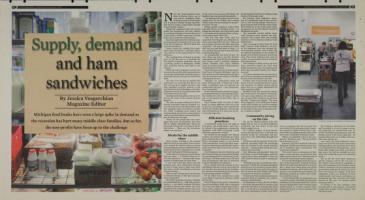
Scanned image of the page. Keyboard directions: use + to zoom in, - to zoom out, arrow keys to pan inside the viewer.
November 26, 2008 (vol. 116, iss. 60) - Image 12
- Resource type:
- Text
- Publication:
- The Michigan Daily, 2008-11-26
Disclaimer: Computer generated plain text may have errors. Read more about this.