
I B Te icign aiy - ednsday Feb uar s0
Why the
BMShOIB0Is
overrated
The Ross School of Business dupes the
rankings and trades imagination for group work
0 0 0
Wednesday, February 7, 2007 - The Michigan Daily 4
QUOTES OF THE WEEK "I could sit here and talk to
you about the buildings I'm
cc I am surprised, frank- building in Chicago and Las
ly, at the amount of Vegas, but I'm sure you'd
distrust that exists in much prefer to see Andy Dick
this town. And I'm actually forcefully removed
sorry it's the case, and from the stage."
- IVANKA TRUMP, daughter of Donald Trump,
I'llwork hard to try to after comedian Andy Dick was removed from "Jimmy
Kimmel Live by security guards when he continu-
elevatei , io ously rubbed her legs and hair.
-PRESIDENTBUSH Wa s "Our job is to bash the presi-
political chilly climate in an inter- dent. That's what we do."
view with National Public Radio's - EVAN THOMAS, a top Newsweek edtior, when
Juan Williams asked about a media bias at the magazine.
TALKING
POINTS
Three things you can talk about this week:
1. Gay sheep
2. How Al Gore made it too cold to walk to class
3. Biden's slip
And three things you can't:
1. The Superbowl
2. New York Fashion Week
3. Aqua Teen Hunger Force
undreds of students send in
an application to the Ross
School of Business every
year, and hundreds get only a rejec-
tion letter. The lucky few who
are accepted become one of the
1,200 elite students admitted into
a school that consistently places
within the top five in national rat-
ings.
I was one of them.
But after a semester, I couldn't
take it anymore. I dropped out. Not
because of bad grades or a tough
curriculum - far from it. I dropped
out because I knew that I wasn't
going to learn anything valuable
sitting in those over-renovated
classrooms, regardless of what The
Wall Street Journal say. And even
though there are Ross alumni in
all walks of life - CEOs of major
companies, mail room clerks and
the middle managers in between
- that will sing its praises, Ross,
hopelessly dedicated to ratings, has
become hopelessly overrated.
Ross isn't designed to produce
innovators like Larry Page, the
Google pioneer and an alum of the
University's College of Engineering.
Actually, the program is most effec-
tive at churning out uninspired
office functionaries and managerial
consultants. The B-School prepares
you for the sort of professional
business careers that are essentially
dead weight in the economic sys-
tem. It's the type of career idea men
- notably Warren Buffet - publicly
disdain.
But all that is a well-kept secret.
In finance class you'll never see a
diagram with "middle manage-
ment" or "consultant" next to your
name. You also won't hear that
for the most part you'll just move,
play with, analyze and talk about
wealth, rather than create it. That's
for the engineers. Except, of course,
when it's not - then it's just for
the graduates of a better business
school.
The coursework is a torrent of
fanciful, fictional case studies in
which corporate strategy boils
down to a simplistic system of
equations and cryptic variables.
Students endlessly calculate prob-
lems involvingthe distribution of
product A to Firms B and p with x
trucks and y dollars. To the mas-
terminds of the B-School program,
management is a science, and busi-
ness is a problem that can be solved
if you have the right variables. It's a
dangerous mindset, and the wrong
one.
The admissions process is geared
toward students with good GPAs
in introductory classes who spend
their spare time earningtitles like
marketing director, head of stu-
dent relations and executive vice
president in various student orga-
nizations. Because the admissions
committee only uses a student's
first year at the University in its
analysis, and because it's difficult
to differentiate yourself from oth-
ers taking the same prerequisite
classes, students are encouraged
to join organizations - not for the
cause, but the rdsum6 line.
A likely candidate would lap up
conversation about deliverables,
corporate strategy and mission
statements, but zone out when the
conversation turns to better ways
to sell sandwiches, or what drove
Facebook's growth or why the
Michigan Union's Wendy's fran-
chise is among the highest-earn-
ing in the country. After all, those
things couldn't possibly show up on
the test.
The curriculum is accordingly
bereft of rigor. In operations and
management science class, for
instance, students learn material
over an entire semester that would
take 45 minutes in an LSA econo-
metrics class. Students spend three
weeks discovering that flipping
heads with a quarter three times in a
row has a probability of 1 in 8. They
power through Excel spreadsheets
with longcolumns of data. And
learn Bayesian statistics by plugging
numbers into tables. While Bayes-
ian statistics could help later in life,
most students would benefit more
from simple arithmetic.
And advanced arithmetic - at
YOUTU BE
VIDEO OF
THE WEEK
One more reason to
read the Economist
OK, you succumbed to the Econo-
mist's "Get four issues free!" pop-up
advertisement, but the magazines just
now stopped arriving.
while you mull over whether to
continue letting the magazine paint
you a clearer picture of the world - no
longer free, but at least 67 percent off
newsstand prices - watch thisEcono-
mist commercial from the 1990s.
It begins in the first-class cabin of
an airplane. "You're sitting in seat 2A,
wondering who'll be sitting next to
youinseat2B,"intonesadistinguished
British voice over a mildly pomp-and-
circumstance-esque tune played by a
trombone.
While the "you"insuspenders and
natty side-part reclines with a glass
oftwine, the flight attendant leadsothe
occupant of seat 2B to his place.
Who is it? Henry Kissinger.
"Ready for a good chat?" con-
cludes the commercial's narrator.
How can you not immediately
jump to your checkbook when
reminded that you could have for-
mer U.S. secretaries of state as fel-
low readers?
-KIMBERLY CHOU
See this and other YouTube videos
of the week at
voutube.com/user/michigandaily
BY THE NUMBERS
ANGELA CESER E/Daily
Groups of Business School students toil over mandatory group work. Wadingthrough coursework laden with cryptic math prob-
lems, are students taught to think outside of the box?
least the practical kind - is lacking side." I also got docked on a problem students can use Excel and Pow-
as well. We'd pull numbers from set because my group's names were erPoint and instill management
the back of the book rather than not in alphabetical order. The focus "best practices" (there's actually a
derive them, or use rules instead was clearly on the terms and pro- whole class that basically teaches
of analysis to answer a question cesses, templates and formatting you how to write professional
(for example, we were taught to - the skeleton of the problem. The memos. But do they practice what
read Excel Solver output by saying real intellectual meat is an after- they preach? One description for a
"If this number is0, then it means thought. three-paragraph assignment ran
X" without being told why. The Maybe the cause of all this is two pages long). In short, they do
answer, incidentally, had to do with that business professors are by whatever sounds good on a rdsu-
negative marginal returns). If a definition not quite right for their m6. The profs don't run companies
program is rigorous, even remedial jobs. At least in math or even eco- or make great products. Most have
kids will do great things, but if it nomics departments (at the top no place at all in the actual world
only teaches procedures, it makes universities), the people who teach of business.
everyone a robot. are leaders in math and econom- So what really propels Ross into
An almost mechanical obsession ics; they publish important papers, the highest realms of college rank-
with formula haunts the curricu- work for influential committees ing?
lum. I lost credit on a problem for and then run classes in their Group work - the sine qua non
writing100A =200 - 20B instead of spare time. B-School professors of the undergraduate business cur-
100A + 20B= 200 because they "pre- make it clear they've been reading riculum.
fer all the decision variables on one The Wall Street Journal, ensure See ROSS, page 7B
Billions of dollars in the president's proposed budget thatwould be
dedicated to military operations with all supplemental requests are
added
Percent of the proposed federal budget dedicated to defense-related
expenditures
Number of billions of dollars the proposed budget will direct
toward the National Endowment for the Arts
Source: Slate.co and The Washington Post
I PIVIW AIK I YT )UbUU ) I 1lvi
Mock Rock - Dress up like your favorite athlete
dressed up as a character from the Lion King. If you're
feeling really generous, charge guests extra for beer
and donate the prof it to Mott Children's Hospital.
Throwing this party? Let us know: TheStotement@umich.edu
RANDOM WIKIPEDIA ARTICLE
OF THE WEEK
General Custer
George Armstrong Custer (December 5, 1839-June 25, 1876) was a
United States Army cavalry commander in the American Civil War
and the Indian Wars. Promoted at an early age to brigadier general,
he was a flamboyant and aggressive commander during numerous
Civil War battles, known for his personal bravery in leading charges
against opposing cavalry.
He led the Michigan arigade whom he called the "Wolverines"
during the Civil War. He was defeated and killed at the Battle of
the Little Bighorn against a coalition of Native American tribes led
by Sitting Bull and Crazy Horse. This maneuver of pushing a situ-
ation to the brink succeeds by forcing the opposition to back down
and make concessions. This might be achieved through diplomatic
maneuvers by creating the impression that one is willing to use
extreme methods rather than concede. During the Cold War, the
threat of nuclear force was often used as such an escalating measure.
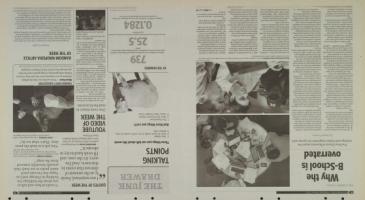
Scanned image of the page. Keyboard directions: use + to zoom in, - to zoom out, arrow keys to pan inside the viewer.
February 07, 2007 (vol. 117, iss. 93) - Image 13
- Resource type:
- Text
- Publication:
- The Michigan Daily, 2007-02-07
Disclaimer: Computer generated plain text may have errors. Read more about this.