
fts easy to
fall love
wi k A2
nn Arbor first seduced me dur-
ing orientation. Orientation
undoubtedly sees its fair share
of seductions; mine was innocent.
I was sitting at the Brown Jug with
a bunch of similarly uninitiated orien-
tees, discussing the Rolling Stones
song "Beast of Burden" The god of
the Jug must have heard, because
about 30 seconds later a local radio
station began piping that very song
throughout the restaurant.
This coincidence didn't seem spe-
C at the time, but since then I've
come to think of it as the first subtly
perfect moment I experienced in this
town. Over the past three years, the
Jug has subsequently played host to
numerous late-night escapades and
boondoggles. Week by week, the unas-
suming establishment has become a
landmark of my college career.
The initial incident and the gradual
*ctions that followed are emblemat-
ic of how this
Ulbe £idiigan ?filg
NEW STUDENT EDITI
LN- N
Iu
F
SECTION
SEPTEMBER 8, 1998
College town
ranks among
nation's best
town worked its
way with me and
a lot of other peo-
ple.
It's like the
scene in "Ferris
Bueller's Day
Off" when
Cameron intense-
ly stares at the
Georges Seurat
painting. Up
close, all the ele-
JEFF
ELDRIDGE
Hip
ments look jumbled and absurd, but
when regarded at a distance, all of
these tiny, abstract components pro-
duce an elaborate and sublime image.
There are the bombastic, celebrato-
ry memories that play themselves out
on South University Avenue after
ery big Michigan victory. When the
Iverines won the hockey champi-
onship this past spring, thousands of
people dashed down the street, carry-
ing enormous maize and blue flags
and declaring victory at the tops of
their lungs before dispersing to nearby
bars and restaurants. Such triumphant
instances are few and far between.
For the most part, the history of
my love affair with Ann Arbor is writ-
ten in smaller moments - a night last
er eating dinner on the roof of
with friends, and then wandering
up and down a crowded Main Street;
swing dancing at the Blind Pig in
early spring; sitting on the floor of the
Gypsy Cafe in Kerrytown while listen-
ing to a local band.
My infatuation with this city is not
unusual, but it is a bit extreme. Maybe
because I hail from Big Rapids, Mich.,
a small town in the northwest part of
testate, I am more easily impressed
than people I know from New York,
Philadelphia and Washington, all of
whom profess fondness for our college
town but always with a sense of reser-
vation.
Perhaps Ann Arbor lacks the cultur-
al and artistic offerings of major ast
Coast cities - but there are other things
it lacks, too, including violence, pollu-
tion, abject rudeness and confusion.
Valid objections can be raised
ad~t this city: Rent is invariably
high, and the town as a whole tends
to embrace things on the pricey side.
The city certainly has elitist under-
currents. Yet, on a seemingly contra-
dictory note, I know some East
Coasters who label the town too
small and provincial.
Regardless, I've come to consider
Ann Arbor an understated Midwestern
q ia. The Michigan Theater repre-
ms its embrace of elegant and off-
beat culture; Kerrytown's unpreten-
tious quirkiness is disarming; Main
Street's shops and restaurants are a
haven from the stress of campus; and
at the heart of the city, the University
is in a class by itself.
Before I became so lovestruck, I
saw the city as icing on the cake.
Absorbing yourself in this great uni-
versity, the city at first becomes a neg-
li ible frame for the intensity of acad-
ccs and social life.
But eventually, Ann Arbor came to
mean something more than a new
stomping ground or an adopted home-
town.
Much of the city is populated by
former students who couldn't quite let
go after graduation. Someday that may
include me. Not long ago I was talk-
ing to the parents of a friend - both
em alumni - who, between
t Min, hold four degrees from the
University and sent both of their kids
here. They still regret that they didn't
settle down in Ann Arbor, instead of a
Detroit suburb.
This is not the first time I heard
such testimony, and it always makes
By Heather Wiggin
Daily Staff Reporter
On a typical Ann Arbor evening, the
city is milling with families taking
walks, students going out for dinner and
maybe even a row of motorcycles
parked on Main Street.
A group of bikers gathered around a
table outside Espresso Royal Cafe to
chat over coffee one evening this past
spring. The sight of burly men having
civilized conversation may strike some
as surprising, but in Ann Arbor it is not
an unusual scene.
Money magazine ranks cities across
the United States each year and although
the rankings fluctuate greatly, Ann Arbor
has received high rankings in recent
years. In 1997, Ann Arbor was ranked as
the 68th best place to live and in 1996 it
was ranked the fifth best city in which to
live. The rankings are based on numerous
categories, including economy, health
care, crime, housing, and the arts.
Money has consistently given Ann
Arbor high rankings in health care and
economy, stating that the economy is
"fueled by its hometown college, the
36,000-student University of Michigan."
The city of Ann Arbor has a popula-
tion of 109,608 people according to the
last census taken in 1990. Approximately
36,000 of those residents are students.
But many of the people found in Ann
Arbor are from surrounding towns and
come to wine and dine, see a movie or
play, or just to hang out.
"There aren't. many places in the
metro Detroit area where you can sit
down at a cafe," explained area resident
Bob Kiessel, a motorcyclist who visits
Ann Arbor with friends for coffee.
Kiessel received both his Masters
degree and his MBA from the University.
"Now my daughter goes to school
here," he said. "This isn't a place where
I'd want to raise a family, but it's a great
place to go to school."
Also biking through the city was
Matt Schwartz, who said he enjoys Ann
Arbor "because it is so culturally
diverse, not just racially diverse.
"In a normal town it becomes cliche
after a while (but here) you could talk to
a skater and he could be an intellectual,"
Schwartz said.
Many people said they find Ann
Arbor is a good place to go out-and get
away from their hectic schedules.
Bill and Mary Stockwell said they
usually come to Ann Arbor during
weeknights for dinner and people
watching. They added that they share an
appreciation for the many different
activities available in the city.
"We love the diversity, we love the
restaurants, and we really like the activi-
ty," said the Stockwells, who are Chelsea
residents. "We've gone to different plays
... the bookstores are great ... it's a great
strolling city."
Ann Arbor not only has many differ-
ent places and events, but they are usu-
ally within walking distance because of
the comfortable five-mile city radius.
"We live close to town and that's nice
... we can walk to everything," said res-
ident Annri Vroom.
Vroom's three-year old son, Koji,
said the Ann Arbor library is one of
his favorite places. "There's a tank
that has big puffer fish - a big one
and a little one," he said.
For graduate students Matthew and
Tricia Jones, Ann Arbor has been home
for a few years.
"We're both still in grad school and
working,' said Matthew Jones.
The Jones' and their seven and a half
month old son, Caleb, especially enjoy
spending quiet evenings in the park.
"Caleb and I take walks frequently,"
Matthew said."
The Jones' also recently sold a car
because they "like the ability to walk
places," Tricia said.
Many Ann Arbor residents said Ann
Arbor has become home to them over the
years, although they had never planned to
settle permanently in the city.
Ann Arbor resident Jack Miller has
lived in the city since 1950.
"It's a very pleasant place to live,"
Miller said.
Miller said that although he has
worked in California and Boston, he
will always come back to Ann Arbor.
"I think I'll retire here," Miller said.
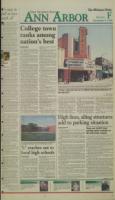
STEVE GERTZ/Daily
The State Theatre, one of the enduring symbols of Ann Arbor and its surroundings, is located on State Street just as Central
Campus merges with the city. Just one year ago, Ann Arbor was ranked as the nation's fifth-best city in which to live.
"It has a big city feel to it without the inconveniences of
the big city"
- Melissa Thun
Ann Arbor resident
In contrast, resident Hank Townsend
said he has only lived in Ann Arbor for
seven years, "but I've been coming to
Ann Arbor for over 25 years," said
Townsend, who teaches at Washtenaw
Community College.
"I like downtown because it's so alive
seven days a week. People are still out
wandering around," Townsend said.
Ann Arbor is also populated with
many younger residents, owing in part to
its excellence in public schooling.
Ten-year old DaMira Anderson said
she enjoys eating ice cream outside
Washtenaw Dairy with Townsend and
her mother.
"I like Ann Arbor because they have
nicer houses. It's nice and calm and
there's not so many robberies,' DaMira
Anderson said.
DaMira's mother, Glynis Anderson,
runs a non-profit organization in the Ann
Arbor area and said she thinks these
organizations are important to making
the city better for those less fortunate.
"I think we have pretty good volun-
teerism," Anderson said. "I think stu-
dents put in good effort, which tells me
that they care about the community"
It's common for Ann Arborites to fall
in love with the town after calling it
home for a while.
"I think it's a great city. It has a big city
feel to it without the inconveniences of
the big city," said Ann Arbor resident
Melissa Thun, who is originally from
New York.
"All this place needs is an ocean or
mountains," Thun said.
High fines, ailing structures
add to parking situation
MATT MADILL/Daily
The relationship between Ann Arbor Pioneer High School and the University is
longstanding. In fact, Pioneer rests on land the University once owned.
'U' reaches out to
local high schools
By Mark Francescutti
Daily Staff Reporter
Finding a parking space in Ann Arbor is about as likely as
winning a lottery jackpot.
University students, faculty and staff, along with Ann
Arbor residents, are finding it next to impossible to find a place
to park because of rising meter rates and garage closings.
"Parking in Ann Arbor? It's impossible," Engineering
sophomore Elizabeth Wilson said. "There is never any meter
parking."
According to University Parking Services officials, there
are 16,407 total spots available on the University campus, and
that number still isn't enough to accommodate the huge
demand.
The parking problem has started to cause traffic back-ups on
streets as motorists will stall traffic to grab the last elusive meter.
Students who drive to class said they run into the problem of
finding a parking space, making it quicker to walk to class.
"When I drove to class, I usually parked near the Dental
school," '98 alumnus Erin Kleis said. "It was close to the
Chemistry building and I could park there all day."
"But I did a lot of 5-10 minute illegal parking," Kleis said.
Complicating the parking issue, this past April Ann Arbor
city officials raised the price of city parking meters from 60
to 80 cents per hour. Parking ticket fines were also increased
from $5 to $10 when payment is made within two weeks after
the ticket is issued.
The income from these increases is expected to raise an
extra $1 million annually - all of which goes directly to the
city's general fund.
City officials said if money from the rate and fine
increase is used to alleviate the parking problem, it will be
directed to the creation of alternative parking for riders of
Ann Arbor Transit Authority buses.
But Downtown Development Authority Executive
Director Susan Polley says that even though the DDA won't
There are 16,407 total
parking spots available on
the University campus.
"We charge 80 cents an hour, and the meters are 60,'
Polley said. "What would you choose?"
The DDA is the key player responsible for repairs and
additions to the ailing parking structures, Polley said.
The parking structures, once a positive aspect of down-
town Ann Arbor, has now become a serious problem. One
structure, at Fourth Street and Washington was demolished
last year. The South Forest Avenue garage, which is the only
public parking structure available to South University visi-
tors, will be demolished in early 1999.
"The South Forest Lot is extremely important to South
University," Polley said. "It is being rebuilt and enlarged and
is scheduled to be finished sometime in late 1999."
"We also have four other structures, all of which that need
something done to them," Polley said.
Polley said that almost every city-owned structure will be
improved over the next few years - including-the txo struc-
tures that will be rebuilt.
"The goal is to improve them, upgrade them, and add
more spaces," Polley said. "The new structures will also be
easier to use, have more lighting and will be more attractive."
Besides the DDA, the University also is doing what it can
to alleviate parking woes. Officials plan to build a new park-
ing structure behind the Power Center for the Performing
Arts. The structure should be finished by 2000 and should
hold about 1,000 vehicles, University officials said.
While almost all of the structures handle only hourly park-
ing, options for overnight parking do exist in limited supply.
Each year in September, usually on the first Thursday of
By Chris Metinko
Daily News Editor
Many students go to college to get
away from high school. Faculty,
administrators and students at the
University, however, seem to take an
opposite approach to many of the
high schools in and around Ann
Arbor.
"We're doing more than most
people know," said Walter
Harrison, former vice president
for University relations, about the
dents and make them enthusiastic
about their future.
"They start thinking about college
as a future'" he said.
The University offers more than
75 Outreach Programs to help high
school students develop stronger
academic skills before they begin
their college life. Along with these
programs, the University has also
been known to make contractional
deals with local high schools for land
and parking.
II
I I
. 1
Scanned image of the page. Keyboard directions: use + to zoom in, - to zoom out, arrow keys to pan inside the viewer.
September 08, 1998 (vol. 108, iss. 119) - Image 69
- Resource type:
- Text
- Publication:
- The Michigan Daily, 1998-09-08
Disclaimer: Computer generated plain text may have errors. Read more about this.