
w w w w w w w w U
T
T
_919p-
r
T
T
T
T
In
TENUOUS
GROUND
Universities often infringe upon
students' First Amendment rights
By Steve Knopper
College students, like all other American citizens, have
certain unalienable rights under the Constitution.
Or do they?
Many U.S. universities enforce strict guidelines to con-
trol student behavior. Almost all have mechanisms for ex-
pelling or suspending students if they attack other people or
destroy property. Some regulate student protest. Others pro-
hibit "blocking buildings."
The University of Michigan has its own set of rules,
adopted by the Board of Regents in 1973. But the rules,
called "useless" by former President Harold Shapiro in 1984,
impose no school-related punishments for non-academic
conduct.
That may change.
Though Shapiro never updated the guidelines, he repeat-
edly voiced support for a stricter "code" during his eight-year
term. But dissent among students, faculty members, and ad-
ministrators on the University Council, a nine-member
committee established to review the current guidelines, made
the code issue drag on.
Knopper is a Daily news staffer
L ast month, Interim University President Robben
Fleming took a different approach. In a draft proposal, he
bypassed regental bylaw 7.02, which requires that the coun-
cil, the Michigan Student Assembly, and the faculty's Sen-
ate Advisory Committee on University Affairs ratify any
change in the rules of non-academic conduct.
Fleming said he would invoke regental bylaw 2.01,
which grants University presidents power to promote the
"maintenance of health, diligence, and order among the stu-
dents" to implement rules of his own.
Those rules would require students to apologize for verbal
or written harassment; if they refuse, they would be put on
probation. Physical harassment or property damage could
result in a one-term suspension. Physical assault could re-
sult in a one-year suspension.
Under the proposal, the deans of the 17 schools and col-
leges would set up panels to judge a student's guilt or inno-
cence. The punishment would also be imposed through the
student's respective school.
Fleming's proposal is still in draft form, and he has not
said when, or if, it will go into effect. Since the draft was
released, Fleming has discussed it with the deans, regents,
executive officers, and faculty members.
His draft, like other schools' behavioral codes, would
limit students' rights, said Kevin Harris, an official at the
United States Student Association in Washington D.C.
"When you enter the university system, you're giving up
many of the rights offered under the Constitution," he said.
"In many ways, University conduct codes are much more
repressive than society outside the university," Harris con-
tinued. "In a sense, they're trying to legislate morality."
For example, Harris said some schools' drug and alcohol
policies are stricter than civil law. In many cases, he added,
the city and the university can employ "double jeopardy"
against students because both may prosecute them under
certain circumstances, like assault or property damage.
University Law Prof. Frederick
Schauer said public universities can
legally regulate certain behavior.
"There's nothing magic about
criminal law. The mere fact that
conduct does not violate the crimi-
nal law does not prevent a state or-
ganization from dealing with it,"
Schauer said.
"A state agency within the scope
of its mission doesn't have to re-
strict its action to criminal law," he
said. "There is nothing to prevent
an agency, providing there is some
form of due process, from enforcing-
behavior that is consistent with its
mission."
Most colleges, including all
Big 10 schools, have stricter rules
regarding. non-academic conduct
than Michigan.
Most of the policies list restric-
tions on non-academic behavior;
describe due process hearings, in
which a committee of students and
faculty members judge a student's
guilt; and outline forms of punish-
ment, such as performing com-
munity service, writing a letter
home, or being placed on academic
probation, suspended, or expelled.
Students who are unhappy with the
hearing committee's decision can
generally appeal to their school's
dean or the vice president of student
affairs.
While students here have
staunchly resisted any conduct code,
insisting that the University follow
the 1973 rules, students at other
schools often take them for granted.
"There hasn't been a lot of controversy," Illinois Daily
Illini Managing Editor Dawn Bushass said. "It's here. It's
part of the University. It's never really been challenged."
Mark Mayes, Campus Editor of Michigan State's State
News, said there has been no recent controversy over MSU's
code. He said the guidelines don't restrict student protest, and
"people haven't had any trouble with them."
At a recent University of Wisconsin fraternity party,
members erected a statue of a Black person with a bone
through the nose. They were immediately suspended,
according to Wisconsin Cardinal Campus Reporter Anthony
Shabid. "That was one of the first times this ever happened,"
he said, adding that Wisconsin's code "hasn't been a big is-
sue."
Students at the American University in Washington,
D.C., however, often feel restricted by their code of non-
academic conduct. "Everybody here has the attitude that, 'Oh
my God, you're going up before the council.' It takes away
the free-for-all attitude that I saw at Michigan," said Mike
Marlin, a Michigan alumnus and American University first-
year law student. "I want kids here to know what it's like."
Marlin added that he wrote to MSA for advice on fighting
American University's code.
MSA President Ken Weine, who opposes the code, said,
"Students do not come to the University to trade their Con-
stitutional rights for their degrees. The only rules (the ad-
ministration) can enforce are in academics. They have no
right to go beyond academic issues.".
Recent Supreme Court cases regarding students' rights
have not dealt with college students, Prof. Schauer said.
Most cases in the '60s and '70s dealing with disputes be-
tween universities and students were decided in favor of stu-
dents.
For example, in 1971, the Supreme Court voted that
Central Connecticut State College officially recognize a
chapter of Students for a Democratic Society - an
organization working for social
change in the '60s - even though
CCSC President Don James was
opposed to the group. James told
the court, "The published aims and
philosophy of the Students for a
Democratic Society, which include
disruption and violence, are contrary
to the approved policy of Central
Connecticut State College which
states:
'Students do not have the right
to invade the privacy of others, to
damage the property of others, to
disrupt the regular and essential op-
eration of the college, or to interfere
with the rights of others."'"
In 1973, the University of Mis-
souri's Board of Curators expelled a
student journalist because she ran
an article entitled, "Motherfucker
Acquitted," as well as a cartoon
depicting police officers raping the
Statue of Liberty. The Supreme
Court reversed the decision, saying,
"We think (the CCSC case) makes
it clear that the mere dissemination
of ideas - no matter how offensive
to good taste - on a state univer-
sity campus may not be shut off in
the name alone of 'conventions of
decency."'
College students, because of
their age, tend to have more exten-
sive rights than high school stu-
dents, but high school students
have been granted certain rights to
free expression as well. In a 1969
landmark case, the Supreme Court
ruled that a high school student
could wear an arm band to school in
- -,. protest of the Vietnam War. The
decision indicated that high school
students had the same rights to free
expression as every U.S. citizen.
Z
-J
W
O
Z
4
2
Z
W
Q
X
O
Z
W
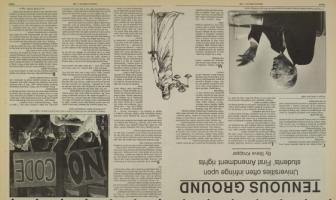
Fleming's opponents view his draft as a thinly veiled code of non-academic cond
an invasion of student constitutional rights.
. 1
/
/ ' i
Last month, however, the Supreme Court took a signifi-
cant step toward limiting high school students' rights, by
granting public school officials the authority to censor stu-
dent newspapers, plays, and other activities. The court voted
5-3 to uphold an earlier case in which a principal in Hazel-
wood, Mo., censored two pages from a high school newspa-
per because he said two articles were inappropriate.
Law Prof. Sam Estep said that public high school news-
papers are part of journalism class curriculuae and that the
state is the publisher. "Publishers tell reporters what you
can and can't put in the paper," he said. The court specified
that only student newspapers run within public schools'
journalism programs can be censored, he said.
Though that decision may have no direct effect on college
students' rights, it may reflect a new trend, said Law Prof.
Alexander Aleinikoff.
Aleinikoff said in high schools, "you don't check your
rights at the door - but those rights are watered down
somewhat."
Estep said the Hazelwood case served as "a little warning
flag" that the Supreme Court will not always rule in favor
of students' rights. The case, he said, "suggests a possible
drawing back of attention they are going to give to students.
There is a real skepticism on whether you can run an
institution like you can run a city."
Though the Hazelwood decision may contradict some of
the court's past decisions, Estep said the court's view on
student rights is not necessarily changing. "I don't see that
much of a difference in the makeup of the court on that is-
sue," Estep said, adding that since the vote was close, such
decisions may vary from case to case.
Aleinikoff said the Hazelwood decision makes the High
Court's stance on students' rights less clear across the board.
But the decision may not have direct implications for
university students because they are legally adults, unlike
high school students. "Young people are more vulnerable,
and not able to make up their own mind," Estep said.
According to Erwin Ellman, a Southfield attorney and a
University alumnus, once a high school student graduates
and attends college that person has greater rights.
"At the college level, it's hard to argue that you should
not be in the same position as any other adult," Ellman said.
"The argument the other way is that when you enroll at a
university, you make a
abide...' Then, the univers
Ellman said, "You hav
going to shed all of your I
sions office. The universit
there is a free market of
through its police force, ti
administration."
Harris, director of the
Weekend Training Projec
inside the University has
outside? We believe stud
same set of rules (as other
But Fleming and othe
that harsh measures must
incidents on campus.
Law Prof. Sallyanne Pa
winter, such as student-ru
racist jokes, the distribut
King and anti-Black fliers
the kind the University ha
between restricting such t
rights, Payton said, "is e:
community has to come tc
"What a white person
part of a pattern," Payton
stand on what kind of beh
Fleming, in his draft,
forced because discrimina
magnitude of our task. W
ulty, staff and the adm
opposition to discriminato
"Enforcement of our r
the written or spoken
complicated by our consi
great many American un
that students at a univers:
discriminatory remarks w
viduals beyond the imme
detract from the necessary
claim immunity from a ca
See COV
'Z
0
0
z
W
Y
W
'U' Interim President Robben Fleming claims his proposal takes the first step in battling racism.
PAGE 6 WEEKEND/FEBRUARY 5, 1988
WEE KEN DI FEBRUARY 5, 1988
Scanned image of the page. Keyboard directions: use + to zoom in, - to zoom out, arrow keys to pan inside the viewer.
February 05, 1988 (vol. 98, iss. 88) - Image 18
- Resource type:
- Text
- Publication:
- The Michigan Daily, 1988-02-05
- Note:
- This is a tabloid page
Disclaimer: Computer generated plain text may have errors. Read more about this.