

Scoring Points: Credit by Computer
You may have a higher credit rating than you think. More and more lenders
are running credit applications through computer "credit scoring" programs
that may actually give you points for being under 25-or living at home with
your parents!
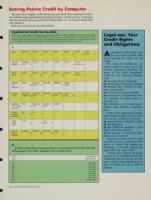
How do you score on the table below?
Hypothetical Credit-Scoring Table
Fill out your credit profile by answering the nine questions below in Table 1. Circle the one response that applies
to you, and then find your total score by adding up the points you got for each response. The points are found in
the lower right-hand corner of each box. (For example: if you are under 25 years old, you get 12 points.) Once
you've totaled your score, look at Table 2 to find out how good a credit "bet" you may be.
1.
age? under25 25-29 30-34 35-39 40-44 45-49 50 or
12 5 0 1 18 22 over 31
time at less than 1-2 yrs. 2-3 yrs. 3-5 yrs. 5-9 yrs. 10 yrs.
address? 1 yr. 9 0 5 0 5 or more 21
age of none 0-1 yr. 2yrs. 3-4yrs. 5-7yrs. 8 yrs.
auto? 0 12 16 13 3 ormore 0
monthly none less than $160-199 $200-279 $280 or
auto 18 $160 6 1 4 more 0
payment?
housing lives with less than $250-550 more than owns
cost? relatives 24 $250 0 10 $550 12 clear 12
checking both checking savings neither
and savings 15 only 2 only 2 0
accounts?
finance no yes
company 15 0
reference?
major none 1 2or
credit 0 5 more 15
cards?
ratio of no debts 1%-5% 6%-15% 16% or
debt to 41 16 20 over 0
income?
2.
A lender using this scoring table selects a cutoff point from a table like this,
which gauges how likely applicants are to repay loans.
Legal-ese: Your
Credit Rights
and Obligations
According to federal law, you
have the right to know what
you're getting into when you use
credit.
The Truth in Lending Act re-
quires creditors to give you a dis-
closure statement detailing the
terms of the credit agreement.
Look for the following informa-
tion:
" the total amount financed
* the finance charge as an Annual
Percentage Rate (APR)-18 per-
cent, for example
" the finance charge in dollars
" information on payments: num-
ber, amount, due dates, early re-
payment, etc.
* a rundown of any other fees or
charges (late payment, insurance,
etc.)
If the credit agreement involves
merchandise bought on time, credi-
tors are also required to provide:
" a description of the merchandise
" the cash price
* the "deferred payment" price
(price plus total interest)
* the amount of any down pay-
ment and/or trade-in
What about credit cards? If cards
are lost or stolen, you have an obli-
gation to contact the creditor im-
mediately. If possible, phone and
then follow up with a letter.
In most cases, a quick call means
you are not responsible for the bills
somebody else has run up on your
card. Under some conditions, you
inay be liable for up to $50 in
charges.
Total
Score
Probability,
of Repayment
90 ........................................................................89in100
95 .................. ...... . ........................................................92 in 100
100 ............... ............ ..... ............... .........................92in 100
105 ................................................................................93in 100
110 .................... ........................... ......................... . .....94in 100
115................................... ............. ...... ..........................95in 100
120 ... ., ... .................................. .....................................95.6in 100
125.... ..................................... .. .................................96in 100
130...................................... ...................... .............96.25in.100
Source: Adapted from Federal Reserve Board