

functions as the U.S. govern-
ment. This is a world devoid of
decency and compassion, yet
rich in stiletto heels, push-up
corsets and garter belts. And
for pure visual delight, there's
Jean Giraud. His nearly word-
less narratives, such as Moe-
bius 2 (Marvel. $6.95), unfold
with the logic of M. C. Escher.
Maxine! (Plume/New Ameri-
can Library. $6.95) resembles a
book-length comic strip. But
with its spare line draw-
ings and economical language,
"Maxine!" comes closer to be-
ing a novel than most of the
word-encrusted, glitzy books
reaching the market. We all
know someone like Maxine:
passionate yet flippant, heart-
breaking and brokenhearted; a
woman who personifies trou-
ble. You know, nuts. Also, she
\ 1986 JON J. MUTH--MARVEL COMICS
Erotic bloodsuckers: Delicate
watercolors in Muth's 'Dracula'
"inured to loneliness," you feel it with him.
As the graphic novel has gained cred-
ibility in book publishing, respected
writers have begun to dabble in the
form. Perhaps the biggest literary name to
go comic is Donald Barthelme, who has
collaborated with graphic designer / illus-
trator Seymour Chwast on Sam's Bar (Dou-
bleday. $15.95), a collection of bar tales
spun against a background of woodcuts-
"Cheers" with a pedigree. Marvel Comics
has published a series of science-fiction ad-
aptations by such authors as Harlan Elli-
son and Ray Bradbury. Unfortunately, the
artwork in this series rarely adds to the
story. But one recent Marvel effort shines:
Dracula ($6.95) by Jon J. Muth. It combines
exquisite watercolors with text selections
to make the horror tale both chilling and
erotic-the way Brain Stoker meant his old
bloodsucker to be.
At the same time that "respectable" art-
ists and writers have embraced comics, a
new generation of comic-book artists has
.^ MARK REVER-PANTHEON ROOKS 1987
gone beyond the traditional format. Many
works first published as comic-book mini-
series now have been bound together for
bookstores as well as comics outlets. Frank
Miller at DC Comics has reworked "Bat-
man" with a vengeance. Batman: The Dark
Knight Returns (Warner. $12.95; DC. $12.95)
depicts Batman as an aging post-Goetz
warrior.' The POW!'s are psychological.
Through gore and fustian tones, Miller
makes us realize how tortured a man has to
be to put on a hood and battle
bad guys, vigilante style.
At their best, grown-up
comics such as "Dark
Knight" are almost cine-
matic in their artistic
scope, blending full-page illus-
tration with smaller frames
of rapid-fire action sequences.
Watchmen (Warner. $14.95; DC.
$14.95) gives us an apocalyp-
tic future in which the lines
separating superheroism from
villany blur into chiaroscu-
ro. While the artwork is not
as well executed as "Dark
Knight," the story line has the
grip of a pit bull.
Howard Chaykin's American
Flagg! (First Comics. $14.95) has
the grimy, jagged-edge look of
the film "Blade Runner" and
the cynical humor of the movie
"Brazil." It's a violent, bawdy
time; a corrupt corporation
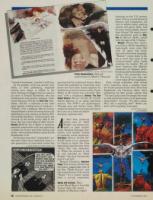
Agony and ecstacy: 'Raw'
artist Mark Beyer's horrible
humor (left), the visual
delight of Moebius (right)
never takes off her sunglasses.
Even though publishers label almost
every long-form comic a graphic novel,
few works actually fit the term. Even Tom
Englehardt, the Pantheon editor who's
publishing the Raw people, admits that
"it's just a jazzy name for people who want
to read comics but want to call them some-
thing better," he says. "It's still a comic.
Why call it anything else?" Better yet,
don't call it anything. Just enjoy.
JOHN SCHWARTZ
U 1987 MOEBIUS
40 NEWSWEEK ON CAMPUSO
OCTOBER 1987