

0
0
-w
The Michigan Daily-Sunday
J..1..1_J...l..lJ.1-
Page 4-Sunday, February 10, 1980-The Michigan Daily
*J.*1*1 .j*.*
a f f f f a a 1 a a a A lA 1A 1A A A1A A AlA A A A A A-_J A A A A A A A AAA A --->_ _l i 1 f l _ _A A A
A.A A A-A-A A A ArrK A A*
r
I
By Mitch Cantor
and Patricia Hagen i
NLY THE BEST compete in the
Noympics, and becoming one
of the best can be an all-con-
K suming obsession. But the University's
super-athletes have a minor distraction***** *******Laay**
with which to deal-they're alo LWWtaity ***W
'P students. That means striking a careful
balance between classes and the often Olympic Committee favors moving the athletes
grueling hor fahei oku-games to another country, the countri(
Several students on this campus have International Olympic Committee has talk p01
managed to straddle that precarious offered no official word. want t
line-and the reward f or them The sentiment at home is varied, dance '
appeared to be right around the corner though most trainees at the University --..
this summer in Moscow. But in seem basically sympathetic to the U.S.' themse]
response to the Soviet invasion of plight. Unive
Afghanistan, along with mounting Cold "It's really my turn, and I really says hi
War antagonism among the super- don't think we're going to send a team boycott
powers, the United States government to Moscow," says Barb Weinstein, a be frigh
may force those athletes to abandon University junior who hopes to earn a present
their hopes of Olympic gold. President position on the U.S. diving team. ''Four stays id
K Carter is supported by Congress and years from now I may not be diving, but the U.
even many athletes in his decision to I do-know I have a really good chance boycott,
Ty
boycott the games in Moscow. right now. It's really ironic that I'm not much c
4' The rest of the world is split between going to have a chance to-find out." Russia,
the U.S. and the Soviet Union, and But despite the disappointment she themsel
4' University Olympic hopefuls are left in would feel should the U.S. boycott any went ov~
limbo. Uncertain whether they will games entirely, Weinstein says she will could p
have a chance to demonstrate their support whatever decision is reached done b
4' years of training in Olympic as a way to "pay back'' her country for citizens
competition, the athletes expressed all it has done for her. Weinstein is one Americ
ambivalence about Carter's political of those fortunate athletes whose and I w
move. Proposals to boycott the Moscow talents have made her the U.S. is as it
4' games or hold the competition at representative in international meets in wouldn'
another site have been discussed countries ranging from Israel to potentia
extensively. But while the United States Holland to Mexico. "I'm very proud to cloud o~
4' be an American," Weinstein says Lattany
Mitch Cantor is the Daily Manag- simply. "Imagine them all standing up Olym
4'
ing editor. because the national anthem is being who no~
the ailyCity played for you," she says, recalling her team, e
S Patricia Hagen is th al iy many international competitions. think an
editor. Although Weinstein and many other their op
Ty )A .A ~** A .AA.L A~AA.~AA,..iAA.
PWW XX A A A A A^^ AnP P S SP P SPSP S SP P S SPP~P ~ ~F~ SP
P% , P% SP~ P P% PPS^ P% P% PS P P ^P% P% P T r' T 7' 7'^'nF ^7nVP. n
rllli
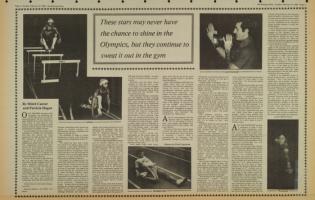
These stars may never have
the chance to shine in the
Olympics, but they continue to
sweat it out in the gym
1II
!I
feet that will prob
needed to qualify,
she must make a
to reach that goal
says he's embarl
weight training p
for the season.
Four of the Univ
by Dick Kimba
compete in the
finishing in the tol
competitions du
years. The 12 me
consist of the top I
in the three meter
10 meter platform
=The 21-year-ol
eighth in the nat
eighth in an inter
Lauderdale last M
his chances in the
but he hopes to ":
by placing in
springboard even
to make "e Olyr
his team- a te Juli
She, too, - 'is he
meter. Bacnman
trials several tin
she placed third i
and sixth in the tov
Attitude is an
divingperformo
Bachman. "How
reflects how I do
Lately she is enjc
been diving consis
last week against
University, Bach
both the one and th
The Olympics
something "in th
Weinstein. Matter
she can tick c
accomplishments.
against Russian
international cc
already tried c
Olympics, Weinm
among sports fol
U.S. team in the 1
The diver acknow
See OLYN
1.A"1.1.. .1J.11111.i.,1.. .1 " ,/.,4 "ir ,lrlr"lrlr lr /rirlr rlr i ,Irl
******************** Coach Kimball *********
will help solve the problem," he says.
"We'll be training everyday anyway,"
he adds.
Weinstein and the other divers
continue to work out twice a day.
"Fortunately I still have the collegiate
season right now. It keeps me sharp
physically and mentally. I have not by
any means lost any intensity," the
Cincinnati native says.
Other potential Olympic contenders
are also keeping up their training
programs. Soon most of them will begin
their most intensive schedules, in
preparation for the Trial competitions
in Eugene, Oregon. All the training in
the world, the athletes admit, may be
superceded by fate during the trials.
Because the head-on competition
among the qualifiers is the final
determinant in who is selected to the
team, an uncharacteristically bad
performance could knock one of the top
contenders out of the Olympics. "What
it really comes down to basically is
who's jumping really well on that given
day of the Olympic trials," says high
jumper Lattany. "There will be one or
two surprises, I'm sure."
Not only is luck a factor, but
participants in the events rated by
judges-such as diving-say the
subjectivity of the judges on that
certain day could mean all the
difference in the world.
"Some people might think you're
good, and if they're not on the panel
that day, you don't make it," says diver
Kevin Machemer.
Diver Julie Bachman added that the
judges often look for previous
experience in international competition
among the divers, and that this
consideration sometimes cancels out
the performance somewhat. "Our
judges over here would rather send
someone who's been exposed (to
international competition)," she says.
The importance of the event makes
some of the athletes "so nervous you
can't see straight," says Weinstein,
who has already competed in two
Olympic trials. Although he is eagerly
gearing up for yet another pre-Olympic
competition, she describes the
atmosphere as "nightmarish."
AND IF preoccupation with the
Olympic trials, or whether the
U.S. is even going to send a
team, isn't enough, the athletes also
have student life to worry about. And
worry they do.
Not only do they have specific goals
in mind, but they seem well on their
way to reaching them. Diver Weinstein
is pursuing a B.G.S. with a
concentration in Business. Her
gradepoint average is currently 3.9
Photos by Paul Engstrom
A*******~f****l******
feel strong patriotism for the
es they represent, they don't
itics at the meets. "You don't
o," Weinstein explains. "You
with them, you eat with them
but between the athletes
ves, there are no politics."
ersity high jumper Mike Lattany
e actually endorses the U.S.
decision, noting that he would
tened to go to Moscow under the
conditions. "If the situation
Ile, or gets even worse, I think
S. made a good decision to
," he says. "Not because it's so
of a political weapon against
but for some of the athletes
ves. If the American athletes
ver there in all this heat, there
ossibly be some bodily harm
ecause some of the Russian
have resentment against the
ans. If I made the Olympic team
ent over there and the situation
is now I'd be very afraid. I
t be about to jump to my full
al..I'd be worried about this dark
ver my head," the 5'7", 135 lbs.
'says.
pic diving coach Dick Kimball,
w coaches the University diving
explains how his divers felt. "I
nyone would be willing to give up
portunity to go to the games if it
"Diving has always been a priority, but
not the only priority. I'm not just a
dumb jock," she claims.
Lattany hopes to graduate with an
industrial design major. Eventually, he
hopes to use his knowledge of sports to
design sporting equipment. He has
about a 3.0 average.
"I look at it this way. High jump to
me is a hobby, so I've gotten good at it,
and I'm going to try to get even better,
but I am sensitive to looking at reality.
Is high jumping going to giveme a
paycheck? No. My body, within a given
time, will not be able to high jump any
more. I have to have something, some
kind of intellectual ability to get that
paycheck every week," the senior
explains.
The athletes' practice time
constrains not only academics but
social lives as well. "I have no social
life, it's as simple as that," says
Lattany.
University Women's track coach Ken
"Red" Simmons, who served as a
coach in the 1968 Olympics in Mexico
City, stresses that the sacrifice of
athletes' personal lives is
"overwhelming. Sociability usually
centers around the girls. and men on the
track teams," he says. "Some things
they can't do.Their first obligation as
tendered athletes is to compete. They
may want to go home for a wedding, but
they can't do it." Weinstein, for
instance, says that she has a somewhat
active social life, but "it's still difficult
to say, I have to go to bed now,
goodbye'." Her friends help make that
easier, though, because they
understand she has early-morning
workouts.
The Olympic hopefuls have at least
one thing in common-that all-
consuming devotion to their chosen
preoccupation, and the drive to succeed
at it. The reason behind this drive,
which at least partially eliminates
parties and studying from the athletes'
regimes, is the need for a challenge.
"The Olympics is the ultimate," says
long-distance runner William
Donakowski. "It's like going right to
the All-Star Game. It's just something I
want to do to see if I can do it. I think it's
a shame that a lot of people, the
average guy on the street, never tries to
do something very well. I just want to
I a _i... . A - .... .J,. ....
take my God-given talent and develop it
to the fullest. If I don't make it, I can
accept that," the 23-year-old student
says frankly.
Diver Weinstein also holds the event
in high esteem. "I'm realizing if I make
the Olympic team that would be the
icing on the cake. But that would not
qualify my career as being a success or
failure. My career should not be judged
on one meet.. .," she insists.
For Lattany, too, the chance to live
up to a challenge keeps him from
regretting the strenuous work and time
he has put into high jumping. If he
didn't give it his all, Lattany says, he
would, when he's eighty, wish he had.
"I'm sure that I would look back and
say 'Could I have been a good high
jumper? Could I have reached that
level of perfection?' I would have asked
those questions for the rest of my life
for sure. No, I don't regret it at all,"
Lattany muses.
ND THE EXTENSIVE training
isenecessary in order to face
the fierce competition. Only
three U.S. athletes will be selected for
each event, though the Oregon trials
are expected to draw many times that
number of participants. Even many of
those contenders who are nurtured in
the often dog-eat-dog atmosphere of the
University acknowledge they are
longshots in the competition.
Lattany, who has been high jumping
since he was in the eighth grade, says he
has a "legitimate chance" to make the
Olympic team. Presently, his highest
jump is 7' 3%". Confident that he is
improving, the 22-year-old senior and
tri-captain of the University track team
says he thinks he'll be able to at least
make the 7' 412" jump necessary to
qualify for the U.S. team in June.
Probably the shortest national caliber
high jumper at 5'7"; Lattany says he
has sometime or another beaten every
top jumper in the country except for
Dwight Stones. The slim Lattany, who
always wears a woolen winter cap for
good luck, has also been highly-touted
by many track and field journals.
Javelin thrower Debbie Williams is a
more promising prospect for the 1984
Olympics than for this year's event,
according to Simmons, her coach. Now
a sophomore, Williams must improve
her throws by 25-30 feet to make the 190
A AA AA AA AA 4 A A.
f;Y
f
ei
********************Donakowski ***************
Sa 1 Al : a~ y, a, - A AA A A, . .__ _ _: A A
-A' A A A. A
A.
LJ
L- i
rrw rw lrrri .r+ .r 'irr. '.ir. .. iu.:. r.' G *', a '. , r r..
_ _ ,
a a . _ _ ., a a a" . a ii i.. i to a+ i. "fi is L l ..i t.
... .
- ~- 4.
t_- 1 +f. 1i i s _1.+_ A l* :tti J . 1 &, alt - !. M. #i *'*-At . It !t * 4t * i'k A rite o l$ a: _s al _= s Y.
i-'-..A .A.A! -1--Lk i A -e-WA A -.L A', -A - A
y 7%15511
WWWWWWIIklw Ww~wWWWWww wWWW