
Page 4-Sunday, February 19, 1978-The Michigan Daily
The Michigan Daily-Sunday, Feb
ROTC:
SELF-ADMITTED jock at
Willoughby South High School
in Ohio, Mike Jones was often
surrounded by fawning home- _
coming queens and was seldom above com-
promising studies for a night on the party r
circuit. He hung out with a rather rowdy reasons-they lil
group at the time-a friend said he was port and they l
"basically a nice kid who got into some bad college. These
scenes," respectability f
In September of 1976, Jones enrolled'in the want to take adv
Navy Reserve Officer Training Program at ORTH
the University. He was not motivated by any verst
sudden urges to serve his country or by un- Force
because he had won a full four-year scholar- asi
ship and it was the only way he could afford program itself,
college.
Jones never had a military bent. In fact,
he says he intended to quit ROTC at the end
of his sophomore year, the time when cadets
on scholarship must make a formal com-
mitment to the military if they want con-
tinued government support (and thus
become obligated to serve four years in
their particular service branch after'
graduation).
But Jones is now a sophomore, and he's enough to seclud
sticking with ROTC. For reasons that read University life.
like a promotional pamphlet come-on, Jones The buildin
has become serious about the program and military. Frame
no longer sees it as a free ride through Carter, comman
school. forces, hang in
"I'm not in ROTC for the war aspect," he company withc
asserts, "but for the growing up aspect. mug shots.
High school is not a dream world, but you The stolid st
don't have to make plans . . . with ROTC these days. Una
you're in the real world." dly believe that I
Jones is one of those people who wouldn't protesters jam
have dared involve themselves in the lawn, demanding
military a decade ago, in the days of the an- and an end to RO
ti-war movement when ROTC cadets were Today, the sc:
frequently objects of derision and hatred. short-haired, so
He represents those students now joining across campus e
ROTC for practical, calculated catcalls.
New role,
old conflicts
By Richard Berke
ke the idea of financial sup-
ike the idea of a job after
students sense a renewed
or ROTC on campus and
antage of it.
HALL, home of the Uni-
ty's Army, Navy and Air
ROTC programs, sits atop
htly sloping hill next to the
g. Just like the ROTC
North Hall is set back
and instructor. "When I came here I was
concerned about it, but now I have no
hesitation to wear my uniform anywhere."
"When you walk across the Diag in
uniform there are people who look at you
kind of funny,'' said freshman Navy ROTC
cadet Matt Marquardt, "but you just have to
think of the kind of people who would do
that." Marquardt was in blue jeans, the
usual attire of most ROTC cadets who are
only required to don Navy blues, Army
greens or Air Force sky blues once a week
N OW, FAR removed from the
realities of the battlefield, they
like the idea-of the personal-
as opposed to national-security
a ROTC stint can offer. Subsidized or free
tuition is hard to come by these days,
likewise assured employment after college.
"Students that come in here aren't asking
questions they used to like 'How short do I
get my hair cut?'; they're looking more for
the future job and what if offers," said Luet-
tinger.
"Overall, it's (ROTC) a good deal. It's for some people and
it isn 't for others-you have to like that kind of lifestyle. If you
want that opportunity, you have to put up with .day to day crap
along with the obligation."' -A former ROTC cadet
tactics, while others learn to fly. They may
learn how to scale the Dental School wall or
to look down the barrel of a rifle, but they
find it hard to comprehend that they are
being trained for war.
Jones said that in an all-out war he'd be
willing to fight. But fellow sophomore Navy
cadet Rob Swanekamp isn't so sure.
"There's not so many people around who
still believe in it (war)," he said. "It's there,
and there's always got to be somebody wat-
ching out just in case."
And freshperson Army cadet Lori
Ferguson said she's a pacifist at heart who
"would rather die than kill anyone." One of
the 40 women out of nearly 400 ROTC
students on campus, Ferguson "looks at the
military as peace-oriented instead of war-
oriented."
"Very few people put on the war monger
stuff," said Jones. "You can't tell if it's an
act or not, but people just don't pay atten-
tion to them."
"A lot of people in the unit are a little
more close-minded than the normal U of M
student," acknowledged Swanekamp. "But
I know them a lot better than most other
students. . . they're just your basic redneck
views."
Jones, however, said one has to be careful
when comparing ROTC cadets to students at
the University.
"Michigan is known for its liberal views.
It's all relative-ROTCs here are more
liberal than others," he said.
"We get more ultra-conservatives, but if
-you discount them there's pretty much a
cross-section," Marquardt stated.
Charles Ahnell, Army ROTC junior in-
structor, also sees a cross-section as far as
mental ability is concerned.
"We've got the brainy right down to the
average academic student," he commen-
ted.
A LTHOUGH ROTC is blending in
(or is at least being tolerated)
on campus nowadays, a large
obstacle from the Vietnam era
still lies in the program's path-lack of
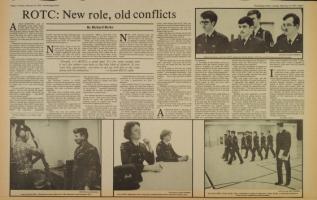
All eyes are front as Air Force ROTC sophomores Dennis Winkler, Bill Ochs and Jeff Anderson stand ir
le it from the mainstream of
g's interior is solidly
ed color portraits of Jimmy
rnder-in-chief of the armed
several corridors, keeping
other well-known military
one building looks sedate
ware passers-by would har-
less than a decade ago, 2,000
med the building's front
g an end to the Vietnam War
OTC itself.
rubbed, tidy appearance of
Adier-suited cadets striding
evoke only novel stares-no
e has any student said
tory to me when I wear my
pus," said Capt. Terry Luet:
e ROTC recruitment officer
or for special events.
Despite the occasional stares and whispers,
some ROTC cadets on campus even enjoy
the way they stand out.
"I think if we showed off our uniforms
more it would get more students interested
(in the military)," contended Marquardt.
"If people saw us more in uniform they
would come to accept us more."
Few students admitted to accepting ROTC
during the 60's. With same fervor demon-
strated by those who denounced the
program, cadets on campus were firmly
committedto supporting the military.
"In the 60's, there was an esprit de corps
. . . students involved tended to be more
committed than either prior to or since that
period," recalled Glenn Garlough, equip-
ment supervisor for -Army and Air Force
ROTC and the only staff member still
around from a decade ago.
"I joined because I want to fly," said Tom
Verschure, an Air Force ROTC freshman.'
"I'll have a guaranteed job after I
graduate."
Some consider service to the country an
important reason for joing the military.
"I'm a struggling pre-med and the military
is a good place to practice social medicine
... it's also a good way for people to serve
their country-defense of the country is
crucial," said freshman Army cadet Paul
Sarvela.
Sarvela's consideration for the country is
an exception. For most ROTC participants,
the personal security motives are of such
importance that the real purpose of ROTC
-to prepare college-educated officers for
military functions-is almost overlooked.
The ROTC students today may see war
films or study what happened back during
such-and-such a conflict in their military
science course. Some learn about combat
accreditation.
At the height of anti-military activity on
campus in 1970, the Literary College (LSA)
voted to eliminate all credit for ROTC
courses; members of an LSA subcommittee
having found the program's course
materials to be "dismal and propagandist."
(Other schools, such as Engineering and
Natural Resources, have always given
varying degrees of credit for ROTC cour-
ses). The issue was brought before the LSA
faculty again in 1975, and once more
defeated by a wide margin.
Norman Anschuetz, an Army cadet and
chairman of a student group to bring back
credit for ROTC, doesn't want to see that
happen again.
"In the past there's been a high degree of
emotional elements involved," he said.
"People haven't looked at it from a rational
-point of view." He notes that the University
is the only Big Ten school which does not
give ROTC credit in its literary college.
His sentiments are echoed among
program staffers. "I feel bad teaching to
some who get credit and some who don't,"
complains Richard Parker, an Army ROTC
instructor. Parker points out that the LSA
faculty vote in 1975 did not reflect the fin-
dings of a curriculum committee, which
decided that the program had changed its
content since the 1970 decision and had
become worthy of accreditation.
There are still strongholds of opposition
among LSA faculty members, however.-Ar-
thur Mendel, a history professor, said at the
,time of the ROTC credit cut that the step
wasn't drastic enough, and that the entire
program should be eliminated.
That was eight years ago, but the
professor still holds to his past sentiments:
"I appreciate and support the need of
military service, but the University is the
last place it should be associated with,"
Mendel declares. "The whole character of it
is more on the lines of an extra-curricular
activity."
Mendell says that opposition to ROTC
credit still remains among faculty mem-
bers-at least among those who were
around at the time of the original controver-
sy. "It was a widely held view (not to give
ROTC credit) and there has been no change
since the 1960's . . . except that there are a
number of people more radically inclined
who are no longer on campus.".
Meanwhile, cadets in LSA remain
naturally unhappy with the situation, but it
doesn't seem to hinder their military par-
ticipation. "We have no right to say that
music majors si
out one Army ca
that about us, si:
on us someday?'
N ADDITI
within thei
several ho
week. The
varies from one I
Army ROTC it
National Secur
typical of ROT
political scienc
regimented insti
The only thing di
any ordinary U
military trapping
insights on the
alliances.
Maps of the wt
chart depicting
medals added tI
green walls of th
student-teacher
cordial, and the
dents present se
regular classroo
an eight o'clock c
See
Richard Berke is a Daily staff
writer
"Never onc
anything deroga
uniform on camj
tinger, Air Forc
U
Doily Photo by JOHN KNOX Daily Photo by Al
Army Sergeant John Thomason oversees John Lim, as the sophomore cadet handles a rifle. Army ROTC sophomores Mary Slavinsky and Ruth Irelan listen attentively dunr
r _ -4t
Air Force ROTC senior Randy Foley commands a group of sophomore cadets during a lea
in the Central Campus Recreation Building.
Scanned image of the page. Keyboard directions: use + to zoom in, - to zoom out, arrow keys to pan inside the viewer.
February 19, 1978 (vol. 88, iss. 117) - Image 14
- Resource type:
- Text
- Publication:
- Michigan Daily, 1978-02-19
- Note:
- This is a tabloid page
Disclaimer: Computer generated plain text may have errors. Read more about this.