
Str t
Daitjy
Vol. LXXXI, No. 1 Ann Arbor, Michigan-Wednesday, September 2, 1970 Ad
ministration Section-Six Pages
ADMINISTRATION
'U'
priorities:
Guns
or butter?
By MARTIN HIRSCHMAN
Editor
LAST SPRING, as thousands of University students and
professors joined with the Black Action Movement to shut
the University down in a strike for increased minority ad-
missions, resolution of the conflict seemed to hinge on one
factor-money.
Until the day they announced that demands for 10 per
cent black student enrollment by 1973 would be met, the
Regents and administration remained on record with the
position that adequate funds to finance such an admissions
program simply were not available.
Strike supporters had another idea. For the first time in
University history, students and faculty members began tak-
ing an interest in an area where only administrators had
tred before-the annual University budget.
And amid neatly printed columns of expenditures, they
found millions of dollars that, for one reason or another,
they felt should be sacrificed in favor of the increased finan-
cial aids and supportiveservices necessary to make a massive
minority admisions program successful. Armed with a list of
about a dozen programs they felt should be eliminated im-
mediately-including such diverse expenditures as a subsidy
for the Reserve Officers Training Corps and maintenance costs
of the University's golf course-strike supporters put forth
a cry for a major re-ordering of University priorities.
WHEN THE University capitulated to the black demands,
however, there was no nention of cutting back these
expenditures. Instead, the administration employed a new
gimmick: The University's schools and colleges hastily com-
mitted their resources to supporting 10 per cent black enroll-
ment if funds could not be found outside the University.
Thus, the move to overhaul University priorities-with
the dramatic political implications involved-was sidetrack-
ed. Even a future tightening of the budgets of the schools
and colleges now seems unlikely: administrators have begun
to hint that tuition increases might be used instead.
Nonetheless, administrators have found that, once in-
terest in University budgeting began to grow, it was difficult,
if not impossible to divert. And this summer, bolstered by a
growing interest in University governance and by the wide-
spread suspicion that funds could be better spent, Student
Government Council and Senate Assembly, the faculty rep-
resentative body, began pressuring the administration for at
least an advisory role in University budget-making.
If President Robben Fleming does agree to create a
proposed student - faculty - administration commission on
budget priorities, a wide diversity of views is likely to be
represented by members of the three constituencies. The
radicals who would probably be named t'o represent left-wing
SGC have called for sweeping changes in the very nature of
the University, while administrators tend to simply reiterate
reasons for present priorities. And, in general, faculty mem-
bers fall somewhere in between.
IN ITS PUBLICITY to those outside the campus commu-
nity, the administration constantly emphasizes the "serv-
ice" aspects of University operations-the body of educated
people, research and technology it provides for industry and
government. But this can be viewed two ways. Some radicals
argue that many of the services the University provides
simply aid the government or industry in perpetuating im-
moral practices. As examples of such University activity,
they point to research done for the Department of Defense
and the use of University job recruiting facilities by corpora-
tions which hold military contracts.
At best, the University administration can argue either
that it is only doing what most other schools are doing,
or that it sees nothing wrong with supporting policies with
which it is in fundamental agreement. President Fleming has
publicly expressed opposition to the Vietnam war and the
See 'U' BUDGET, Page 5
-Daily-Rchiard4 Lee
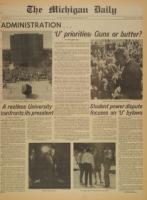
Administration Bldg.: Where interests sometimes collide
A restless University
ton fron ts its presiden t
President Robben Fleming: Maintaining stability?
Studentpowsute
focuses. on'Ubyaw
By ROBERT KRAFTOWITZ
Like many university presidents, Robben
*right Fleming views himself as a caretaker.
Entrusted by the Regents with maintaining
the stability of the University, Fleming spends
a large portion of his time trying to isolate
the University from- the violent upheavels which
have occurred on many of the major campuses
around the couitry.
And perhaps it is this goal which has, over
the last 12 months, led him to take actions
which have marred his widely-lauded Image as
a tolerant and sensitive college administrator.
For as the tenor of dissent at the University has
become more militant and increasingly disrup-
tive, Fleming's response has become more firm.
For example, when a sit-in was held in the
LSA Bldg. last September, the president called
in local, county, and state police to end the
protest-an action which was unprecedented in
University history.
Explaining that his purpose was to prevent
"disruption. and violence" from replacing "ra-
.'nal dialogue" as the prime mode of political
action at the University, Fleming said, "It is
my deep conviction that you can't run a campus
society with people coercing each other."
And since the LSA Bldg. sit-in, he has sum-
moned police to the University on several other
occasions, each time expressing regret, but re-
'erating his promise that interference with the
functioning of the University nor acts of vio-
lence will be tolerated.
To many who have watched Robben Fleming
since he became University president 31 months
ago, his recent readiness to resort to police action
represents a change from an earlier preference
' resolving confrontations by "talking things
over."
But observers close to the president feel that
his attitude has not really changed-he is merely
reacting to new and different situations at the
University, situations in which he has not been
tested prior to last fall.
When Fleming succeeded President Harlan'
Hatcher in January 1968, he had already spent
four years as chancellor of the Madison campus
of the University of Wisconsin. At 52, he had an
And when confrontations did occur, Fleming
was quick to bring the disputants together, dis-
cuss at length the issues involved, and effect an
agreement ending the dispute.
But the apparent ease with which issues were
resolved was due, in part, to the fact that the
University had not yet begun to feel the frus-
tration and dissension which were enveloping
other institutions of higher education.
For only in the last academic year has there
emerged a readiness on the part of this student'
body to militantly confront the faculty, the
administration, and the Regents on its demands
for equal voice in decision-making, an end to
the University's ties with the military, and the
power to govern itself.
As president of the University, Robben Flem-
ing eyed the approaching tempest last summer
See AN UNSETTLED, Page 5
By ROBERT KRAFTOWITZ
A small, green booklet, loosely bound so that
it can be easily updated, contains the ultimate
guidelines under which the University operates.
And in its status as a pseudo-constitution
for the University, the Regents bylaws have be-
come a focal point of efforts by students and
faculty members to reform and democratize the
existing procedures for decision-making, rule-
making, and discipline.
But the goal in mind-convincing the Re'-
gents to amend the bylaws to vastly increase
the role of students in decision and rule-making
-has been found to be as difficult to achieve as
amendment of the federal Constitution.
For as the dispute enters its fifth year this
fall, students, faculty members, and the Regents
still remain far apart in their conception of the
degree and types of authority which should re-d
side in the student body.
Students, increasingly concerned about their
lack of input into University decisions, base their
efforts to amend the bylaws on the principle of
"student control over student affairs." And this
means granting- the student body the authority
to make and enforce rules governing the conduct
of students outside, the classroom, as well as
to control University agencies which are concern-
ed with the welfare of students, such as the Of-
fice of Student Affairs.
Faculty members vary widely on their views of
the appropriate role of students in decision-
making. While most agree that students should
be consulted on virtually all decisions, a large
number fear that delegation of actual rdecision-
making power to students would limit the tra-
ditional authority of the faculty in formulating
rules and handling discipline within each school
and college.
And the Regents, meanwhile, stand firm in
their view that to delegate to students the power
to make and enforce rules, and to control the
Office of Student Affairs, would be tantamount
to "abdicating" their responsibility as governors
of the University.
But implicit in the Regents' position is a con-
cern, shared by the University executive of-
ficers, that students placed in powerful roles
in the University's hierarchy would induce re-
forms which the 'administrators adamantly op-
pose.
For these reasons, the Regents and the ex-
ecutive officers-the seven vice presidents and
President .Robben Fleming-have indicated they
will approve proposed amendments to the Re-
gents bylaws only if it is clear that the ultimate
authority in rule-making, discipline, and deci-
sions related to student services remains with
the administration and faculty.
As they stand now, the bylaws contain 15
chapters, most specifying delegations of author-
ity by the Regents to the faculty and the ad-
ministration. The delegation of authority to the
student body, now virtually absent from the
bylaws, would be contained in chapter seven,
entitled "Student Services." But chapter seven
is currently in flux, pending resolution of the
__ _ _ _ ___
- - ; m:i;?::
Scanned image of the page. Keyboard directions: use + to zoom in, - to zoom out, arrow keys to pan inside the viewer.
September 02, 1970 (vol. 81, iss. 1) - Image 41
- Resource type:
- Text
- Publication:
- The Michigan Daily, 1970-09-02
Disclaimer: Computer generated plain text may have errors. Read more about this.