
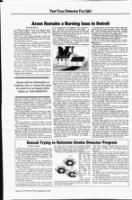

troit about
year b for , ar on
, and in 1991, th
Anyone who has information on
suspicious fires or arsons th£y know
are about to be set should call the
hotline at 1-800-44ARSON.
high arson problem," Michalik aid. "I would ad
dress that as the outhwest area and the east area,
and they are gang-related. I would ay that initia
tion is re ponsible for most of them, although we
hav had one or two incidents of retaliation."
Michalik said that the gang-initiated atson prob
lem has become more prevalent in Detroit in the
last three or four years.
"The main targets of these ar onists are aban
doned buildings and automobiles," Michalik said.
"And they tend to hit the low-income area. Occu
pied homes, abandoned tructures, cars and
dumpster fire are the top targets of arsonists
here--we have a lot of abandon d structures in the
city."
Evancho pointed out that the number of ar ons
and investigated fire include car fire and nui
sance fir s--not all intentionally set fire involve
home and building .
Th arrest rate is about what the national aver
ag run. In 1993, 14.7 p rcent of the arsoni ts were
arrested; in 1992, 13.7 p rcent were arrested and in
1991, 11.3 percent were arre ted. Over the three year
period, the conviction rate wa 77 p rcent.
,Lik many fire departments acros the country,
the Detroit Fire Department' Ar on Squad does
all th preliminary inv tigation into po ible ar-
on. How ver, the imilarity top ther. In
many other citie , the ar on ctions of the fire d -
partment then hand the ca e over to the police
d partment in their particular juri diction. Not 0
with th Detroit Fir Departm nt.
"In D troit, the Fire D partm nt do the ar-
re t ," Evancho aid. "All of our officer are pre
viou ly firefighter with a minimum of five years'
experi nee in firefighting, a requirement before
they even apply for th ar on quad."
Evancho went on to ay that after the firefighters
go through the te ting and reviewing process, they
ar put on a li t according to seniority. Those who
are picked are then ent to the police academy to
earn state c rtification as law enforcement officer .
"We handle ev rything," Evancho said. "from the
cau e and origin right through th � pro ecution, we
are the police offic r involved. We're all fire de
partment p ronnel, but we'r all certified police
officer, and we erve at the plea .ure of the chief."
He added that although many other citie hand
the cases to their 10 al di trict attorneys for prose
cution, it diff rs in Michigan.
"In Michigan, it' not called a D.A.--we are the
prosecuting attorneys and the county prosecutor's
office handles all our prosecutions," Evancho said.
"We prepare all the paperwork and evidence, take
'it to them for final approval, and they actually take
it to court."
There are very strong, united efforts in place to
di courage r on nd to inv ti te and pro cut
the crime, Evancho said, and in Michigan', jt is
through the efforts of the Michigan Arson Preven
tion Committee (see related article in this is ue).
The committee, which is, composed of about 30
to 35 individuals who are all intere ted in curbing
the state's arson problems. These include the
State Fire Marshal, the Detroit Fire Marshal, ar on
investigators such as Evancho, insurance adju -
tors, busine owners and many other .
One of the committee's proj cts is an arson re
porting hotline, which offers a reward of up to
$5,000, for informati n which leads to the arrest
and/or conviction of ar oni t . This reward system
wa� initiated in 1975, and ince then, more than
$257,450 has b en given out in r wards.
Anyone who ha information on suspicious fires
or arsons they know are about to be s t hould call
the hotline at 1-800-44ARSON. People who pro
vide the information can retain their anonymlty-
they are given code numbers that will make it
possible to contact them for their reward money.
Michalik urged that the public be vigilant in
watching for ar on.
I
•
"If p opl patrol or take care of th ir own com
munity, they can report po ible ar on '," Michalik
aid. "We inve tigat u piciou p ople. If p ople
have lead, they ihould r port them. We do follow
up lead, and we are open to any ugge tion ."
Michalik aid that peopl hould take not of u pi
cious p ople or pattern in their n ighborhood, even
through the neighborhood watch program .
"On of the main thing people can do in deter
ring ar on i to' keep their neighborhood w 11 lit,"
Michalik said.
Thankfully, the problem of trash being u ed to
light ar on fires i minimal in Detroit.
"We have a fairly good anitation department and
in mo neighborhood, the trash i picked up
we kly, and that's a factor we try to tay on top
of," Michalik said. "If the area's clean, then that' a
big help in deterring arson."
In Detroit, the r on Squad's educational efforts
have al 0 spread through the chool ystem.
"One of the things that we did in conjunction
with th (Detroit) Chamber of Commerce i over
the year, we picked out a school and targ ted the
intermediate grades to give them general aware
ness that arson i a crime, and that arson kill peo
ple," Evancho said.
"There are a lot of people who aren't aware that
in Michigan, it's illegal to burn your own property,"
he added. "That' be n the rule for quite a while.
If omeone ay., 'it' my car' or 'it' my hou e, I'll
burn it if I want to,' you can't do that."
Another way Detroit is combating arson is'
through tew--not th type one eat , but through
tew, th ar on sniffing dog.
Stew i a 2-year-old black labrador retriever
trained through the Aetna Insurance Co. to niff
out any chemical u ed to tart fires. Called accel
erants, the e chemical --such as gasoline, barbe
cue lighter fluid, kerosene, etc.--have one thing in
common--hydrocarbons, which Stew has been
trained to niff out.
tew came online ju t this June, in the able
hand of the Police Department's Roger McGee.
Evancho said that although Stew work with the
police d partment, the dog is on 24-hour call to th
Ar on Squad of the Detroit Fire Department.
" tew IS a great tool," Evancho said. "He's brand
new at this, Roger McGee is brand new at this, and
'r 11 learning. "He' only been atit for lightly
over a month and a half, so we're still setting up
protocol and everything."
Although new at the job, Stew has already been
able to cut down the amount of time' arson investi
gators spend at complicated sites.
"Stew should improve thing considerably, espe
cially in the larger fire ," Evancho said. "In tead of
you going and taking many samples, you have the
dog go through it, pick out the spots, and the dog
can niff it right out for you, in as much as several
inches of debris.
"Rather than speculate, you just take the dog,
work the dog around, and it's funny, becau e the
dog might be kind of lazy, then as soon as his han
dier puts the leash on him and says; 'okay, let's get
to work,' the dog tart working hard!"
Arson sniffing dogs, or Accelerant Detecting
Dogs, a they are more formally called, have be
come one of the new r tool used in detecting ar-
on around the country. It wa logical, therefore,
that ar on inve tigators in Detroit would leap to
the opportunity of using yet the latest tool in com
bating the highly de tructive crime of ar on.
trolt
rY ng to
By P tti David
Pag Fire Prevention We k upplement 1994
einst te Smo e
the major and the council. The purpose behind
this approach i to show that if ev I)'one contrib
utes, then everyone win . Plus, it Will allow u to
forego the needle begging and pleading.
"If people are pre ented with a legitimate n ed
and we can pro
vide the data
that will indi-
cate that we
have a method
of olving it,
then I think
that we will en
coura�e tho e
donations, and
the people will
be willing to
put up th
mon y for th
d teet r ," h
aid.
Th
mok d t tor
program wa form d after a number of fir d part
m nt p r onn I got tog th r to di cu mok or
fir entitie, Parn 11 ald.
tector Pro r m
"We had a numb r of people who wer low-in
come, and a number of fire re ponse that in
volved, burn or fatalitie ," the communication
chief said.
What wa done was. to form th fir t moke de
tector program, one which involved going to a
numb r of people who resided in an area where
th re w re burns and fire fatalities.'
"We would introduc smoke d tector literature
and a �rogram of in tallation by r que t, which
would includ an msp ction of their particular
r id nee, th in tallation of the d tector --don
by fir p r onn I on duty--and we would I ave
th m with lit ratur , which they could har with
oth r family m mb r , enabling other family m rn
b r to b come awar of the dang r as ociat d
with fir ."
In addition, the fire d partment would al 0 pro-
vid fr batt ri and fire extingui h r to fami-
li that r QU t d them.
"Commi ic n r Watkin i a 41-y ar v t ran f
th Fir �p rtm nt who would like v ry much to
th Fire ,partm nt . tak a proa tiv ap
pr ach toward fir pr v nti n from v ry in I
divi i n in th d partm nt."