

I •
•
alarmIq of all. Groups of Nepo
of young hite toughs; the de-
ar jo they had OIl matched
hite Jroups to ou them. There
p tor w rn d the migrant a in t Ii tening to tal bout unions and
urged th m to remember t all time that th one powerful friend the
Negro h d in Detroit was Henry Ford.
For year Ford h d maintain d private police and detective sy tem,
Housewifes League of Detroit dedicated to supporting Black busine ,buying Black product ,
. patronizing Black prof ionals and keeping Black money in Black communities. Founded in
1930, it grew to a member hip of 10,000 by·1934.
These three men-Coughlin, Norris, and Smith-are the best known
of the Detroit religious-political demagogues, but there are thousands of
others. Some have been in Detroit for years; other came during the
recent migrations. It is estimated that there are more than 2,500
Southem-bom evangelists of one kind or another in Detroit alone, not
counting those in near-by communities. This war has caused an up
heaval among the little houting sects in the South; they have split and
plit again, and new sects have been formed. When the flow to the war
industry towns began, numerous piney-woods and sandy-bottom clerics
went alon representing the Last Day Church of OQd, the Church of
Ood (Reformation), all brands of the Assemblies of Ood, the fire
brands of Jesus, the Pillar of Fire, the Pentecostal Baptists, the Christian
Unity Baptists, the Two-Seed-in-Mind Baptists, and various splinters
of the Holine sects. One of the militant sects in Detroit is the Ameri ..
can Bible Fellowship headed by a former Methodist' preacher who
refused to accept the merger of the Northern and Southern Methodist
churches. Some of these pulpit-thumpers have gospel tents (complete
ith oilcloth signs, saxophone, and microphone); some have regular
churches; some are radio preachers; the humbler' ones have "store
front" churches or work in war plants and preach in their spare time.
There is a connection between the apocalyptic doctrine of these
sects and religious and raclal intolerance. The appeal is not only highly
emotional but is grounded on old tr ditions-which in the South mean
White Protestant Supremacy. A local preacher described it thi way:
"1beir forerunners for generation preached from the crossroads and
schoolhouses that 'Christ came to His Own and His Own received Him
Gott-'His Own' being the Je ." On a Friday night in January, 1943
at Mis ionary Tabernacle, the Reverend R. H. W. Lucas said that
Jesus had destroyed Jerusalem because it was a Christ-crucifying city.
The next Sunday morning it was stated over a national radio hook-up
that the hi tory of the Jews for the last 2,000 year is proof that God
punishes a nation becau of its sin. Many of these exhorters are memo
bers of the Klan off-shoot organizations, defiantly "American," suspect
ing "radical," and completely at bome with White Supremacy. For more
than a d cade-and increasingly during the past three years-these
rustic preacher have been preading their brand of the Word. As feeling
in Detroit became more aroused over the race issue, the effect of this
kind of preaching was like pouring gasoline on a bonfire. .
Feelings also have been kept on edge by labor conflicts. Detroit had
never been a union town, but in the bad days of the depression a num
ber of attempts were m de to organize the auto workers. Th Com ..
munists, through their Trade Union Unity League, led four little trikes
of auto' workers in January and February, 1933. Other groups mad.
several attemp , mostly Iutile, to organize' the auto industry. Th
mov 3 excited the alarm of the local manuf ctur rs, and th Detroit
Union League called for trong measures against labor agitation. Many
prominent industrialists ere members of the Union League and its
and a part of the system was devoted to the oversight of Negro em
ployees. What ord's colored worker did at home and during their
hour f recreation were matters of great interest to these Ford detec
tive . Organization of Ford' colored employee by the union meant not
. only overcoming their devotion to Ford, but also combating the influence
of the py Y tern. Finally, in 1940, the campaign was undertaken.
The .1.0. cnt money and it best organizers to help in the campaign.
The full trcngth of the U.A.W. was enlisted in the effort, and the color
line wa declared to be a thing of the past.
The thing that eventu lIy brought success in thi campaign w s an
unexpected strike, which was not initiated by the union at all. Once the
trike had developed, it became a question of whether Ford's egro
help at the River Rouge plant would go out or slay at work and break
the strike. 'The union decided to make the strike official and redouble
its efforts to win over the Negroes. A group of prominent Negro citizens
of Detroit urg d the Ford Negro employees to stand by the union. The .
result was a tremendou victory for the union in the ensuing National
Labor Relation Bo rd election and the collapse of the last opposition
to the U.A.W. Today the largest union local in the world is U.A.W.
C.LO. Local 600, the River Rouge Ford plant local. It has about
90,000 member , of whom 1 ,000 are Negroes ....
It i intere tin to n te that despite the racial collisions and the fre
quent enforcement of Jim Crow practices in Detroit, Negroes have suc
ceeded in getting some p litical preferment. There are two Negro as
sistant prosecuting attorneys, the State Labor Commi sioner i a Negro,
and one of the State Senator is a Negro. The Detroit Street Railway
Company, which is owned by the city, employs about a thousand Ne
groe =both men and women-as motormen, bu driver, conductors,
and worker of other kind. With the police it i another matter, and
thi has been a burning il\ ue. Out of 3,600 policemen, only forty are
Negroes. In addition, uthern whites have been taken into the force
freely, and they have frequently shown a ho tile attitude toward Negroe .
The 10<.. I political machine was perfectly willing to cooperate with
Negro gambler , but they had no interest whatever in the fact that mo t
of Detroit's Negroe lived in two wretched lum area Th two principal
Negro di trict in D troit cover about thirty square block on the We t
Side and a larger district on the East Side called Paradi Valley. This
latter name goes back to irst World War day and the wonder of $S
a day. "Goin' to Paradise" meant going to a job that paid more money
than there wa in the world. But the section did not 100 like Paradise
in the beginning and it does not now. There are few city areas in tb
United States more jam-packed. Ha ting Street, a dirty thoroughfare
lined with dive and gin mills, is filled from dawn to dark and until the
small morning hours with a dense crowd. Here-on the East Side-live
most of Detroit's Negroe . Almost everybody now ha plenty of war
wages to pay for lodging but decent house imply do not exist. The
only recourse the' Negroes have is to cram them elve into the filthy
valley tenement ....
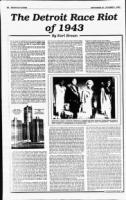
The most
vi ible ymbol
of the city's
renewed
dynaml m
the
Rena! sance
Center project.
One of the features of Detroit that in many ways it off from
many other cities is the presence of great numbers of religious and
political fanatic . Even before the last war Detroit was known as the
city of "jazzed-up religion." Today all shade of opinion re to be
found in the city, all races, all creeds, all political attitudes and belief.
The first figure to attract national attention was Father Charles Cough
lin. Railing against Hoover and Wall Street from his radio pulpit, he soon
attracted a great following in Detroit and through the Middle West.
Next came the Black Legion, an organization of native white Americans
and an offshoot of the Ku Klux Klan-with hood , grips, and passwords.
It wa organized originally for the purpose of getting and holding job
for outhcrn whites, but it quickly developed into an elaborate "hate"
rganizauon=ir enmity directed against Catholic, Jew, Negroe , and
"radical ." After the conviction of the Black Legion leader, Virgil F.
. ·(hnger, a f rm r Klansman, for the murder of a Detroit catholic
named Charle Poole, the 'police had the clue to a long eri of un ..
olv d crimes which included several murders, arson, the bombing of
Father Coughlin' house and the Workers Boo Store as ell th
homes of a number of labor organizers. An investigation by a grand
jury resulted in the listing of eighty-six person as members of the
Legion. In this Jist were found the name of a member of the tate
legislature, th manager of the state ales tax, a city t urer, he riffs,
and other officials.
By the middle 30's, D troit had a representation of every kind of
panacea, politi al no trum, and agitation. There were the Anglo-Saxon
r· deration and n anti-Negro organization called the National Work
er Le gll . But the' most steady, day-in and day-out exhortation came
from tac sen tional preachers. Of the e the best known re the
Rever nd J. r nk orris and the Reverend Gerald L. K. Smith. Norris
\\ b rn in Alabama and ha held pulpits in a number of Southe�
Continued Next Wee