

T or the
British or th G€rmans, the ten
dency to ettle on one group
among many under cored, at
ropean
• •
liS W e
t exploiting
hni c tensions
e
heart, a practical and economic
ne icy: To administer their
far-flung holdings, the Euro
pean powers needed locals to
rule in their place. But too often,
said Amitav Ghosh, an Indian
novelist who was trained as a
sociologist, the Europeans delib
erately settled on selected mi
nority grou to serve as their
collaborators. "The idea was to
c te a kind of client commu
nity, and dependency," said Mr.
.Ghosh, "It was a way of insuring
loyalty."
In superimposing what in
some cases was a new hierarchy
atop an existing social system,
colonialism gave a new shape
and t nsion to relationships be
tween different ethnic groups,
even if did not reorder them en
tirely. In Rwanda, the Tutsi his
torically had been the feudal
overlords, although their pre-eo
lonial relations with the Hutu
were marked by a great degree
of flexibility.
Under the Belgians, however,
aid Alison DesForge, an African
historian, the system was made
more rigid. "The colonial system
reinforc d the tatus of the
Tutsi, by emphasizing the differ-
th un Ii.:: in t n turbulen
of m jority rul ,th Tutsi ine
cur unr veled, Tnb I uprisings
mong th Hutu ingl out th
Tu i for repris 1; hundreds of'
thousands fled, ten of thou-
s nd were m acred. Last
w k, in the lat nd most hor-
rifics m of hnicand political
viol en yet, unoounted thou-
an of Tu i w 1 ughtered
by Hutu gan and soldiers, who
went on a bloody rampage after
the Hutu presidents of both
Rw nda and Burundi died in a
suspicious plan crash.
Beyond central Africa, far
away from the str of Kigali,
where m ebete-wi lding youth
dragged victims from their
houses and hacked them to
death on the spot, the scale of the
violence seems yond rational
accounting. Yet even before the
end of the cold war and the col
laps of Soviet rule unl ashed
hidden thnic fury and hatred
within places like th former Yu
goslavia, Africa and much of the
developing world have been
struggling for nearly half a cen
tury to com to terms wi h grind
ing e hnic and tribal rivalries
tha r main, in a way, on of the
The 8ettmaM Archive
man bore feather porii-porn on
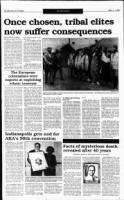
Edward, ·Prince of Wa , rev ew d Kikuyu warrior in Nairobi between the World W r8. lh tri
their pear a a 8how of pace.
ences between the groups."
Among other things, the Bel
gians even introduced identity
cards that required that every
one be identified by their tribal
origin.
other parts of the developing
world. In recent years, gro . ng
poverty, disease and corruption
have also stretched the frayed
social fabric of these societies,
and given rise to a post-colonial
class structure where education
and jobs are increasingly hard to
come by.
"The structure of post-colo
nial society has perpetuated
these conditions, and, if any
thing, created an even greater
emphasis on ethnicity," said
David Newbury, of the Univer
sity of North Carolina.
nature .
. 'A self-perpetuating
proce '
"In a way, it is a self-perpetu
ating process," aid Gareth
Austin, a professor of history at
the London School ofEronomics.
• Just as the Europeans were
able to divide and rule, by choos
ingone group or another as their
surrogates, so are the post-colo
nial political leaders, who now
wield tribalism and ethnicity as
a kind of flag to whip up political
support. The long-term lesson is,
tribalism and ethnicity works."
In some ways, the very tribal
'ism or contemporary ethnic ri
valries that have contributed to
the polarization of ethnic politics
in northern India or parts of Af
rica were, at root, European in
ventions, reflecting a mix of
political expediency· and, at
times, spurious racial science. It
was the British, for example,
who filled their colonial armies
with Sikhs or Ghurkas or Massi,
because the British concluded
that they were "martial races,"
courageous and disciplined by
EVEN MORE BALD was
the. attachment Europeans de·
veloped toward the Tutsi, an at
traction that was, at root, racial.
In the late 19th century, the
Tutsi were even celebrated
among Europeans as the descen
dants of the biblical patriarch
Ham, a lighter-skinned people
whose narrower features re
minded Europeans of them
selves. In western Africa, too,
said Peter Ekeh, the head of M
rican-Ameriean Studies at Buf
falo University, the British and
the Germans turned to the Fu
lani, a minority people who were
the existing' elite, because of
their .. regal bearing. But in
Guinea, the French passed them
over for the very same reason.
"The French had just come
out of their own revolution, and
they found the Fulani too aristo
cratic, • said Mr. Ekeh.
It is wrong to suggest that the
colonial era is the direct cause of
the bloodshed and ethnic tension
that has afflicted Rwanda or
ALL OFT created a rich
broth of grievances and resent
ments that, in the post-colonial
period, easily lent itself to the
manipulations of local politi
cians looking to excite popular
support. In Rwanda, the awful
bloodshed and reprisal killings
by H utu against Tutsi last ee
were not entirely spontane
ous; for years, the regime of
President Juvenal Habyari
mana, the Hutu strongman who
was killed in the plane crash ten
days ago, had stoked the fires of
ethnic hatred, providing weap
ons and direction for tribal
gangs.
"ONE SHOULD NOT un
dervalue the underlying indige
nous forces," said Ms. DesForge,
a central African specialist. "But
power relationships within
these societies have been shifted
in ways that no on could per
ceive or predict. If nothing else,
this legacy has increasingly pro
vided ruthless or ambitious pe0-
ple with opportunities to'
manipulate these tensions to
their own advantage."
d · anapolis gets nod for
56th convention
,
acts. of mysterious death
reve ed after 40. y�' �
Plasma pioneer died just east of county
bunked by hospital officials,
Drew's survivmgtravel compan
ions, and Drew family members.
The collection, processing,
Editor" Note: A rumor perst..ts
thal Dr. Charles Richard Drew (an
Aft"tcan-�rlcan iaho discouered a
revolutionary met hod fbr pruerving
blood plamaa) died after M wa. re
f'tued admittance to a regated
ho.pltaL The (ollowing article from
the Feb. 24 edition o( The Carolina
Pe�aJcer shed. light on tM ru
mor which ha. reached legendary
.,atru.
ACCORDING TO Jim
Hoskins, author of "One More
River to Cross," Drew's fatal ac
cident occurred when he fell
asleep at the wheel. It is true
that Alamance G€neral Hospi-
tal was a segregated facility in
1950 when the seriously injured
plasma scientist was brought in
for emergency treatment, out all
the evidence points to the fact
that he w given good medical .
attention at the hospital, includ
ing at least one blood transfu
sion, before he died.
As Dr. H. Renbert Malloy, for
mer Bowman Gray School of
Medicine professor and a
Forsyth County native who
trained under Drew at Howard
University, said in Winston
Salem in 1992, the rumor and
legend had no basis in fact.
There are now a mark r nd
sculpted bust of Dr w by local
artist Ogden D I at th ite of
the fatal accident, th nks 0
Burlington and Green oro
members of Omega Psi Phi F
ternity' Tau OmegaCh p r.
Four men were in a car on
their way through Alamance
County (N.C.) north of Greens
boro, 44 years ago.
The car crashed t�o mil
outh of H w iv r, injuring all
four. Oneofthem, Dr. Charl sR.
Drew, died from the injuri .
The rumor quickly spread
that Drew, the famous African
American surgeon and pioneer
in blood-plasma res rch, had
died becau Alamance Gener I
Hospital had refused to treat his
injuries becau e he was African
Am rican. The rumor persisted
and became legend, until 1989
when i wa thoroughly de-
A Hoosier Welcome - GTE Ea t Vic Pre ident for Public Aft ir
Clare D. Coxey pre ents a commi ioned piece of art on the art
to AKA president Dr. Mary Shy Scott, n art -enthusla t, during
a GTE- ponsored reception recently h Id in her honor.
ing and political.youth, ndme
dia forums, with each featuring
promin nt personality or trail
bl z r. An exhibition of UC8-
tion 1 materials, crafts, and
oth r consumer products will
lso operated.
. Special activities, includin a
concert by AKA's own 1
Knight, have also been planned
to entertain the members.
The agenda will be released in
June. Individuals inter ted in
exhibiting should contact AKA
Headquarte at 5656 South
Stony Island Ave., Chicago, IL,
60637, or call 800-252- 908.'
and storage procedu for blood
upplies employed by Dr. Drew
are still in u e today. It was Dr.
Drew who di covered that
plasma, the liquid portion 'of
blood, could be dried and tored
for long period of time and thus
u ed as the basi of emergency
blood suppli
,.
"