

SBRO
�nllT't'AQ to vor t ir zon ."
A visit to Choco, h
I tion i 95 percent Bl
n un r I gacy of d d of
neg! ct by Colombia' European
elite.
"There i not one kilometer of
p ved road in Choco," E torgio
Perez Rosero, th tate civil de
fense director. Tra I from here
to Pacific co t, 60 mile by
plane, tak . two days by river
boat, the only m 'of surface
transport.
Arriving at Quibdo irport,
visito jolt down a potholed
road, pas ing open ewer
ditch unpainted shanties on
stilts and ooden town hou
on the verge of collapse. In a
tropical region with one of the
world's highest rainfalls, this
city of 300,000 i routinely
racked by floods.
Largely populated by d cen
dants of Blacks freed after Co
lombia abolished slavery in
1851, Choco today is a forgotten
region. The only.road out of
Quibdo, a spine-wrenching 150-
mile dirt track to Medellin, tak
15 hours on a good day. The Gov
emm nt recently sent bulldoz
ers to smooth the road, but only
after guerrillas shut it in Janu
ary for a week.
"That's why Colombia has no
Blac cyclist - the roads are b d
in Black regions," Dr. Makanaky
said, referring to the national
passion for bicycle racing. In
contrast, Black athlete domi
nate Colombian boxing and soc
cer, sports that require little
equipment.
Two handicap
noted
"We n't children ny more,
r org niz d," aid the
1 ader of on Quibdo lum
d II 1'8 . ation, "Ifth Gov
ernDlent does not have the
political will to in in our pe0-
ple, w will have to follo the
lead of all the other groups in
this rountry - tum to arms."
While the prospect of racial
violence IDS remote, Black c
tivists complain that their strug
gle for greater political power
uffer from wo handicap .
They are obstacles common to all
of Latin Ameriea.: racism byth
nation's European elite and a
low level of racial identification
among Colombia's fi million
Black.
Colombi has Latin Amer
ica's cond largest Black popu
lation, after Brazil. But
P ident Gaviria p id over
an all-white C bin t, Black
fa rarely appear in national
news magazines and television
n tworks rarely employ Black"
actors or reporters. Schools and
universities largely ignore Black
hi tory and the country has no
museum of Black culture
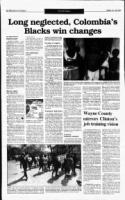
Stirrin among Colombia's Black population hav brought som changes, but they have yet to
r ch thi poor barrio in Qu·beto, a largely Black city of 300,000. Moat of th barrio' children do
not attend chool.
ogy, a Government agency
dominated by Indian specialist,
the "Negri tudes Law" specifi
cally orders the institute to start
researching" Afro-Colombian
culture."
Remembering the fia co of
the 1991 constitutional conven
tion, Black activis here assert
th Colombia's I ndians won p0-
litical power only after they wo
national respect for their histo
and culture.
Billed as "a constitutional
convention of all Colombian,"
this gathering reserved two
seats for Colombia's 500,000 In
dians. Blacks, with a population
1 0 times larger, had no seats.
dants of a community of escaped
slaves still speak a dialect based
in part on languages spoken in
contemporary Angola and
Congo.
"The stamp of Africa is on the
Afro-Colombian family struc
ture, the centrality of women in
the family," said Nina S. de
Friedemann, an anthropologist
author of a n book,
Black Saga: African P ence in
Colombia." "The worship of
saints is often a cultural mask
for the worship of African dei
ties."
Over protests from the Co
lombian Institute of Anthropol-
Governm nt has r u anti
malaria p nding. Coinciden
tally, malari is concentrated in
Black a "
Slowing political identifica
tion has n a low level of racial
identification, a phenomenon
common among th mixed-ra
populations of Latin America.
"Some Colombia Black
don't identify them eves as
tBlacks, nd 0 mixed race
people don' identify themselves
with Blacks," Peter Wade, a
British an hropologi t, wrote
last year in an ay, "The Black'
Movem nt in Colombia."
Dr. Makanaky said more
bluntly: "We are like the Black
movement in th U.S. in 1945.
Blacks are voiding being Black.
Theya trying to be as white as
possible."
Hampering racial and cul
tural identification, Colombia's
anthropological establishment
argues that t Spanish Inquisi
tion wiped out African customs
and religious practices among
the 200,000 captives imported
from Africa during Spanish colo
nial rule. In Colombia, the Inqui
sition cou rt was based in
Cartagena, the only legal port of
entry for sla ves.
Blacks rights
- law approved
Starting with a handful of sit
ins at Gov mment office h re
in 1991, political consciousn
grown gradually among Co
lombian Blacks, who make up
about 15 percent of th nation's
35 million people.
Perh ps the most important
change came last year when
pressure by Blacks in th form of
treat prote ts and even guer
rilla actions helped win passage
ofa Black rights law that is con
idered the most far- reachi ng in
Latin America.
"For the first time this law
recognizes that there are Blacks
in Colombia," said Gus vo
Ma anaky Cordoba, a d or
here in Choeo, a Pacific Coast
state that has become Colom
bia's reservoir of Black con
sciousn
Signed by President Gaviria
on a visit here, the "Negritudes
Law" allows for extending land
titles to traditional Black com
munities, promoting Black edu
cation, "punishing" racial dis
crimination and tting up a
presidential advisory board for
Black affairs.
In a first con re e step, two
. recently elect depu ie a. n
tering Congress, r presenting
sea ts re erv d for the Black
population, th only such a
'Statistics' Sad Story
In Bogota, officials an
nounced recently that Colombia
no longer needs low-interest de
velopment loans from the World
Bank. But just as Mexico has
Chiapas, Colombia has Choco.
As easy to see as the dis
tended bellies of barefoot chil
dren here, Choco's infant
mortality rate is 155 per 1,000
live births - five times Colom
bia's national rate. Life expec
tancy is 52 years, 25 percent
below the national level. Illiter
acy is twice the national rate.
"It's what I call a pigmen
tocracy - white people have
mor a to schools and ho -
pitals, Blacks and Indians have
less a ," idDr. Makanaky,
who treats a daily stream ofpeo
pIe with p ventable diseases at
his or front clinic he . "The
Wayne County
mirro C inton's
job training vision
Quibdo is a city of shanties,
potholes and open sewers.
"We are invisible," Alba Otilia
Duenas de Perez, a Bl ck activ
ist, said in Bogota, the capital.
Most of Colombia's Black
population live on the tropical
nation's Pacific and Cal ibb n
coasts. From Barranquilla and
Cartagena, Colombia's two larg
est seaports, the nation' Black
population extends to coastal
villages, interior sugar cane
plantations, and the shanty
towns of big Andean cities.
To protect historically Black
upgrade skills of people who
may have never worked before
or may be working toward be
coming reemployed in a new ca
reer.
MESC provides labor ex
change information and unem
ployment services. The
Department of Social Servi
works with those on welfare and
provides services that coordi
nate with customers goals of get
ting back to work such s
transportation and child care.
Kathleen Alessandro, E
tive Director of The Wayne
County Job Connection, said,
"This represents a partn hip
for people. We have b gun to r -
think how we do busin and
with the opening of this t te of
th art Career Center, w have
put people first."
The Highland Park Job Cen
ter a si ts the hard-to- erve
population of Highland Park
and Hamtramck providing jo
training and job pla men
sistance. Th rvi provided
are FREE to th who qualify
and include basic r medi tion,
skills developmen , comput r
xperien and jo reh kill .
Job Training issues are now
in the spotlight as a result of the
proposed Re-employment Act of
199., which will revamp the na
tion's unemployment system.
Locally, Wayne County has
taken a proactive approach to
job training, with the estab
lishment of The Highland Park
Job Center, the State's first
"One-Stop-Career Center."
The 'Highland Park Job Cen
ter combines the three major
agencies that deal with putting
people to wor from welfare de
partments to employment coun
selors for job seekers.
The Wayne County Job Con
nection, The Michigan Employ
ment Security Commission and
the Department of Social Serv
ices work together to provide a
unique mix of services all avail
able under one roof, making it
asier for th unemployed to get
th job training, job placement
si tance and the upportive
ervi they need.
"This is a state-of-the-art job
training facility. It is where the
future of job training is headed.
Its' uniquen li in the fact'
that for the first time, three serv-
i genci like this are in on
central location, which elimi
na th runaround associated
with social service agencies and
job training offi ," said Wayne
County Executive Edward H.
McNamara ..
Cultural
research ordered
Contradicting these argu
ments, linguists say that only 20
miles inland from Cartagena, at
San Basilio de Palenque, descen-
T G rk Job
Cent r is located a 16480 W
ward, south of McNichol , in
Highland Park. It is 0 n d 'ly,'
Monday through Friday, from
8:30 a.m. to 4:30 p.m.'
For information r g rding
rvi 11 (313) 8 5-0200 Th
Wayn County J b onn ion
also has a Disloca Work r
sistan Office in Livoni (261-
3420) and a Wes id om in
Dearborn (274:3700 . If you
would like to visi any it,
pl contact Joel R. Gaj w ki
at 562-4600, ext. 273.
"CO T G unemploy-
ment is not an easy task, but
w hen three agenci like this
can work together, th results
can be outstanding. "
At The Highland Park Job
enter, The Wayne County Job
Conn ion provides rvi to
ABOVE some of the Jericho marchers, on Saturday' morning,
. April 2, 1994, stroll past the Wt)ite House, bringing th demand
for reparations - a $44-billion downpayment for labor and life
tolen from Black people during and after slavery - to the
doorstep of th man who has refused to acknowledge the d bt
and who, therefore, in the word of the Jericho lead rs, symbol
ize the greate t of thieve . At the extreme left, educator Marilyn
Preston Killingh m m y be glimpsed in' wheelchair he
determinedly participated in the Jericho. (photo by Roy lewis)