
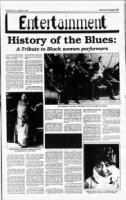

In honor of Black History
Month, The Scoop giv a mini
profile on the history of Black
f male Blu Singers.
When m t people think of
female blu ingers the nam
Koko Taylor, Deni LaSalle,
Millie Jackson and others usu
ally come to mind. But, long be
fore th e ladies were even born,
there were scores of Black fe
male blues performers who were
pioneering the way for them.
Big Mama Thornton was one
of them. She was known for her
strong, powerful voice and
rubenesque build. Thornton was
born in Alabama, but later made
her home in Houston, Texas.
She toured the country with her
powerful voice, but was in hot
der-and primarily in the Gulf
Coast area, where she not' only
wo Ned audience with her gutsy
singing, but was also a 'skilled
drummer and harmonica
player.
into independent 'colored' min
strel hows that toured planta
tions, ttlements and juke joint
eaf .
One of the t female blues
ingers to emerge from the cir
cus circuit w Ida Cox, born in
1889 in Knoxville, Tenn .
Cox performed on the road for 50
years before she died in 1968.
She had her own company called
Raisin' Cain. Two of her most
popular records were "Mean
Lovin Man" and "Down The
Road Round Blues. "
During the 1920s and 80s the
careers of Ma Rainey (Gertrude
Pridgett) and Bessie Smith were
at their zenith. But about the
same time, there were other
blues women on the scene who
were equally talented but less
well known. .
CLARA SMITH WAS an ex
ample. She and Bessie Smith (no
relation) had similar singing
Be sie Smith, vaudeville . tage tar and hit
recording art! t of the 1920 .
For thos who proudly pro
claim Elvis Presley as the' 80-
called "King of Rock N' Roll," it
hould b noted that it was Big
Mama Thornton who give him
the ong"H ound Dog." It be
cam' on of Elvis' signature hits,
bu t Thor-neon originally re
corded the tune with only minor
success.
I'
BETWEEN THE LATE
1800s and the 1940s, there were
as many Black female blues
singers as. there are rappers to
day.
I t' unfortunate that most of
them died broke in undeserving
ob curity, en though many
had m de several recordings.
Many of the first blues sin rs
were m n and women who were
part of major . reus shows that
toured during the late 1800s.
Th e acts w r for Negro audi
ences and their performers
earned th ir k p by doing the
dirtiest job in the circus, in ex
chan for food. These Negro cir
cus entertainers later evolved
styles. In fact, the two ladies
made a record together before
Clara died in 1935. It is believed
that she was the only singer to
record with Bessie Smith.
Lillian Glinn, a Dallas, Texas
native, was also a popular blues
act throughout the South. She
recorded two records, "Atlanta
Blues" and "Shake'era Down. "
Around the 1920s Black fe
male blues ingers were in great
demand after amie Smith
proved to be ,a commercial re
cording uccess. Her first re
cords were selling at the rate of
75,000 copies a monthl Other
ingers such as Lillyn Brown,
Lucille Hagamin and Alberta
Hunter were signed to record
contracts. Alberta Hunter made
her earliest records with a small
black-owned company called
Black Swan Records.
All of the various blues ladies
had a distinctive sound, depend
ing on what part of the country
she was from, Many of them had
their own catchy billing names.
o
wo
known not only for her excep
tionally loud and strong voice,
but was also a superb guitar
player. She and her husband Joe
McCoy (Kansas Joe), recorded
for Columbia Records for six
years. Memphis Minnie once
beat fellow blues guitarist Big
Bill Broonzy in a friendly con
test in the battle of the blues
guitarists.
Today, Houston, Texas native
Katie Webster, "The Swamp.
Boogie Queen., "i one of the few
ladies keeping the role of the
classic traditional female blues
singer alive. The mayor of La-
were ministers and each night
before a show they would read
Bible scriptures together.
KATIE'S DISTINCTIVE
left hand piano licks �o be
heard on the live version of ROO
ding's classic hit, "Try A Little
Tenderness" from the album
"Otis ReddiTJ8 At The Whiskey A
Go-Go."
Katie was scheduled to be on
the fatal plane trip that took the
lives of Redding and his band. "I
tried every way possible to be on
that plane," said Katie, with
some sadness. "My first grand
child was about to be born and I
couldn't leave my daughter, who
was only 15 at 'the time. Plus, I
had a' beauty shop appointment
later that day. But Otis told me
they'd be waiting for me to rejoin
them when the baby was born.
The "Mother ot-the Blue" M Rainey with her Georgia Jazz Band.
But, it wasn't God's will .... " she
recalled. Webster was so dev.as
tated by Redding's untimely
death, that she quit performing
for several years. But in 1982,
she made. a triumphant come
back and her career continues to
excel. '
The men and women who
sing the Blues know their music
is about life in its most basic
form. What's the secret to its
longevity?
Simple. No matter what so
cioeconomic strata one falls into,
whether professional or per
sonal, sooner or later mishaps
take place and that's when the
Blues step in.
(Res rch (or thi. atory can found
in th book"Th Story OfTh Blu "by
Paul Oliver and from
Kati Webster).
Mami Smith, pioneer recording arti t ho
launched the 1920 craz for the blue .
•
For example, Clara Smith was
known as "Queen of the
Moaners"; Martha Copeland
was billed 8S "Everybody's
Mama "; Lottie Beamon, "The
Kansas City Butter Ball"; Mary
Johnson as "Signifying Mary";
and Ma Rainey as "The Mother
of the Blues."
, OTHER POPULAR FE
MALE blues singers during the
period were Bertha "Chippie"
Hill, Lizzie Miles, Ann, Cook,
Estelle Yancy and Cleo Gibson.
Gibson recorded "I'Ve Got Ford
Engine Mouements In My Hips. "
After the Depression several
female blues singers made their
mark in Hollywood films. Hattie
McDaniel was originally a blues
singer, but was later known for
the stereotypical "mammy" roles
she played. The world, however,
remembers her best as "Aunt
Jemima" on food labels.
Just as their contemporaries
of future generations, early fe
male blues singers sang about
the hardships of everyday life,
their jobs and wrong-doing men.
I t was common for the ladies
to marry other blu performers.
There -were several hus
band/wife Negro ,vaudeville
blues acts uch as: George Wil
liams and Bessie Brown; Butter
beans & Susie, and Coot Grant
& Kid Sox Wilson. Grant and
Wilson wrote over 400 ongs
during their marriage and ca
reers. Their song "Gimme A Pig
foot" was recorded by Be ie
Smith.
r
ONE OF THE beet known
blues singers to emerge during
the 1930 was Minnie Dougias
_:_ Memphis Minnie. She was
fayette, Louisiana, once
crowned her as the official
Swamp Boogie Queen because of
her earthy, emotional singing
and boogi -woogie barrel-house
playing. Webster's career has
spanned 'more than 30 years,
with scores of albums and live
shows. She's a household name
in Europe, having toured the
continent over 40 times since
1982.
And, mega pop stars such as
Cyndi Lauper and Bonnie Raitt
have done guest appearances on
her album. In fact, Raitt's been
a long time fan.
Early in her career, Webster
became known for her work with
bluesmen Clifton Chenier, Slim
Harpo and Lightning Slim.
Harpe's 1966 single "Baby
Scratch My Back" features Katie
in the background.
It was in 1964, at the Bamboo
Club in Lake Charles, Louisi
ana, that Katie first met the leg
endary Otis Redding. He was
the headliner act and Katie was
the club's house act. She and
Redding developed a close spiri
tual bond. Both .of their fathers
•