
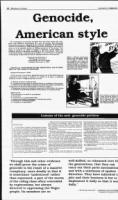

-From the introduction to
I 'W C Genocid :."
pubii hed by the Civil .Right
Congr Dec mber 9. 1948
ARTICLE II, CONVE TIO 0 THE PREVE T 0
T OF THE CRIME OF GE OCIDE:
William L Patt r on, aft ction ely
known a ' r. Civil Right ' h lped
I ad the fight for fr dom for th
nln Scott.boro, Ala. youth who
w r fr meet In 1931 on charge of
r ping Ruby Bate, white woman.
P tterson dit d th 238-pag re
port entltl d, ·We Ch rge Genocide:
Th Crime of th U.S. Gov rnment
again t th Negro P opl .•
.�
Paul Robeson pre ents ,th.
Charge Genocide p tltion t.
United Nation Secr tariat In
York in. December, 1951. Th
did not .1 n onto the COny.
. until 1988, wh n It w • Incorpo
Into a federal crime bill.
-, Lesaons of the anti- genocide petition
�------------------------------------------------------------------------------------------------------------------------------
When the gap between quality of life for Black and white
is widening in every significant category to where it was
before the gains of the civil rights movement, we must talk
about a genocidal tendency. There is a steady increase in
unemployment, poverty, disease, homeless ness, infant mor
talitv and AIDS.
There is a worsening of racist violence, crime and drug
victimization, police brutality, .
Tho whole range of facts and statistics that appear month
after month, year after year, in Urban League reports, in
publications like the World, in numerous university studies,
show a trend toward more death for African-Americans.
Death on this scale raises a question of genocide.
In t.his context, when African-American workers are
thrown out of jobs into the streets by Big Business and then
must die in the desert for a racist president and Big Oil, does
this not aggravate the genocidal tendency? Does not a U.S.
regime that will bomb the Iraqi people barbarically evidence
a genocidal indifference or even malicious aggression toward
the lives of people of color? As of now the democratic upsurge
among the American people is not sufficient to stop that
bloody massacre.
Thus, we must revisit the assessment of a democratic
upsurge among the American people, just as we have revis-
ited the assessment of an anti-racist majority. This is espe
cially true when a majority of whites questioned in a recent
nationwide survey by the National Opinion Research Center
at the University of Chicago said they believe Blacks and
Hispanics are likely to prefer welfare to hard work and tend
to be lazier than whites, more prone to violence, and less
intelligent and less patriotic.
In the great African American liberation tradition there
are many vigorous anti-racist efforts, from the NAACP to the
trade unions and the Rainbow Coalition, from hundreds of
grassroots marches and demonstrations to giant marches ...
However, the mass movement is not demonstrating
enough haste to overtake the rate at which deadly forms of
racism are creeping up on a number of fronts -not in the
construction ofextennination ovens as in Nazi Germany, but
in a less obvious manner.
In the tradition of Patterson, with the purpose of injecting
more urgency into the anti-racist fight, we must ask" "Should
we cry genocide again?"
John Henry is a Detroit lawyer.
Reprinted by permission from Feb. 9, 1991 People's Weekly
World
By John Henry
In 1951 William L. Patterson, Charlotte Bass, Paul Robe·
son, Claudia Jones, George Crockett and 95 other Americans
petitioned the United Nations charging the United States,
with violating the United Nations Convention against geno
cide, adopted on December 8, 1948 but not signed by the
United States. That petition was later published as a book
length chronicle of the many lynchings, murders, assaults
and all-around oppressive living conditions of Blacks in the
United States in that era.
After 40 years of struggle, in 1988, the United States
passed an anti-genocide law as part of its criminal code. Now
the ational Alliance Against Racist and Political Repres -
sion has initiated an effort to enforce that law as part of the
Alliance's overall campaign to outlaw the Nazis, KKK and
all forms of racist and anti-Semitic violence.
Despite the victory that pascage of this law represents, it,
strikes me that the Reagan and Bush era has been marked
by a distinct backward change in the conditions of life of
African Americans. This forces us to raise the same alarm
raised in 1951 by signers of the Patterson petition.
Adopted December 9, 1948
"In the pre nt Convention, enocide means a.ny of the following act
committed with intent to d troy, in whole or in part, a national,
ethnical, racial or religiou oup, a such:
(a) Killing member of the group; . '
(Q) Cau lng erious bodily or mental harm to. embers of the group;
(c) Deliberately inflictingon the group conditi on of life calculated to
bring about its physical destruction in whole or' inpart;
(d) Imposing measures intended to prevents hirths within the group; .
(e) Forcibly transferring children of the group to another group."
ARTICLE III:
"The following acts shall be punishable:
(a). Genocide;
(b) Conspiracy to commit genocide;
(c) 0- t Ic e t to commit enocide;
(d) ttemp to com it gen� de;
.(e) Complicity in genocide.
"Through this and other evi dence
we sh 11 prove the crtme .. of .
genocide is the re ult of a ma
conspir cy � more deadly in t ......
is sometimes 'under tood' rather
than expressed, a part of the more
of the ruling clas often concealed
by e phemisms, but always
dir ·c e to oppre lng t. e eg
people. s memb rs re so
... .
well-drilled, so rehearsed .over tb
the generatt ons, th t they c __
carry out t.hefr parts utomat ca
and wtth a minimum of spoken
. d Irectton. Th y have inherited t1
plot d· their b · essIs but .to
implement it d ily 0 that It wo
daily."
-"We Charge Genocide" published by the Civil Rig]
Congre ,December 9, Ie
, .