

'.
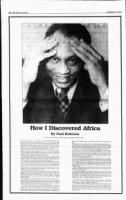
By Paul
obeson
"Her' My tory," Fr edom, -Iune 1953-Reprinted in Fighting Talk, April 1955
I "discov r d" Africa in London. That discovery-back in the
Tw nties-profoundly influenced my lif . Lik m t of Africa's chil
dren in America, J had known little about the land of our father . But
in England, where my care r a an act rand inger took me, I came to
know m ny Africans. orne of their nam ar now known to the
wor ld-c-Axikiw ,t and Nkrum h,2 and K nyatta, who ha ju t been
jailed for hi I ad r hip of the liberation strug le in Kenya.
Many of th African wer tud n s, nd I p nt many hour
talking with them and taking part in their activitie at the We t
African Students Union building. om how th y came to think of me
a one of them; they took pride in my ucce ; and th y made Mr .
Robe on and me honorary memb r of the Union.
Be ide the e tudents, who were mo tly of princely origin, I al 0
came to know another c1a of African the eamen in the port of
London, Liverpool and Cardiff. They too had their organization , and
much to teach me of their Jive and their variou p oples.
As n.arti st it was mo t natural that my fir tinter t in Africa wa
cultural. ul ure? 'The for ign rul r f that con inent in i t d there
wa no cultur worthy of th name in Africa u already mu ician
nd s ulpt r. 10 urop w r tir wi h th ir di. ,COY ry of frican art.
And I pl un d, with excited in re t, mto my tudre of Afri at the
London Univ r ity and el where, I cam to th t Afric n ulture
was ind ed a tr ure- tore for the world.
Tho who corned the African I n
dialect" could n v r know, of c ur
guag s, and of th great philo ophy
come down through the age in th
these languages-a I do to thi day:
and the other .
I now felt a one with my African fri nd nd b c me fill d with
great, flowin prid in th riche, new found to me. I learned that
along with th towering achi v ment of th culture of ncient
Greece and hina th re tood th cultur of Afr ic ,unseen and deni d
by the imperiali t looter of Afric ' mat rial walth.
I came to th root ourc of my own p opl ' cultur ,e pecially
10 our mu ic which i till th riche t nd mo t h lthy 10 Am rica.
chol r had tr c d th influ nee of African mu ic to Europ -to
Spain with th Moor, to Per ia and India and hina and we tward to
the America . And I came to I arn of th rem rkable kin hip betwe n
African and Chine e culture (of which I intend to write at length orne
day).
My pride in Africa, that grew with the learning, impelled me to
speak out again t the scorners. I wrote articles for the New tatesman
and Nation and elsewhere championing the real but unknown glories
of African culture. I argued and di cussed the subject with men like
H. G. Wells," and Laski.t and Nehru; with students and avant.
Now, there wa a logic to thi cultural truggle, and the pow r _
that-be realized it before I did. The British Intelligence came one day
to caution me about the political meanings of my activiti . For the
question loomed of itself: If African culture wa what I in I ted it wa ,
what happens then to the claim that it would take 1,000 year for
Africans to be capable of If-rule?
Ye , culture and politics were actually inseparable here a always.
And it was an African who directed my interest in Africa to omething
he had noted in the Soviet Union. On a visit to that country he had
traveled ea t and had een the Yakuts, a people who had b n cla ed
as a "backward race" by the Czars. He had been truck by the
resemblance between the tribal life of the Yaku and hi own people
of Ea t Africa.
What would happen to a people like the Yakuts now that they were
freed from colonial oppression and were a part of th con truction of
the new socialist society? .
I saw for my elf when I vi ited the oviet Union how·th Y kut nd
the Uzbek and all the other formerly oppre d nation w' r I pin
ahead from tribalism to modern industrial economy, from illi r cy to
the height of knowledge. Their ancient culture bIos omin in n w
and greater plendor. Their youn men and women rna t rin th
� cienc and art. A thousand year? No, Ie th n 30!
o through Africa I found the oviet Union-a bacon, tri d and
t ted way for whole nation , people , contin n to r viv the
moth r-roots of culture, to flower in freedom.
A thou and y ar ? No, Africa' time i now! We mu t that and
realize what it m an to u , we American brother nd ister of th
African. We mu t ee that we have a part to play in h lpin to pry
loose til rob rs' hold on Africa. For if we take a cIo e look at the
hands that ar t Africa' throat, we will under tand it all: ui know
those hand.