

_J nt t ining.
o big p g to r ad
nd 01 or.
:.J up r ized heavy
pap r.
ake great gift.
o L r iz allow
for more than on
hild to color t th
m time.
g.
b ·0
o m ceor
· chigan Citizen
125 cond
·ghIandPar
868-6420
(. ry
His wife was the first colored
woman to graduate from New
Bedford High School, and was
one of the first colored women to
teach in the state's public
schools.
Carney's heroism at Fort
Wagner earned him lasting
fame. During the charge on the
fort Carney saw the Union color
bearer fall; he immediately
seized the flag and carried it to
the front of the, column. Crossing
the ditch that lay under the
fort's guns Carney struggled up
the parapet beyond. Struck in
the thigh by a bullet, Carney fell .
to his knees but continued to
hold the flag alfoft. He knelt
there for over an hour, as mus
ket balls and grapeshot flew
around him. As the U nion troops
were forced to fall back under
the heavy fire, Carney followed
them; creeping on one knee, he
was shot twice more before he
reached safety. His fellow sol
diers cheered as they saw him
return with the colors; as he en
tered the field hospital, ex
hausted from loss of blood, he
was able to say: "Boys, the old
flag never touched the ground."
The flag which Carney so
zealously guarded was en
shrined in the Massachusetts
State House after the war, and
Carney never tired of telling vis
iting schoolchildren of the day
he held the standard aloft. The
Massachusetts veteran was a
popular speaker at Memorial
Day observances; in 1897 he
participated in ceremoni dedi
cating a monument to the 54-th
Massachu etts and its com
manding officer, Robert G.
haw. Upon Carney's death the
,governor of Massachusetts or
dered the State House flag flown
at half mast, and the chaplain of
the state Senate pronounced a
eulogy at his funeral.
A letter of Carney's contain
ing some autobiographical infor
mation can be found in volume 8
of Frank Moore (ed.), Th R bel
lion Record (1865). Carney's own
d ription of his conduct at Fort
Wagner can be found in volume
1 ofW. F. Beyer and O. F. Deydel
(eds.), Deeds of Valor (1906).
Several Boston newspapers car
ried obituaries of Carney; the
most informative are in the
Transcript and the Globe.
Richard H. Abbott
We feed minds.
I
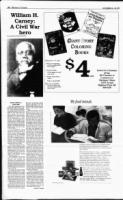
Carn y, William H.
(1840-1908)
Civil War veteran and Con
gressional Medal of Honor win
ner. Carney was born in Norfolk,
Va., the son of Ann and William
Carney His mother, a slave, was
freed by her owner upon his
death. Carney, who was four
teen years old at the time, then
attended for a year a secret
school maintained by a local
minister. The following year he
worked with his father in the
coasting trade. In 1856 the elder
Carney decided to eek greater
freedom and opportunity for his
family in the N orth, and moved
with his wife and son to New
Bedford, Mass.
In New Bedford young
Carney undertook a variety of
odd jobs and joined a local
church. A man of strong relig
ious conviction, he considered
becoming a minister, but the
Civil War interrupted his plans.
On Feb. 17, 1863, Carney en
listed in the 54th Massachusetts
. infantry, the first regiment of
colored troops to be raised in the
'North for the Union Army.
-He became sergeant in Com
pany C, whose members came
rno tly from New Bedford.
Carney accompanied the 54th
Massachusetts to South Caro
lina, where on July 18, 1863, the
regiment spearheaded an as
sault on Fort Wagner, outside
Charleston harbor.
The attackers were thrown
'back with heavy losses, and
Carney was among the
wounded. Hi commanding offi
cercited Carney for bravery, and
thirty-seven years later, on May
23, 1900, Congress awarded him
a Medal of Honor for the heroism
he had displayed during the at
tack on the fort. .
On June 30, 1864, Carney
was discharged because of dis
abilities caused by his wounds.
After a brief sojourn in Califor
nia, he returned to New Bed
ford, where he served as a mail
carrier for thirty-two years.
Upon his tirement in 1901 he
moved to Boston to take a job as
a m nger in the State House.
On Nov:' 23, 1908, he was in
jured in an elevator accident and
died on Dec. 9 Carney, who was
buried in New Bedford, was sur
vived. by his wife and daughter.
At Kraft
up
n
s
, 993 Kraf1 Gen ral Food . Inc
( .,,, I(! onlv In I" Pu 'nil R" ... In 1 I " ('''\t'rnll'' III Ifh! ,11.11'0"
--- _- - - --- - --� - -_- - - - - -